Category Archives: Business Planning

Business Plans are Always Wrong, But Still Vital

(Note: It feels like business planning season to me. Fall, or almost fall, time to think about next year. So I’m reviewing business planning fundamentals, this week and next, refreshing some of my older posts.) 

Business plans are always wrong. That’s because we’re human. Business plans predict the future. We humans suck at predicting the future.

Istock_000000549056small_2

Paradox: nonetheless, planning is vital. Planning means starting with the plan and then tracking, reviewing progress, watching plan vs. actual results, correcting the course without losing sight of the long-term destination.

Planning is a process, like walking or steering, that involves constant corrections.

  • The plan sets a marker. Without it we can’t track how we were wrong, in what direction, and when, and with what assumptions.
  • Use this marker to manage the constant conflict between short-term problems and long-term goals. You don’t just implement a plan, no matter what. You work that plan. Use it to maintain your vision of progress towards the horizon, while dealing with the everyday problems, putting out fires.
  • So the plan may be wrong, but the planning process is vital.

The truth is that forecasting is hard. Nobody likes forecasting. But Istock_000000408066smallone thing harder than forecasting is trying to run a business without a forecast. Plan, connect dots, identify interdependencies, set numerical goals. Then track results, review, and revise. 

A business plan is normally full of holes, but you fill them, after the fact, with the management that follows. That’s what turns planning into management. 

Good planning is nine parts implementation for every one part strategy.

(Images: shutterstock.com)

Every Business — Yours Included — Really Needs a Market-Defining Story. Really.

Good market descriptions are rare. I write that as entrepreneur, consultant, and angel investor. I read more than business 100 plans, and watch 3-4 dozen business pitches, every year. Most of the market definitions I see are useless. So I really appreciate a good one. So I’m offering some tips on how to define a market right.

For example, I have a real case: HavePresence.com, a social media service one of my daughters operates. It’s market-defining story is this …

Terry loves her business, puts heart and soul into it, and is making it work. Sales are growing, customers are happy, the employees get it. Social media makes Terry nervous, though, because it feels like it’s important for growing the business, but, in Terry’s words, “who has time to run a business and mind social media too?” And that’s where Eugene Social comes comes in: we make time so Terry makes money. We don’t tell people what to do, or how to do it, because that’s really not hard. What we do is the part that is hard: we do the updates, the tweets, the retweets, the content curation, strategically and respectfully, so Terry can focus on the core of the business while the brand is building, traffic is generating, and somebody is taking the time to watch the amplified word of mouth going on in the social media.

The story defines the market several ways:

  1. It explains the need, or want, or, if you like jargon, the so-called “why to buy.” In this case it’s defined in part by what it isn’t: It’s not about selling knowledge, experience, and wisdom by the hour. It’s not built around a guru. Instead, it’s about doing, not knowing. It’s about getting things done in a business setting, and having time to do the right things, but not enough to do everything. It’s about time management, division of labor, and small business owners getting things done. There are millions of social media gurus, some of whom really know the territory. This story isn’t about knowing; it’s about doing. It’s about time.
  2. It defines the target customer. In this case it’s a defined subsegment of small business owners, specifically those who know that social media is good for business, but don’t have time to do it themselves. This too is defined in part by what it isn’t: The target market doesn’t include business owners who either do it themselves or have solutions in place. Furthermore, it doesn’t include business owners who don’t think it’s important.
  3. It leads to credible numbers. In this case, there are about 27 million businesses in the United States, about six million of them big enough to have employees, 21 million so small they don’t have employees, and only a million or so too big to be in this target market. From that big pie we would (if I were going into detail here) cut segments according to how many in social media, how many doing very well with it, how many just dabbling, and so forth. I’ll stop here, assuming you get the idea.
  4. It generates marketing messages, media, tactics, and programs.
  5. It communicates a market to somebody else, like to an investor, banker, partner, or employee.

Do you see what I mean by communicates? The real market isn’t some number, it’s that collection of people. Sure, the number is nice, once you know the people, but first you have to feel like these people actually exist, and the reason to buy exists, and that the people and the reason match up.

The statement “this is a $43 billion market” without a market-defining story means nothing to me. The story drills down to the nitty gritty or the number just annoys me. And I don’t think it’s just me. I’m often with groups of fellow investors, or groups of business plan competition judges, and I don’t think I’ve even met one who cares about the market number without a market-defiining story.

So, business owners, here’s your assignment: immerse yourself in your market-defining story.

And furthermore, if you’re going to be pitching to investors, make it good.

Isn’t it Creepy to Walk Into a Startup with Fancy Offices?

Funded or not, ambitious or not, I just don’t see the sense of startups having fancy offices. In the old days, as a consultant to startups and investors both, I hated walking into an interview with a startup when it was a nice office, beautiful windows, carpets, and lots of space. In the middle days, building my own company, I didn’t want to be spending on appearances when there was never enough for product development and marketing for growth. And nowadays, as an angel investor, I don’t want a company that has nice offices. 

There are exceptions: some kinds of businesses need fancy offices as part of their strategy; accountant, lawyers, and some high-end consultants. Those are rare special cases. I was a successful and expensive consultant for years, out on my own, without a fancy office. I never met a client who wouldn’t work with me because my office space wasn’t nice enough. I did have at least one who selected me because (among other factors, obviously) he didn’t want to pay high-end-consulting overhead. 

Another exception I always make is powerful tools. As consultant, entrepreneur, or investor, I don’t respect a company that has people working on slow computers, outdated software, or slow network bandwidth. That’s a dumb way to save money. 

I just read 7 Frugal Startup Tips from Millionaire Entrepreneurs on Entrepreneur.com. It includes some great tips, like avoiding expensive office furniture, reusing supplies, being careful about space, and so forth. That reminded me. 

A bootstrapped company doesn’t overspend because it can’t. By definition. It doesn’t have other people’s money. But a funded startup should spent the money on the product and the marketing. Not the offices. 

I don’t respect obvious overspending. It doesn’t mean smart founders or smart investors. The best example are those absurdly expensive SuperBowl ads in 1999 and 2000. But a fancy office is right up there. 

(image: bigstockphoto.com)

Q&A: Are There Business Classes That Busy Smallbiz Owners Can’t Afford Not to Take?

Over this weekend I was in email with a college student who asked me to answer some questions about business education, as part of a class project. I found this one interesting, and one that comes up a lot, so I decided to post the question and my answer here today. 

The question: 

On your blog, you strongly recommend getting an education for the purpose of living your life better. However, I know many people who have sadly passed that opportunity — they are parents and are overtaxed by their own small businesses. Is there a minimum curriculum you recommend to help these people deal with their own businesses — classes that busy owners can’t afford NOT to take?

My answer: 

I like your question and I think that’s a very useful idea. I would recommend basic courses in accounting, finance, and marketing. Most of business is learnable outside of a classroom but understanding cash flow and the principles of marketing is a very real advantage. Debits and credits, the difference between sales, costs, profit, assets, liabilities, and capital, and the difference between cash and profits are essential, in my opinion. Also, the fundamentals of marketing including market segmentation, target marketing, and market focus are every bit as important in the new world of social media as they were 50 years ago in the old world of advertising. Although you can learn those outside of a classroom, it’s the kind of knowledge base you can pick up quicker in a class.

For the record, I practiced what I preach. I did the Stanford MBA while married with 3 kids with no economic help from family, from savings my wife and I had managed from a Journalist’s salary while raising our kids, and working part time. The meager savings lasted just the first quarter of the first year and the rest was financed with my own part-time income and debts. So I know that’s hard to do because I did it, and I don’t want people to think that when I recommend it that I’m being unrealistic about what it takes. And I want to add, also, that when I have recommended it, I’ve always been respectful of the fact that it may be a luxury that not everybody can afford. 

Thanks for asking. 

(Image: istockphoto.com)

Go Ahead: Disagree. I dare you.

This one had me from the moment I saw the title: Dare to Disagree. I clicked, watched, and I love it.

Good disagreement is central to progress. She illustrates (sometimes counterintuitively) how the best partners aren’t echo chambers — and how great research teams, relationships and businesses allow people to deeply disagree.

I’ve seen this for years in starting, growing and running a business. It’s vital. Do yourself a favor. Take 12 minutes to watch Margaret Heffernan in this TED talk. She starts with a real story, and gets into the nuts and bolts of making disagreement work for you.

http://video.ted.com/assets/player/swf/EmbedPlayer.swf

If you don’t see this video here, you can click here to link to the original on TED.com

You’re Not a Startup. Why Would You Want to Plan?

Ask the owner of a small-to-medium company about a business plan. Expect the answer: “Business plan? but I’m not a start-up. Why would I want a business plan?

Former president and military leader Dwight Eisenhower once said:

The plan is useless; but planning is essential.  

The business planning process is such a great tool for growing a business. That myth of the business plan for start-ups only gets in the way far too often. If you own or run a company, you probably want to grow it. And if you want to grow a company, then you want to plan that growth. And the planning is only the beginning; you want to use the full planning process to manage growth.a business plan as a one-time document, hard to prepare, meant to be read by outsiders, so many businesses miss the real benefit of planning. Like Eisenhower said. 

Think for just a minute about how many different reasons there are for an existing company to plan (and manage) it’s growth. There’s the need first of all to control your company’s destiny, to set long-term vision and objectives and calculate steps to take to achieve vision. Without planning the company is reacting to events, following reality as it emerges. With planning, there’s the chance to pro actively lead the company towards its future.

For an existing company that wants to grow, planning process is essential. Everybody wants to control their own destiny. The planning process is the best way to review and refresh the market and marketing, to prioritize and channel growth into the optimal areas, to allocate resources, to set priorities and manage tasks. Bring a team of managers together and develop strategy that the team can implement. Work on dealing with reality, the possible instead of just the desirable, and make strategic choices. Then follow up with regular plan review that becomes, in the end, management.

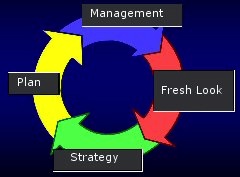
This normally starts with a plan. The plan, however, is just the beginning. It takes the full cycle to make a plan into a planning process.

(Note: this is slightly updated from a 2006 post.)


What is the most important thing to have when you are just starting your company?

Entrepreneur.com asked What is the most important thing to have when you are just starting your company?  on LinkedIn and here are the results:

While I really like the answer business plan — I’m a business planner — I don’t completely agree. If I weren’t biased down to my bones, I’d answer “something else” and clarify that what you really need, more than anything else, is customers. You can have money, idea, business plan, and the guts to go for it and still fail miserably if nobody wants to buy what you’re selling.

However, realistically, not all startups have the luxury of early customers. While ideally you find some early customers, or promises, or prepaid sales, sometimes you need to create something first (such as a product, website, app,etc.) before people can buy it. And in those cases, the business plan is the next best thing because — if it’s done well — it focuses on real indications, real information, and reasonable estimates of believable sales prospects.  So that makes business plan is a good compromise.

And business plan alone isn’t enough; it has to be a realistic, practical, concrete business plan that you can execute on.

The guts to go for it isn’t enough. It’s what we call a necessary but not sufficient condition. You’re nowhere without it, but you might be even worse than nowhere with it. Courage without customers, for example, is a terrible combination.

Enhanced by Zemanta

You Need People Committed, Not Just Involved

In breakfast, the chicken is involved, the pig is committed. Baconandeggsistock_000001083916smal

In the business planning process, commitment is essential. Chickenistock_000000427700smallPlans need to be implemented, and implementation means commitment.  There has to be accountability, and peer pressure.  You have to follow up on what was planned to make sure that it was actually carried out. Here are some ways to develop commitment within your team:

  • Use the SWOT Analysis (Strengths, Weaknesses, Opportunities, Threats) to start discussion. SWOT brings team members into the  strategic discussion. It makes strategy understandable. Your managers have to be part of the team that discusses strategy.Pigistock_000000873019small
  • Make the budgeting elements of the planning process visible. Managers should see what their peers are spending and should hear why. One of the best things I ever watched, as a consultant, was a management group that argued over the activity budgets during the planning process. Each manager had to defend his or her budget, showing what sales and marketing budgets would come out of it. There was a lot of peer pressure.
  • Make sure people know that actual results will be compared to plan.  With time, in a company that uses the planning process, this becomes second nature.  In the beginning, however, it is extremely important that the main company owners and operators set the standards by scheduling plan review meetings each month and attending them. This has to be important.

The bottom line here is that planning process, for a growing company, is about the people more than the plan. Not only does everything have to be measurable, but it also has to be measured, after the fact, and tracked, and managed. Your people must be committed to your plan.

(Images: istockphoto.com)

(Note: slightly revised from a 2007 post here)

Displacement: A Critical Small Biz Factor We Never Acknowledge

DisplacementDisplacement: In the real world of small business, everything you do rules out something else you can’t do.

Understanding displacement is vital for business planning, vital for growing a business, vital for small and medium business in particular. Consider the picture here, marbles dropping into a full glass of water. The water comes splashing out of the glass and onto the table. That’s a good illustration of displacement and how it works in business.

I’ve seen it so many times: trying to plan their business, people start making lists of things that ought to be done and end up with huge unrealistic and impossible business plans because they haven’t come to terms with displacement.

Everything you do displaces something else that you can’t do. Learn to live with this and you’ll do better planning your business, and, particularly, growing your business.

(Note: this is a rewrite from a 2006 post)

(image: istockphoto.com)

Infographic: Small Business and the US Economy

Palo Alto Software’s marketing team prepared this infographic from information provided by 10,000 users of its LivePlan web application for business planning. So that’s not a random list of small business owners, but it is a list of people who have wanting to plan a new business, or grow an existing business, in common. So that, to me at least, makes this information pretty interesting.

You can click the image for the larger size.