Category Archives: Personal Productivity

5 Steps for Dealing with Social Media Malice

Let’s say you’re involved in social media for your business and you’re the victim of a social-media attack. Somebody you don’t really know singles War Gamesyou out because he’s mad at your company, or had a bad day, or whatever; and launches an attack out of the blue, mentions you and the company you work for, and claims you treated him badly. Ouch.

So you’re just doing your job, doing your best, dealing with a lot of people at once, and suddenly somebody targets you. They are messing with your business reputation. It happens a lot. People whose job involves dealing with a lot of people do become the target of personal anger that’s really directed at the company, the situation, or life itself (sometimes it’s one of those bad day things, a last straw situation) and it ends up feeling really rotten, like having an enemy for no good reason.

So let’s say that has happened. You’ve been blindsided by one of these attacks. What do you do now?

1. Stop, breathe, think.

Remind yourself that the meanness usually shows. Assume you’re dealing with an idiot. At least the smart people who encounter one of these attacks will see through it. They’ll click links to see where it started. They’ll see the malice if they look.

2.  Don’t take it personally.

I know this is hard. We talk about thick skin, but jeesh! People can be really mean sometimes. Why do they take their anger out on you? Remember that if part of your job is dealing with a lot of people, then these things come with the territory. You have to have thick skin about it because if it spoils your day then that’s bad for your health on the long term and it makes you unhappy. The idiot had the power to make you stop and think about a response. That’s all. Don’t give him the power to ruin your day, or even your hour. He ruined your moment. That’s all.

3. Decide whether or not to respond.

Sometimes the most eloquent response is silence. Be careful, though, because more often than not, silence gives the wrong impression. And it might even be bad for your health too.

Remind yourself that you can’t argue in social media. Like it or not, what you put in Twitter or Facebook is publishing, and it lives forever. Angry words are not biodegradable.  Like in the movie War Games, the only winning move is not to play (by the way, you can click the picture up above for the Youtube video, or just scroll down).

4.  Settle your anger and hurt first, then respond professionally.

If you should respond, take your time, be careful, clear your head first, and give a single response you can live with forever. Don’t argue, apologize. If an apology makes sense – don’t take it personally, this is business, you didn’t mean to offend, you didn’t realize, it was accidental, part of your job – make it a clear, clean apology that covers the whole issue. Make it one you can live with, without further comment, forever. Make it a response that shows the world that this was one-sided only.

Don’t get mad, get even. Expose the idiot by staying professional and not engaging.

5. Then forget about it. Let it go. Get on with your day.

If you like this job, and you like dealing with people, then of course this hurt your feelings, but you have to get over it or it continues to hurt your feelings. The idiot spoiled your moment, and that’s his fault; but if you brood over it or stay angry or hurt, then that’s your fault. Because what happens now is in your control. You can minimize the damage, or not.

And for extra credit…

Even though it’s been more than a year now since I wrote my 18-point Twitter Etiquette Primer, I believe all of it as much or more now. I did have “don’t argue with people in Twitter,” but I didn’t have “don’t use Twitter as a weapon, a threat for blackmail, or for venting.”

Have you seen that bumper sticker that says “mean people suck?” What do you think of people who blindside other people by broadcasting personal complaints on social media? Pie in the face might be funny when the Three Stooges do it in black and white film, but mud in the face in social media isn’t. It’s meanness multiplied by social media influence.

Now here’s that video:

I Think Seth’s Slick is, Sadly, Too Optimistic

I don’t think the world is as easy to deal with as Seth Godin suggests in Slick, posted on his blog a few hours ago. He says that now even small-time individuals can have big-time production values, “gloss for not much money,” by using Kinko’s and Moo cards and so forth. He concludes:

So I guess instead of slick we’re now seeking transparency and reputation and guts.

I wish that were true, but I doubt it. What actually happens is that the bar goes up, as in my invention is the mother of necessity post from a couple of months ago. As gloss becomes available for not much money, everybody has to have gloss. The bar goes up. When slick becomes more accessible, the unslick looks even worse.

If you’re old enough, think back to the middle to late 1980s when desktop publishing became easy: Did we think typed was better? No. We all adopted desktop publishing standards for every damn letter.

It’s Not the Technology That Makes You Dumb. It’s What You Do With Your Time and Attention.

Yesterday I posted WSJ vs. NYTimes on How Dumb You Are or Aren’t on Huffington Post, tracking conflicting opinions on whether technology makes us all smarter or dumber. Smarter because it’s a lot of print, creativity, and intellectual work; dumber because of multitasking, distractions, shorter attention spans.

I find the debate interesting, but I go with the commenter to that post who summarized:

Seems to me that the Internet can do both. It probably depends on the person…

Amen to that. Don’t confuse tools with how they’re used. I think we all have that friend who’s petting the phone, reading email and doing instant messages while pretending to listen, and we’re all guilty of that sometimes (well, I am). But we also have that other friend who’s now writing seriously on their blog, taking up haiku via Twitter, and reading and writing like never before.

I grew up without all this. I was in my 30s before there was email, in my 40s before I got a cell phone, in my 50s when the dot-com world crashed, and in my 60s when I fell in love with Twitter. Back in that distant past, we still had endless choices of distractions and amusements vs. thinking and working. We still made choices. We still had to choose between staying late at the office, getting things done, or not. There were a lot of good business reasons not to take vacations. Today I find myself turning away from the computer at times, while talking on the phone, to focus on the conversation, without the IM interrupting me. And I find myself not doing that, wandering out of the conversation and looking at email, turning dumb.

The power of it all, these days, the instantaneous communication or whatever you want to call it, it’s just plain amazing. I love it. And yes, I misuse it all the time, just like you do.

But in the end, today as in the 1960s, what you value, who you are, and what and who you care about is a matter of how you spend your time. It’s a matter of focusing attention. You aim attention, or fail to; it doesn’t just happen.

And attention is time, and time is the scarcest resource.

(Image: HomeStudio/Shutterstock)

Traveling With iPad Alone

I’m writing this post from a hotel in San Francisco, using my new 3G iPad (propped against the wall on the desk) and an Apple Bluetooth keyboard.

This was supposed to be a quick trip, Friday to Monday, helping my youngest daughter move from Palo Alto to San Francisco. It was going to be a lot of work, leaving not a lot of time for blogging, browsing, or email. And the iPad, although not as useful as a normal laptop, is so much more fun. And I’ve already done one week-long trip carrying both the iPad and a MacBook Air, which felt like some sort of ironic defeat of cool new technology. So I decided to do this one with just the iPad, no laptop.

Here are some random discoveries I’ve decided to share:

  • The iPad is irresistibly entertaining. Maps, apps, videos, books, and I haven’t even got a single game, but it’s still that entertaining. I’m not sure it’s a business tool, but it’s definitely a delightful travel companion.
  • The battery life is sensational. It really does last like 10 hours.
  • The Bluetooth keyboard turns this iPad into an acceptable writing instrument. I’m a touch typist (does anybody use that phrase anymore?) and I almost think with my fingers on the keyboard. The iPad built-in keyboard is an acceptable compromise for data input and quick emails, but I need the tactile feel of the keyboard to write. And it fits in my backpack well enough.
  • I wish they’d add a Bluetooth mouse. I’ve read about somebody setting up a mouse to go with the keyboard to turn the iPad into a small laptop; but that required jailbreak and I don’t have the heart to do that with a brand new iPad.
  • I love the 3G. Usually I buy the $10-$15 per day Internet connection in the hotel, it’s a business expense, so it’s a no brainer. But because of the moving work, I didn’t even get back to the hotel until past 8 p.m., and I intend to leave first thing in the morning. So with the 3G I saved my company $12.95. My daughter’s new apartment doesn’t have the Internet connection set up yet, but with the 3G, we were still able to browse the Web for information.
  • I’m running into a lot of problems with the Safari browser on the iPad. A lot of things don’t work well. For example, in a previous hotel I needed to scroll a window of text to accept the hotel’s conditions for free wireless. On a laptop, it would have scrolled the text to the end and popped up a button to click for acceptance. The iPad wouldn’t scroll the window, so I couldn’t get the free Internet. Flash-based maps (and there are a lot of them) don’t work. It can be frustrating.
  • I love the pricing of iPad apps. I’m amazed that people complain about paid apps. The Apple word processing, spreadsheet, and slide deck apps are only $10 each. Mind mapping is $6. Guided navigation for $30. Lots of free apps. As a software entrepreneur, it scares me. As a user, it’s exciting.
  • The entertainment value, meaning the pure fun of iPad videos and books and apps and such, is unmistakable.
  • For real business, a laptop is better. The iPad doesn’t have multi-tasking, and doesn’t have a keyboard.

Conclusion: it’s a lot of fun. But it’s a luxury item, not a work tool.

(Image: from Wired Magazine)

The Best Business Email Might Be a Phone Call

This morning I picked up Finding the Right Words for Business Emails, a recent post by Bradford Shimp on his Allbusiness Answers blog. Bradford’s a smart person, and he has good advice here. Use language you’d use for a friend. Be careful with the subject line. Avoid phrases that sound like spam. And this, my favorite:

You can’t control how a reader will interpret your email, but you can work hard to find the right words to communicate your message clearly. Avoid murky language. Instead, go for crisp, clear sentences. If you want to make a point, repeat it a couple of times in the email. One thing to avoid in email is sarcasm. It just doesn’t translate. Satire may be pretty hard to pull off as well.

Even so, Brad’s good advice about email notwithstanding, the post reminds me how I’ve come full circle on email in 25 years. I used to love email, but these days I say dial the phone.

In the beginning of email (I was on Applelink, CompuServe and the Source in the middle 1980s) it was a fabulous productivity booster. My favorite business relationships were the people I could reach in email.

Lately, however, every day I see more of the occasions when email is a weak second-best alternative to dialing the damn phone and talking to somebody. Talk, and more important, listen. Have a conversation. You have the benefit of two-way conversation, tones of voice, inflection, and so forth. Email gets lost, quarantined as spam, misunderstood, and misinterpreted. It’s dangerous. Once you send something in email, that person has control of it, forever. It gets forwarded without context to the wrong people.You can’t get it back. And if it’s misunderstood, you might never get to explain it.

I find email seems like an easy way out sometimes, because I’m too lazy to talk to an actual live human being. When it matters at all, use the phone, talk, and listen.

Are You Kidding Yourself About Tools and Productivity?

Is this you?  Over and over again, you fall off on regular consistent organizational practices like to-do lists, emails, planning, backing up your computer … then you run across some cool new tool. You jump on the bandwagon enthusiastically, promising yourself that you’re finally going to get organized and stay organized. You spend happy hours reorganizing everything to fit the new tool. Then, over time, as the novelty wears off, you end up right back where you started, with the same problems.

And then you find a new cool tool and run the same cycle over again.

I will tell you that this is definitely me. I’ve done this all my life. I veer off to a new organization system like a dumb fish following a shiny new lure in the water. And I see other people doing it too, all the time, all around me. You don’t need a new spreadsheet, or to-do list software, or project planning system; you need to use what you have regularly.

I end up wasting the time it takes to reorganize to the mindset of the cool new tool, repeatedly, instead of managing to follow up on any one thing consistently over a long time.

And what works in the real world is not the tool, not any of the damn tools, but rather the following up. It’s the human behavior that matters, the good habits, consistently applying methods, not getting bored with it, not rationalizing out of it.

I apologize for mixing metaphors with this, but I can’t resist referring to the Rime of the Ancient Mariner, with “Water, water everywhere, and not a drop to drink.” Given the world we live in, computers and the Web, it’s something like: “tools, tools everywhere, and not a drop of productivity.”

Goldilocks, Three Bears, and Productivity Software

You may remember that fairy tale in which Goldilocks got herself locked into a repetitive rut about choosing her optimal rocking chair, porridge, and bed softness settings. Every time, for every choice, first it was too little, too much, and then just right.

There’s a lot to say about Goldilocks (and all of her consumer friends) related to business offerings and product development; particularly, software product development. Think about business productivity software.

In productivity software, what most of us want is simple. Easy to use and understand. Hooray. Except that we don’t buy simple. We don’t even buy just right. We buy too complicated. Too hot.

Sure, there are exceptions. Most of them are old-timer exceptions, like the original QuickBooks (vastly simplified checkbook data entry) and VisiCalc (vastly simplified business financial analysis). Maybe there are some this-millennium exceptions too, like possibly Basecamp, Skype, and what else? There aren’t a lot of them. Not when we stick to simple.

I get choosing the big and complex stuff for database management, accounting, even for graphic design. But in productivity software, no. Simple is probably better.

Here’s a problem: we don’t buy simple, at least not easily, not for productivity software. Worse still, we don’t even buy just right. We buy too big, too tall, too hard. We don’t want software companies talking down to us. We don’t want a simple word processor, we want that big word processor that can scrape names off the web and read data and do mailing lists and footnotes and color coding and tracking changes and versions and write from right to left too. We want it to absorb graphics and resize and reshape, and, if we click the right place, add and subtract and tell us our horoscope too.

And then we don’t like it. Everybody wants simple, but nobody buys simple in productivity software.

Am I wrong about this? Is there successful productivity software out there that’s taken the simple and effective strategy, instead of adding everything including the kitchen sink? Tell me, please.

(Image credit: Rob Byron/Shutterstock)

5 Ways to Break Up a Bad Office Work Day

It’s one of those days. Maybe you have technical problems, or a project that isn’t going well, you couldn’t sleep last night, you’ve run into a writer’s block or thinker’s block or city block. Maybe you just lost a client. Or learned about a powerful new competitor. Or maybe it’s simply just a bad day. It happens.

These are things that help break up a bad day.

1. Clean up the clutter.

Put on some music you like. Throw things out. Find the desk space down at the bottom of all the papers, books, cables, envelopes, and so on. You’ll be amazed at how much better you’ll feel in just a few minutes.

Second prize: clean out your digital clutter. Start with email. Sort into categories (folders or tags) for things you should keep, and archive. Empty the inbox.

Grand prize: take an hour or two. Do both.

2. Do one of those nagging-annoying tasks you’ve been avoiding.

Your business life is full of small annoying tasks you put off. Most of us rationalize that we have other more important, or more urgent, things to do, and we let this go. It’s that list you promised, the research you wanted to do, maybe it’s a call or a letter or email task you’ve been avoiding. Get this one done and you’ll feel better about everything else.

3. Exercise. Take a walk. Or a run.

Break out of your routine. Exercise is funny because of what John Jantsch, the marketing guru, called the math of exercise: the time you take gives you more time later. Particularly when you’re in that droopy slump time. Break it up, get out, come back to it later, fresh.

4. Do something Creative. Draw something. Write a haiku. Or a blog post.

What I mean is do something creative. Seriously, a haiku is a great mood changer: just three lines. Try this search for haiku on Twitter, and you’ll see. And if that’s too much, do whatever you do when you want to break the mood. Or, how about this: write an email to somebody you care about, not about business, just catching up with things.

5. Indulge somebody else.

My point 4 above reminded me: if the first thought is to go get yourself a chocolate and a hug somewhere, indulge yourself. But this is even better: indulge somebody else. Don’t get yourself a candy and a hug, give both to somebody else. Or call your mother or your sister or your spouse. Buy a kid you know a book you think they’d like.

There’s research I saw in the New York Times that shows spending money on somebody else is more likely to buy happiness than spending it on yourself. Here’s a quote:

“These experimental results,” the researchers conclude, “provide direct support for our causal argument that spending money on others promotes happiness more than spending money on oneself.”

So, seriously, have a good day.

(Note: I posted this on Huffington Post yesterday. I’m reposting here because this is my main blog.)

Maker or Manager: Do You Hate Meetings?

Focus: in personal productivity, focus is power. Or maybe I should call it concentration. Have you ever borne down on a task, locked out all distractions, and gotten more done in an hour or two than you thought you could get done in a day? I have the feeling I used to do that a lot;  but now, only rarely.

Part of the problem is the obvious computer-dominated workplace, with emails, instant messages, Twitter, my office phone, and my cell phone, all competing with the task at hand.

But it’s more than just technology. It’s like in an office, more to do, more distractions, more of everything. Especially, more meetings.

I was struck the other day by Paul Graham’s recent essay Maker’s Schedule, Manager’s Schedule. He says time is different for different types of jobs and people:

Most powerful people are on the manager’s schedule. It’s the schedule of command. But there’s another way of using time that’s common among people who make things, like programmers and writers. They generally prefer to use time in units of half a day at least. You can’t write or program well in units of an hour. That’s barely enough time to get started.

So the manager’s day divides into 5, 10, and 15-minute pieces. The programmer’s, designer’s, or writer’s day doesn’t.

I can relate to this. In 40 years of adulthood I’ve had three lives as a maker and one as a manager. For years my real work was developing a software product, which included some of the code plus content and even documentation. Meetings were big interruptions. Then for a lot of years I was building and running the company, doing nothing but meetings. During those years I was unable to get much writing or software content done at all.

People are different. I like the maker’s life better; but then I’m a hermit by nature, I can go for hours concentrating on a task without talking to anybody. I know people who would hate that, and live for the actions, the thrill of the chase, the decisions, the jockeying for position, the sense of getting things done (in a different way) and, with it all, the meetings.

What are you: Maker or manager?

10 Emails That Shouldn’t Have Been Sent

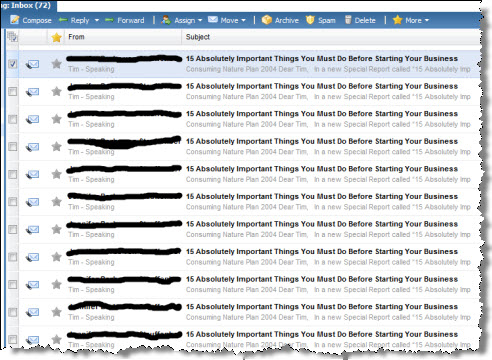
Oh dear. How would you like to be the sender whose name I’ve blocked out here? Charged, apparently, with emailing a press release to bloggers, and struggling with a technical problem, he ends up creating this blight on my inbox (and probably doesn’t even know he’s done it):

I count 11 repetitions, the same message, the same sender, and even the same sending minute (although you can’t see that in this view).

And I wonder … do you think one of the 15 absolutely important things recommended is to test all email list sending utilities before hitting ENTER? Or would that be the 16th?