Category Archives: Personal Productivity

Harness the Power of Procrastination

(Suggested background music: the Rolling Stones, Time is on My Side)

With all the hoopla we make about decision making and how much we frown on waiting, sometimes putting a decision off is the best thing you can do.

Line drawing

I got this in a decision sciences class at business school. While not everything in decision sciences is to be taken as gospel, try this one on:

Never make a decision now when there is no penalty for waiting.

Shocking as that might seem, it’s good practice. Think about it: Often there is a penalty for waiting. Flights get booked, projects fall behind schedule, windows close. But when there isn’t a penalty — and you know, if you think about it, when there is and when there isn’t — then wait and see. You’ll be glad you waited.

This is especially important when you know there is more information coming. Wait, breathe, keep your options open, and see what happens. We agreed, by definition, that we’re talking about the decisions that don’t carry a penalty for waiting. So wait.

Here’s a corollary:

Never make a decision now when there is no penalty for waiting, and there is more information coming.

Good decision making doesn’t mean jumping in fast and all decided, even if you could wait, and even if there’s more information coming. And yet, if you watch for it, you’ll often see people jumping early.

When time is on your side, wait.

You Aren’t Really Multitasking and 99 Other Surprises

The things you find on the web: going from one thing to another, you click, you stumble on stuff, I have to say, I love it. Yesterday I found Susan Weinschenk, Ph.D. in Psychology, who has a fascinating series called 100 Things You Should Know About People. That’s on a blog I found called What Makes Them Click.

For example, her #7, You actually can’t multi-task:

The research shows that people can attend to only one cognitive task at a time. You can only be thinking about one thing at a time. You can only be conducting one mental activity at a time. So you can be talking or you can be reading. You can be reading or you can be typing. You can be listening or you can be reading. One thing at a time.

She finds one exception:

The only exception that the research has uncovered is that if you are doing a physical task that you have done very very often and you are very good at, then you can do that physical task while you are doing a mental task. So if you are an adult and you have learned to walk then you can walk and talk at the same time.

But even there, she has doubts related to walking and talking on a cell phone. And then she attacks the common assumption that the millennial generation does multi-task while the rest of us don’t, with research from Stanford to back her up.

It’s all very interesting. And I found it reading 7 ways to improve your writing, by the so-called James Chartrand, on CopyBlogger. She (yes, James is a woman, but that’s another story) used one of Susan’s surprises to talk about ideal line length. I love the web. Maybe that jumping around isn’t multi-tasking, but it is multi-interesting. And kind of fun.

(Image credit: ifong/Shutterstock)

Your Brain on Drugs? No, Your Brain on Computers.

Remember the “your brain on drugs” commercials? You’d see the egg frying in the pan, and then the announcer’s voice would say “this is your brain on drugs.” What do you think of the Your Brain on Computers take on this?  It makes it sound almost as bad as your brain on drugs.

That brain on computers theme is from the New York Times piece earlier this week, with the full and scary title:  Your Brain on Computers – Overuse of Digital Devices May Lead to Brain Fatigue. This is not a pretty picture, but it’s the New York Times.  And it cites research. So we have to believe it. Have to.

Author Matt Richtel (of the San Francisco bureau, of course, part of the Silicon Valley … everybody is petting their phones constantly) notes how people fill every last minute with connection. Waiting in line, exercising, they are also checking email or linking somewhere on their phones. He warns (with research studies to cite):

The technology makes the tiniest windows of time entertaining, and potentially productive. But scientists point to an unanticipated side effect: when people keep their brains busy with digital input, they are forfeiting downtime that could allow them to better learn and remember information, or come up with new ideas.

Me, I hate waiting in lines. No, come to think of it, make that HATE waiting in lines, with more emphasis. If I get trapped waiting for something, anything, I’ve got my phone in an instant. If I run out of email, then there’s twitter, or, if I’m really desperate, that novel I’ve been reading. 

But studies, or so says this story, indicate that it’s not that simple. I should breath deeply and reflect on things, absorb things, maybe – God help us all – think. Here’s another quote:

Almost certainly, downtime lets the brain go over experiences it’s had, solidify them and turn them into permanent long-term memories,” said Loren Frank, assistant professor in the department of physiology at the university [of California], where he specializes in learning and memory. He said he believed that when the brain was constantly stimulated, “you prevent this learning process.

This would have worried me, if I’d stopped to think about it. Instead, I turned to my phone to check email.

(Image credit: Roman Sigaev/Shutterstock)

What’s Really Wrong With Urgency Addiction?

Business Insider tipped me on this post from Mark Suster on his Both Sides of the Table (investor and entrepreneur) blog. Especially the drawing below. Notice importance on the vertical, and urgency on the horizontal. At first glance, it seems to me like operating in the upper right quadrant is a good thing. You’re addressing urgent and important problems.

But that’s what makes the post interesting (or more interesting): in fact, if you live in the upper right, you’re suffering from urgency addiction. He’s paraphrasing Steven Covey in the book First Things First as he answers:

You retain less knowledge.  You take shortcuts.  You make too many trade-offs.  You suffer too many internal stresses.

Okay, I guess. I wasn’t entirely convinced, to tell the truth; and Mark himself notes that urgent and important is still pretty attractive. He says:

Actually, people with the “urgency addiction” thrive on the pressure.  We rise to the occasion as it stirs our creative juices.  There is something about the adrenaline rush of being under time pressure that excites us and teases out our creativity.

Don’t you want to join him there, in that upper right quadrant, when you read that? I do.

But then it turns out, reading even further, that I want to be in the zone of effectiveness. Do you think maybe that’s why they named it that? Here’s how Mark (again, paraphrasing Covey) describes it:

The examples that Covey talks about here are things like exercise and planning.  They can’t be rushed.  If you can carve out some time during your day to not sit in meetings but instead to dedicate to thinking about the longer-term, strategic initiatives that are important to you then you’ll do bigger things in life.

That sounds really good to me: Exercise and planning, and long-term thinking too. It makes me think twice about urgency addiction. If only there weren’t those urgent important matters to deal with first…

(Image credit: I took it from Mark Suster’s Both Sides of the Table. Click it for the original)

When Selling is the Hardest Part of Consulting Biz

Looking back on my consultant years, I know that one reason I focused so hard on repeat business was I wasn’t good at sales. Doing the work, yes; finding new clients, no.

alignmentI was reminded of that yesterday reading Perception is not reality. Author Mike McLaughlin, co-author of Guerilla Marketing for Consultants, tells a good story that a lot of us (me for sure) will recognize.

It felt like the presentation went badly:

The audience of twenty client managers glared at me with icy indifference. I tried to appear at ease, but the voice in my head had already convinced me that my presentation was a disaster of Titanic proportions.

I certainly empathized as I read it. He continues:

On the long drive home, I mentally dissected every part of the presentation, retracing my missteps. I came up with a list of things I’d do differently next time. I would do anything, I vowed, to avoid another stinker like that one.

And then, the next day:

A call came the next day from my client. Fortunately, she couldn’t see my nervous fidgeting as I listened to her: “Our managers have evaluated your presentation. We’ve decided that we want you to come back and give that same presentation to each of our operating divisions, beginning next week.” What? My dread dissolved instantly–into utter confusion. “Of course, I’d be glad to do the presentation again,” I managed to choke out.

At that moment, I realized how little I actually knew about reading people.

His point is well taken:

You can easily misread people by observing behavior. I’ve seen some, for example, who project a false sense of confidence when they’re frightened; others express inner anxiety as eerie calmness. As with the audience during my presentation, outward behavior often belies inner feelings. As a consultant, ignore this reality at your peril.

Still, though, I don’t buy that altogether. I say it’s not as much a failure to read people as a natural result of the selling situation for what I call “the rest of us” who don’t naturally sell well. I never got the idea of sales as an exciting challenge, or a fun competition, or fooling people or somehow getting them to do what they didn’t want to do. To me it was always off-putting, like a job interview, or oral exam.

I think the mentality is related to why so many normal people look in the mirror and see themselves as fatter or thinner or in some way or another less attractive than they actually are. It’s natural. But it’s not fun.

And Mike McLaughlin goes on, in his post, to offer some pretty good advice on how to go on with the selling and go on with the business. Whether it’s a natural self consciousness, which I’m suggesting, or a failure to read people, as he says, he offers some good tips on how to get over it.

For example, ask questions. “Do you think this is taking on too much?” “Are you worried about what might go wrong?” “Does this seem to be the right scope?” “Do you feel like the deliverables are realistic enough, or comprehensive enough?” “What do you think is a workable schedule for all of this?” Ask specifics. Ask questions that invite real answers. Don’t just trust your instincts; find out for sure.

(Image: Mashe/Shutterstock)

Take That, Spammers!

Do you want satisfaction after all the annoyance of spam?

I just finished clicking full pages of spam with one click, and then deleting all of them with a second click. The view below (warning: the subjects include stupid and offensive subjects) shows the page just for that satisfying click that sends them all to oblivion. Boy that’s a good feeling. Take that, spammers!

view of spam

If you don’t have a spam filter, then you need one. My company uses Postini and I also use SpamArrest and MailWasher. I recommend all three of them. Anything to not see the spam.

The Sad Truth About Best Practices

… is that most of the time, they won’t work for you or me. They worked for somebody, some time, in some situation, in the past. Sure, the idea of best practices is attractive. Supposedly you or I can follow along, obediently, and succeed using so-called best practices. Too bad it doesn’t work.

For example, Jim Collins’ blockbuster business book Good to Great, published in 2001, featured 11 supposedly great companies. All of them did extraordinarily well on the stock market for 10-20 years. But by 2008, when Steven Levitt posted Good to Great to Below Average on Freakonomics, two of them had died. He wrote:

Nine of the eleven companies remain more or less intact. Of these, Nucor is the only one that has dramatically outperformed the stock market since the book came out. Abbott Labs and Wells Fargo have done okay. Overall, a portfolio of the “good to great” companies looks like it would have underperformed the S&P 500.

I don’t mean to criticize Jim Collins, his book, or his methodology. I do mean to question the whole idea of so-called best practices. There are so many built-in problems. What works in one case is hard to translate to the next case. It’s different times, places, people, resources, problems, and so forth.

The best use of the so-called best practices is as generator of new practices, new ideas, new possibilities for you, in your business, that you might be able to take in, digest, and adopt to your situation. It’s a lot like business cases and business stories, not intended as recipes to be followed, but rather as examples of what other people did.

However, you have to be careful. Don’t ever just blindly follow. You always think about it, consider the options, how it might be different in your case, and then, if it still sounds good, try it. Carefully.

If I ever give you any advice, I want you to please never take it without thinking first, analyzing, and deciding for yourself whether or not, and how, and to what extent what I say fits your situation.

Guy Kawasaki and the Zen of Not Zen

I admit it. I got really jealous of all the Zen of this and Zen of that writing, dating all the way back to the book Zen and the Art of Motorcycle Maintenance, which I wanted to like, tried to like, but couldn’t. Zen templeYes, I gave into the horrible temptation, and even posted Zen and Business Planning here. I’m sorry. It was a moment of weakness.

Yes, I’m conflicted. Here I am after 30+ years of professional business planning fascinated by Gil Fronsdal and friends on Zencast, trying hard to reconcile Zen and business planning, and failing. Putting Zen and business planning into the same post is kind of like putting a dog and a raccoon into the same laundry bag.

Confession: my vanity license plate reads “not Zen.” If I could add a subtitle, it would be “… but trying.” After all, if I really were Zen, I wouldn’t put it on a vanity license plate. Right?

So you can only imagine my envy when Guy Kawasaki manages to bundle Zen of PowerPoint, Facebook, and Twitter, all at once, in a single post on the American Express OPEN Forum. Complete with 10 Japanese Zen concepts, each of them in Japanese, and each connected  to the points he makes. And then 10 more, which is really showing off. Damn, he’s good! He writes:

I love this kind of stuff: not only can these principles improve your PowerPoint pitches, products, website, and outlook on life, but they make people think you’re smart when you mention them.

Amen to that. Or something more Zen than Amen.

(Image: well, at least I get a point for that one. I took that picture in a Zen temple in Kyoto.)

Are You Cheating Time on Your Own Strategy?

How do you spend your time? What you spend the most work time on ought to be what you value the most in the business. Right? That’s your real priority.

watch handsWhen I was an active consultant, one of the problems I had with business strategy consulting was getting the client companies to manage their spending and activities according to their own priorities. The danger was that they’d set strategy one way in the off site strategy meetings, then go back to the office, get back in the routine, and follow a completely different strategy in what they actually do.
I don’t know if this is universal; I didn’t read it, I just started using the term strategic alignment, which I define as making your actual work match your strategic priorities.

In my consulting mode, with groups in larger companies, I did two things to help with strategic alignment:

  1. First, I’d help them build a strategy pyramid to relate strategies, tactics, and programs (business activities).
  2. Second, I’d build a database of spending and track program spending to tactics and strategies, to see how the spending matched the priorities.

So lately I’ve been trying to apply that kind of business strategy concept to my own work. It’s scary when it’s just me, not a big company. Try this for yourself: look at how you spend your work time. It doesn’t take pyramids or database, just watching and seeing yourself accurately. Does your time spend match your priorities?

(Image credit: Janaka Dharmasena/Shutterstock)

Easy Spreadsheet Plans a Session or Meeting.

I often have to engineer a workshop or presentation to fit into a few hours with topics divided into segments, and times set up for breaks. That’s just hard enough to do that I sat down the other day and looked up the Excel functions so I could set it up and then shuffle and juggle the different items. Is the break two early? Change it. Does somebody say you need to change the order, or change the time allotted for the session? Change it. With the right spreadsheet, it’s a lot easier. You don’t have to retype.

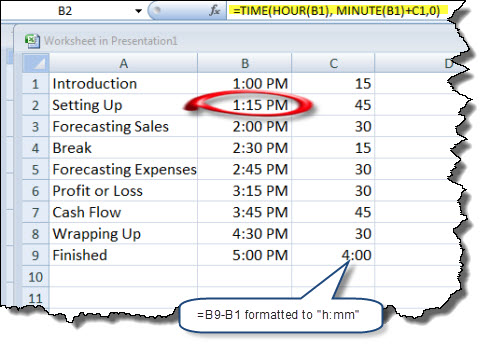
It depends mainly on one formula with nested time-related functions. Look at the illustration here first, and you can assume that once it’s done, then as you type the minutes in column C and the titles in column A, the start times will adjust automatically. If you insert a new row, you have to use the fill down feature to copy the formulas again from B2 through the last row. To make your own, you can follow my step-by-step directions below. And I’ve put a simple one, that you can modify, where you can download it (see my last paragraph).

  1. Just type the starting time as a time. I typed it into cell B1 as 1:00 PM. And with that entered there, you can change the whole thing just by entering a different start time. Just type the time. Screen ShotExcel understands that 1:00 PM is a time.
  2. The important part is the formula to cell B2. I’ve highlighted it in yellow. Make that formula as shown there and it will show you a strange number. Don’t worry; take the next step.
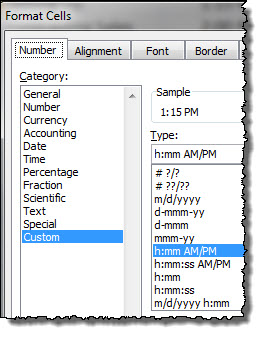
  3. With that cell highlighted, go to your Format Cells command (there are multiple ways to get there; check help if you have to) and change the Number format to show up as h:mm AM/PM as you can see here to the right. You’d think that would be in the Time Category, but it’s in custom.
  4. Then you just fill in the sections in column A and the times allotted in column C, as shown, and you copy that formula in cell B2 down to the other cells in B3 through (in this case) B9. And you’ve got something you can work with now.
  5. By the way, I like that last calculation, in cell C9 where I’ve highlighted it in the main worksheet illustration above, because it tells me exactly how long the event will be (that is, if I stick to my timing plan). Its formula is =B9-B1. And its format is “h:mm” from the custom format list we’ve already shown you.

You can use it with PowerPoint too.

You often want that schedule or agenda as part of a presentation. For that, you can open up an Excel object in PowerPoint and set it to show just the first two rows. You can see an example here. PowerPoint opens up Excel and I do the same as above, but I set the fonts larger. It’s also interactive, since it’s just embedded Excel, so you have the same functionality. To the right there’s an example of the resulting slide.

I’d like to give you more details about how you work with the Excel object in PowerPoint, but that’s too much detail for this post. But the executive summary is that you find the feature to insert an object into the slide, and then a dropdown menu lets you choose among objects including an Excel worksheet. And then you use the same formulas and functions and formatting as above. And if you insert a row, you have to adjust the formulas in the second column with a fill down command.

By the way, if you’re interested, I’ve left a simple version of that XLS file in my public dropbox where you can download it. To do that, just right-click this link and use your browser’s commands (usually that’s save as, but it depends on the browser) to save it to your disk as an Excel file, then run it.  Change it, modify it, it’s yours to use and enjoy.