Category Archives: Web/Tech

Can Stories be True When They’re False?

So it turns out that Jenny whiteboard quitting was a hoax. The Jet Blue guy with the chute exit and the beer wasn’t. I posted about both of them here Wednesday. Jenny Whiteboard CorrectedYou can read in that post that I suspected Jenny was fiction. I said so then, and I hedged my bets.

The two brothers who run thechive.com contrived the Jenny whiteboard story, hired an actress, scripted it, shot it, and put it on their site as a real thing. TechCrunch has all the details, with more on the actress and the brothers.

The Jet Blue guy, meanwhile, has been charged with a couple of felonies.

The coincidence of Jenny and Jet Blue together is a great example of stories: the power of stories, and the truth of stories.

William Blake wrote:

Anything which is possible to be believed is an image of truth.

And Harvey Cox wrote:

All human beings have an innate need to hear and tell stories and to have a story to live by.

So I ask: don’t you think Jenny’s story, although it was contrived, had useful impact?  Wasn’t it contagious media at its best? Doesn’t it have real meaning in business, a lesson about how and how not to treat people, a morality play, with relevant details like the part about the online snooper utility? Isn’t there a golden rule lesson in there?

And what’s the impact of the element of hoax? Did they lie to us, and does that make us angry, and make the story less true? I have no issue with that with Jenny because of the way it was presented. If I’d read it as fact in the  New York Times or Huffington Post I might react differently. We don’t like to be lied to. But if you go back and look at the original, nobody’s really lying there. They are not claiming it’s fact. And maybe I’m not all self righteous about it because I guessed it early and didn’t get burned.

And then there’s the Jet Blue guy: didn’t it strike a chord as well, in about the same way? I noticed CNN had a whole piece on flight attendants venting, which wouldn’t have been news without his spectacular exit. Would this one have been less valid as a hoax? Maybe, right? But this one actually happened.

And those two related flurries of attention: is the one based on story less valid than the one based on fact? There is a journalism element to this combination of stories, I believe. We expect truth, not stories, when it comes from professional journalists. Right? But John and Leo Resig, authors of the Jenny whiteboard story, don’t pretend to be journalists.

My point here: good stories told well communicate a very important variety of truth. That’s true for business and the rest of life too. Even if they aren’t true on the surface, they can be true in a deeper and more important way. Did The Godfather or One Flew Over the Cuckoo’s Nest or Moonstruck have to be documentaries to be true and useful? Are Othello or MacBeth only valid if they’re factually true?

(Image credit: thanks to TechCrunch.)

Take That, Spammers!

Do you want satisfaction after all the annoyance of spam?

I just finished clicking full pages of spam with one click, and then deleting all of them with a second click. The view below (warning: the subjects include stupid and offensive subjects) shows the page just for that satisfying click that sends them all to oblivion. Boy that’s a good feeling. Take that, spammers!

view of spam

If you don’t have a spam filter, then you need one. My company uses Postini and I also use SpamArrest and MailWasher. I recommend all three of them. Anything to not see the spam.

3 Blog Titles and One Novel in a Single Sentence

This sentence was at the end of the lead paragraph:

In this Q&A, he warns of the classic mistakes of manager-wannabe-leaders, the perils of too many bullets and not enough Zen, and why CEOs are like dogs.

Isn’t that great writing? Page ViewDoesn’t it make you want to read on?

There are three blog titles in that one sentence:

  • Classic mistakes of manager-wannabe-leaders
  • Too many bullets and not enough Zen
  • Why CEOs are like dogs

And that middle one, “Too Many Bullets and Not Enough Zen,” is intriguing enough to be the title of a novel. I may use it (apropos of my recent Zen/not Zen post) myself.

That sentence is from What Breed Is Your CEO? Randy Komisar on Leadership and Management, by Kermit Pattison, on Fast Company a couple days ago. Too bad that title isn’t as good as any of the three in the sentence above, but I think I know why: The Fast Company website isn’t a blog, it’s journalism. It’s supposed to be news more than opinion.

And at this point in this post I’m tempted to quote Kermit’s interview with Randy to explain his intriguing come-on sentence. But I won’t. You can click the link. This post is about the writing.

Graphic Evidence of What We Value Most

Like it or not, your real priority, my real priority, our society’s real priority shows up not in what we say but in how we spend our resources, including, of course, how we spend our time. Time is the scarcest resource.

Author David McCandless at Information is Beautiful called it Cognitive Surplus Visualized in honor of Clay Shirky’s Ted Talk.  I don’t love the phrase “cognitive surplus,” but I do get the point. And this chart speaks for itself. Well done.

Business Chart

When I see those two boxes, I can’t help thinking how huge the effort of Wikipedia; how much is there, information on how many different topics, how many people it took, and how many hours it took. Then I compare it to the big box next to it.

Is Flipboard’s Buzz Bad Timing or Good Marketing?

What do you think? Is this bad timing, a buzz-killing mistake, or artificial scarcity that creates more buzz?

I was in an email conversation recently with the founder of one of the coolest new news apps available on the iPad, and he asked me what I thought about Flipboard.

I’m guessing why he asked: all that buzz, all at once. This is an iPad app released last week. It’s supposed to integrate Twitter and Facebook,  with news and blogs, and a cool iPad look. In case you missed it, try this Google search. Nearly two million hits. Suddenly, everybody was talking about Flipboard.

Buzz envy. Who can blame him? Pardon my cynicism, but it doesn’t look that much different from the new Huffington Post app, or Apollo News, Pulse News, or Skygrid. So how did they get all that attention all at once? Have your marketing people study that one. It’s very impressive.

But here’s the business problem: timing. Wasting your buzz by not having your logistics ready for it. Take a look at what happens today, after you download your Flipboard, when you start to use it:

You guessed it: they’re taking email addresses and building a waiting list. “We’ll reserve your place in line,” they say. The bandwidth wasn’t set up to handle the marketing. I got interested, downloaded, and now have to wait for however long it takes to actually run the app. The buzz happened without delivery. Remember a few decades back, when people talked about vaporware? Credibility gone fast. Buzz wasted. What a shame.

Unless it actually works. After all, I just added another page to the buzz.

Guy Kawasaki and the Zen of Not Zen

I admit it. I got really jealous of all the Zen of this and Zen of that writing, dating all the way back to the book Zen and the Art of Motorcycle Maintenance, which I wanted to like, tried to like, but couldn’t. Zen templeYes, I gave into the horrible temptation, and even posted Zen and Business Planning here. I’m sorry. It was a moment of weakness.

Yes, I’m conflicted. Here I am after 30+ years of professional business planning fascinated by Gil Fronsdal and friends on Zencast, trying hard to reconcile Zen and business planning, and failing. Putting Zen and business planning into the same post is kind of like putting a dog and a raccoon into the same laundry bag.

Confession: my vanity license plate reads “not Zen.” If I could add a subtitle, it would be “… but trying.” After all, if I really were Zen, I wouldn’t put it on a vanity license plate. Right?

So you can only imagine my envy when Guy Kawasaki manages to bundle Zen of PowerPoint, Facebook, and Twitter, all at once, in a single post on the American Express OPEN Forum. Complete with 10 Japanese Zen concepts, each of them in Japanese, and each connected  to the points he makes. And then 10 more, which is really showing off. Damn, he’s good! He writes:

I love this kind of stuff: not only can these principles improve your PowerPoint pitches, products, website, and outlook on life, but they make people think you’re smart when you mention them.

Amen to that. Or something more Zen than Amen.

(Image: well, at least I get a point for that one. I took that picture in a Zen temple in Kyoto.)

Journalism and Blogging: Both Sides Now

Jolie O’Dell is a journalist who blogs. She cares about journalism, I gather, because of the way she writes about it in posts like How to Tell a journalist from a Blogger and Not all bloggers are journalists and not all journalists are jerks on her own blog. Most of the time, though, she’s a very prolific tech writer for Mashable. Blog PageAnd what she does for Mashable, one of the top techie blogs in the world, is technology journalism.

I really like her vision of what makes a journalist, as opposed to “just” a blogger. In that journalist or blogger post she says journalists are trained in journalism (and she means they have a degree in it), they aim for objectivity and truth, they care about form, they’re skeptical, and they serve the people. She makes it sound like a profession; like the quality matters.

I loved this down-home real-world description of a critical difference between journalists and bloggers. I’m quoting her here, journalists, she says, get used to editing, which she calls “having your work get ripped to shreds.” This is good writing. I’ve been there myself:

As a result, you do not get offended when your editor tells you, and I quote, “Jolie, this sentence fell off the ugly tree and hit every branch on the way down.” (Marshall Kirkpatrick, ReadWriteWeb) You begin to look at your writing the way a stranger would. You see the errors, the ugliness, the factual haziness, the sloppy turn of phrase. And you or your editor make repairs as needed without much fuss.

These words aren’t your limbs, your children, your masterpieces. They’re simply another grouping of column inches or another few hundred words to fill up the “news hole.” You’re not married to them, because you’ll be on to a new collection of words within an hour or two. With any effort, the next article will be better written than the last as you quickly learn from your mistakes.

The blogger is an autonomous creature, not accustomed to being under the scrutiny of a professional editor. He hasn’t had his work and soul trampled quite as mercilessly — although commenters can be cruel bitches, it’s true — so he’s a bit more attached to his words. Also, his words are more frequently tied to his personal ideas. More on that in a bit.

This brings back my own fond memory of UPI overnight editor Norberto Swarzman, who managed the New York Latin America desk for United Press International (UPI) when I was on the night desk in Mexico City, back in the early 1970s. I was very young, and he wasn’t. He was a frequent caller.

“Berry,” he said, more than once, “you write like a god-damned literature major.”

I’d finished class work for an MA in Journalism to add to the lit degree by then, but the only way to soften the abuse, long term, was to write better. In his terms, not mine. Later, when I finished a thesis and actually got that MA in Journalism officially, the Dean of the J-school at University of Oregon told me his only complaint with my thesis was:

“Your writing style is not academic enough. You write like a wire-service journalist.”

You might guess, if you knew my background, that I was going to like Jolie O’Dell’s respect for journalism. I do have the degree, and I did spend nine years as foreign correspondent in Mexico before quitting to get the MBA. And I’m delighted to see a 20-something professional journalist come up with the same kind of respectful view of why journalism matters that I’d learned 40 years ago.

I’ve come full circle, from journalism to entrepreneurship and lately to blogging. And I have no problem at all with her saying blogging is easier. Her kind of journalist researches and interviews to generate actual information, not just good writing. And then cites sources and quotes people with their actual words. I used to do that. Back then, as a journalist, I couldn’t write anything ever just because I knew it was true. That was really hard. I couldn’t just write what was true, back then; I had to quote somebody.  And we didn’t have the Web, not even cell phones, so I actually had to get that somebody on the phone, at least, and talk to them, I have no problem recognizing that blogging, which is basically me writing to you about whatever I can come up with as long as I don’t bore you, is a whole lot easier. Today, as a blogger, I get to be me. I can have opinions.

As you probably guessed, controversy followed Jolie O’Dell’s journalist vs. blogger piece. A lot of bloggers don’t like to be told they’re not journalists. And journalists without degrees don’t like to be told they need a degree. There’s a reference to “English-degree journalists” who don’t like to be told they’re not journalists unless they have a degree. And a lot of people think any hack getting paid to fill news space between ads is a journalist. I followed the controversy from the original post to some heated words (and a lot of praise) on Twitter, and a thoughtful follow-up post by journalism professor and journalist Kirk LaPointe, punctuated by some surprisingly emotional comments.

The “trained in journalism” mention is galling to many. and O’Dell distinguishes journalists from writers, casts some doubt on “English-degree journalists,” and accurately predicts the objections that followed. I loved her best-defense-is-a-good-offense conclusion:

If you’re a blogger and you’ve been offended somehow by my piece, ask yourself why — I highly suspect it’s because I called some behavior of yours out as not being “journalist-y” enough. While it’s true that we all hold ourselves to different professional standards, the above are pretty basic. If you feel threatened or attacked by what I’ve written, I suggest you get back at me by taking a couple journalism classes at a community college and doing an internship at a local newspaper; it’ll change your writing and your life.

So why do I care? Why does anybody care?  It’s because we still need journalism and we’re starting to confuse blogging with journalism. But then it gets confusing when we have excellent journalism showing up on so-called blogs like Mashable, or the mix at Huffington Post, which gathers the news – including with its own reporters – but also indulges in lots of blogging opinion. Mashable is a blog. Jolie O’Dell, writing on Mashable, is a journalist. If you have any doubt, look at her work on Mashable.

There has always been an awkward gap between journalism as trade and journalism as profession. Doctors need med school and exams, CPAs have their boards of standards, and dentists, vets, psychologists, and other so-called professionals have their licensing and standards. And we do have schools of journalism and professors and degrees and journals and standards. But still, give any hack a few dollars for writing anything that gets published as news, and then we call that hack a journalist.

And then you add in the ease of entry in blogging – sign up at WordPress or Blogger or TypePad and start publishing – and I for one am glad to see the occasional reminder of what journalism is supposed to be.

On the other hand, do you know who H.L Mencken was? One of the best journalists ever, a reporter for the Baltimore Sun, as famous a journalist as any in his time. Google “H.L. Mencken quotes.” He first wrote “nobody ever went broke underestimating the intelligence of the American public.” And he didn’t have a degree in journalism.

Easy Spreadsheet Plans a Session or Meeting.

I often have to engineer a workshop or presentation to fit into a few hours with topics divided into segments, and times set up for breaks. That’s just hard enough to do that I sat down the other day and looked up the Excel functions so I could set it up and then shuffle and juggle the different items. Is the break two early? Change it. Does somebody say you need to change the order, or change the time allotted for the session? Change it. With the right spreadsheet, it’s a lot easier. You don’t have to retype.

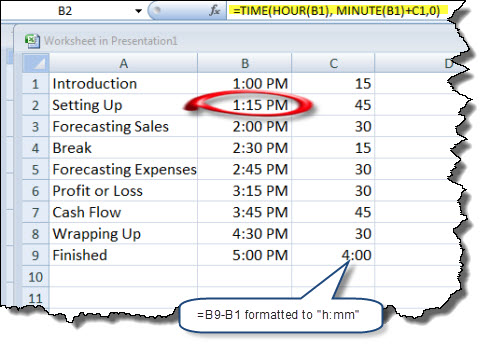
It depends mainly on one formula with nested time-related functions. Look at the illustration here first, and you can assume that once it’s done, then as you type the minutes in column C and the titles in column A, the start times will adjust automatically. If you insert a new row, you have to use the fill down feature to copy the formulas again from B2 through the last row. To make your own, you can follow my step-by-step directions below. And I’ve put a simple one, that you can modify, where you can download it (see my last paragraph).

  1. Just type the starting time as a time. I typed it into cell B1 as 1:00 PM. And with that entered there, you can change the whole thing just by entering a different start time. Just type the time. Screen ShotExcel understands that 1:00 PM is a time.
  2. The important part is the formula to cell B2. I’ve highlighted it in yellow. Make that formula as shown there and it will show you a strange number. Don’t worry; take the next step.
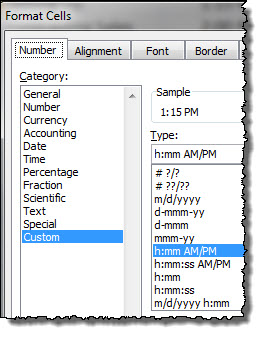
  3. With that cell highlighted, go to your Format Cells command (there are multiple ways to get there; check help if you have to) and change the Number format to show up as h:mm AM/PM as you can see here to the right. You’d think that would be in the Time Category, but it’s in custom.
  4. Then you just fill in the sections in column A and the times allotted in column C, as shown, and you copy that formula in cell B2 down to the other cells in B3 through (in this case) B9. And you’ve got something you can work with now.
  5. By the way, I like that last calculation, in cell C9 where I’ve highlighted it in the main worksheet illustration above, because it tells me exactly how long the event will be (that is, if I stick to my timing plan). Its formula is =B9-B1. And its format is “h:mm” from the custom format list we’ve already shown you.

You can use it with PowerPoint too.

You often want that schedule or agenda as part of a presentation. For that, you can open up an Excel object in PowerPoint and set it to show just the first two rows. You can see an example here. PowerPoint opens up Excel and I do the same as above, but I set the fonts larger. It’s also interactive, since it’s just embedded Excel, so you have the same functionality. To the right there’s an example of the resulting slide.

I’d like to give you more details about how you work with the Excel object in PowerPoint, but that’s too much detail for this post. But the executive summary is that you find the feature to insert an object into the slide, and then a dropdown menu lets you choose among objects including an Excel worksheet. And then you use the same formulas and functions and formatting as above. And if you insert a row, you have to adjust the formulas in the second column with a fill down command.

By the way, if you’re interested, I’ve left a simple version of that XLS file in my public dropbox where you can download it. To do that, just right-click this link and use your browser’s commands (usually that’s save as, but it depends on the browser) to save it to your disk as an Excel file, then run it.  Change it, modify it, it’s yours to use and enjoy.

With or Without Paper, the News Lives On. I hope.

As the newspaper business seems to die slowly, I console myself with the idea that journalism isn’t dying with it. The Huffington Post is booming. The New York Times will bring in about $350 million this year. The new iPad shows us how we can spread the paper in front of us with coffee and a newspaper in the morning. There’s hope. They capped the stupid oil spill overnight. Maybe they’ll cap the journalism spill too. Eventually.

I wish I knew who I’m quoting here, but I don’t. Somebody mentioned this quote to me recently:

I don’t care about newspapers. I do care about journalism.

iPad NewsWhat if news didn’t come on mashed-up trees? What if it came online instead? What if the iPad is the future of the daily newspaper? I can still sit with my coffee and page through the news. Sort of.

Can we survive with a few big online news organizations, but no newspapers?

In that case, who’s going to cover the city council meeting? Who’s going to spend months doing investigative reporting? And who’s going to pay the salaries of the people spending months on investigative reporting?

Meanwhile the Huffington Post, by far the most successful news business of the last half decade, is paying journalists full time incomes to develop the news. They have a handful of their own correspondents. That’s not the answer to those questions, but it is a start.

And I read this morning on TechCrunch how Ex-Google News, Bing Engineers Set Out To Build ‘Newspaper Of The Future’. Oh the irony: my stream of consciousness goes from TechCrunch to blogs to declining print advertising to slow death of newspapers; and I read about it in TechCrunch.

And, then, without hesitation, I signed up for both the apps mentioned, Apollo and Pulse, to go with my New York Times, Huffington Post, CNN, USA Today, Wall Street Journal, NPR, and SkyGrid. So it’s not like I won’t have news. And local news? That icon in the lower left of my iPad picture above is the Eugene Register Guard, which is my local newspaper. Now, as long as the local paper can figure out how to survive on its online revenues … sigh…

No, I’m not suggesting the iPad is the big answer or magic solution. It’s mostly just a good illustration. This is a long-term change of worldwide news landscape, and the iPad is significant here because this is how things are going to be. The iPad will have good competition soon enough. Let’s hope it does, and that the competition generates money for news organizations, so that the journalism survives.

3 Tech Benefits and 1 Threat for Guru Businesses

By guru business I mean the expert business, and particularly the one-person expert business. I mean consultant, coach, adviser, researcher, business hired gun, life coach, trainer, and so on.  I mean a person who makes a living by selling (real or imagined) expertise, experience, and knowledge.

magnifying glassI was a business planning consultant for most of the 1980s and early 1990s, working almost always alone, just myself, no company. So that’s an example of an expert business. And I’ve been thinking lately about how much social media has changed that business model for the better. In this case – but with one notable exception – change is good.

Benefit 1: Marketing your expertise is way easier

There is a new way of marketing that is so much better than the old way. Call it the Web, social media, blogs, Twitter, or the combination; it means way more reach, automatically, if you do it right.

Consider the comparison, now vs. then: I lit out on my own as a business planning and market research expert in 1983. I had my credentials, of course, including academic degrees and a fancy title with a brand-name consulting company, plus some published works. But how did I make myself known? Word of mouth from clients who’d worked with me as an employee, yes. But from there it was a struggle to get my articles into magazines, my self onto the podium at the big trade shows (such as Comdex), and to finish a couple of published books on my main subject matter.

Today, in comparison, successful experts build their business by a combination of useful blog posts, active mini-blogging on Twitter, ebooks, and work with Facebook and LinkedIn. Do you see the pattern there? The gatekeepers are gone.

Where it used to be important to validate your expertise by getting through the gatekeepers in corporate branding and publishing, nowadays can’t you validate your expertise by making good sense on your blog? Believe me, that’s so much easier than the old way of publishing, speaking, and giving seminars.

Benefit 2: Acceptance is based on expertise more than setting

I posted this related thought on this blog Tuesday, about how clients can get better value from a one-person business with no overhead. Who does the work? The client is much more likely today, compared to 20 years ago, to accept and even approve of the fact that you’re on your own. Not having a company around you is no longer cause to wonder what’s wrong with you.

Benefit 3: With gatekeepers devalued, it’s the work that matters

And then there’s this last thought, which I hope is true: today we judge experts by their work, meaning their writing and speaking (and tweeting), much more than we used to. Today an expert’s work is more immediately available, and with less distortion through gatekeeper filters, than ever before. Isn’t it?

How do you evaluate a guru ahead of time? Usually the about page and the content of the blog. There’s less interference there. Back when I started, it took getting through magazine editors to get published, or event managers to get a podium, or joining or creating a company.

Do you frown on an ebook because it wasn’t published by a name-brand publisher? Do you mistrust a blog because it isn’t in a major business publication? Not so much. Am I right?

And the warning?

The bad news is the other side of the good news: It’s the work that matters. Today you have to either do good work or settle for clients you can fool. It was easier back then to hide mediocre work with a company around you, or an editor of a magazine to rewrite it. Today, if you claim to be an expert, you’d better create some content to back that up. Transparency is cool when it’s a bright and beautiful looking glass that highlights and spotlights you. It’s not so nice when it’s a magnifying glass that’s going to burn you like an ant in the backyard on a hot summer day.

(Image: Freshpaint/Shutterstock)