Category Archives: Web/Tech

Why Richard Branson’s 5 Tips for Success Are Really only 4.5

Hard to have a more successful or more high-profile entrepreneur/winner than Richard Branson, so I clicked quickly this morning from email to the Amex OPEN forum to look at his Top 5 Tips for Entrepreneurial Success .

Lots of people have opinions, lots of people have expertise, but he has Virgin Airlines, Virgin Records, and all of that. His five tips are pretty good reminders:

  1. Find good people
  2. Realize that the employees are the business
  3. Always look for the best in your people. Lavish praise. Never criticize.
  4. Don’t take yourself too seriously.
  5. Screw it, just do it.

I say this is maybe only 4.5 tips because of the “never criticize” part of his third tip. In more than 20 years of building and running a company, one of the hardest things to do, but most important, is managing mistakes.

Richard Branson says:

When mistakes happen – which is inevitable – I always take the position that you have to learn from them and try not to dwell on what went wrong. It’s almost always better not to go over the obvious with the people involved. They know exactly what happened.

I agree with the first sentence there, but I’m afraid that you do have to “go over” what happened, because it’s not always obvious. And I don’t think they always “know exactly what happened.” You and they need to review it at least once, so everybody is on the same page. It’s business, not fun, and you’re supposedly running it. It’s only normal that without the right kind of follow up on poor results, some people will rationalize or gloss over or fail to learn from mistakes. If you, the boss, never acknowledge the mistakes, you don’t optimize the business.

Obviously I mean good constructive criticism. Not back-biting or second guessing when it doesn’t matter.  But there’s that tendency to want to be friend rather than boss, and ultimately if you’re running a business, somebody has to have the backbone required to set expectations and track results, and, the hardest part, deal with results that are less than expected.

I learned that the hard way, by not giving negative feedback. People don’t always correct themselves.

For Better Market Research Get Real Clicks not Fake Answers

For real information, watching what people do is way better than asking them what they think, what they did, or, the worst case, what they intend to do. That’s why I like this new click-based and search-based research so much.  Don’t go with what people say; go with what they do.

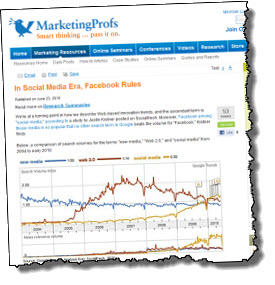
A great recent example is Marketing Profs’ In Social Media Era, Facebook Rules. The data is fascinating; but the methodology, and the tool used, is even more so. Screen Shot

This particular post, for example, uses Google Trends to illustrate the comparative rise and fall of the common phrases. You can see at the bottom of this post how the trends chart shows the rise and fall of the three terms “new media, web 2.0, social media.” You can look at the chart here – taken from that post, which, in turn, highlights research done by Justin Kistner posted on socialfresh. He’s saying that social media is the new third wave of the Web, and he uses the Google trends search and news charts to illustrate. I hope you can see it on the chart below. In Web searches, on the top, “new media” gradually fades from 2004 to now. “Web 2.0” goes up fast in 2005 and 2006, but peaks, and then falls. “Social media” goes up gradually, but seems to be accelerating. In Web news reports, on the bottom, social media is taking over.

Line charts

That’s done with Google Trends. Try it. Go to the Google Trends Web tool and start typing in search terms to see what the whole online world has been looking for, and finding, for the last few years. Try it with the terms “hamburger, sushi” and then with “Twitter, blogs” and you’ll see what I mean. I like what I see for “accountability,” which I think is increasing in importance these days.

This is a great tool for thinking, and planning. Educate those guesses.

Hell with School or Work, Startups are Genetic

What a relief. Entrepreneurship is genetic. That’s great news. Here I’ve spent all this time (since 1974) thinking it was ideas, plans, teams, taking steps, getting things done, doing things well, paying the damned bills, solving problems, and all that hard stuff. What a waste!

In Is Entrepreneurship Genetic? on Brazen Careerist, Jake Poinier writes:

Roughly one third to 40 percent of the tendency to be an entrepreneur is innate rather than taught. Independence, tolerance for risk, ability to recognize opportunity, and leadership are all affected by your genes.

He goes from there to a well-written, thoughtful, sensitive tribute to his father, an excellent post. But I still had that 40 percent ringing in my ears when it reappeared yesterday in Dyan Machan’s Is Start-Up Savvy in Your DNA on WSJ.com. He poses that education question I see a lot lately, which usually suggests that since entrepreneurship can’t be taught, you should just wing it:

We’ve always had a hunch that entrepreneurs are a different breed, but some academics are taking that idea quite literally. Turns out … 40 percent of the variation in the tendency to be an entrepreneur is inherited. [T]his work puts a new spin on an age-old question: Can classroom learning really teach you how to succeed?

Very interesting, that 40 percent number. So if nobody in either my background or my wife’s was an entrepreneur, and we started a company, does that mean we have only 60 percent chance of success, even 20-some years later? And we have five grown-up children, so does that mean they’re 40 percent entrepreneurs, or that two of the five are entrepreneurs? Is it a dominant or recessive trait? And my dad, the ophthalmologist, he doesn’t have independence or risk tolerance, or ability to recognize opportunity? One of our five children runs our company now, so does that mean one of the other four – all duly employed – needs to start a company quickly? I wonder which one it will be?

So all those good entrepreneurial traits, those are just inherited traits now, with or without schooling? How could book learning help? Damn, I liked school too, I wouldn’t have missed it, but apparently it was wasted. But then I don’t have entrepreneurial DNA, apparently, so maybe that’s why I needed an education.

And what about work? Doing it? Getting into the office, returning phone calls, solving problems, hiring and firing people as needed, finding credit, doing prototypes, getting the right vendors? They say that 90 percent of success is just showing up. I wonder if that’s including or excluding the 40 percent that comes at birth. If our grown-up children have all 40 percent of the genetic part, do they have to show up just half of the time, to be successful?

While all of this is fun, sort of like the nature/nurture argument when done as an impromptu party game, it’s just about as useful as comedian Jeff Foxworthy’s “you know you’re a redneck when” stand-up routine. It doesn’t get to any meaningful conclusions about who and when and what makes startups.

Clearly, just like the redneck routines, lists of entrepreneurial traits are fun — I posted a list of my own here and another here and a third here on this blog. But don’t take them seriously.

For the record, this whole idea comes directly from Scott Shane’s Born Entrepreneurs, Born Leaders, which I bought and read and liked. It has none of the simplicity you’d think from the summary here. Actually Scott examines a lot of interesting research around the nature vs. nurture question as it relates to careers, and he jumps to no over-simplified conclusions. He’s exploring. He’s got table after table of background information about career choices and traits, characteristics, and genetic research. It’s a good book. But not a great one to be summarized in a headline.

Generalizations about startups almost always fail. People start companies for as many different reasons as there are companies. And those companies fail or fly for an entirely different set of reasons. Like I said in my opening paragraph on this post: It’s also what you’ve done, what you do, what you want, what you like, who you love (try to start a business without family support, and you’ll see), what bores you, what you did for your first job, where you live, where you’d like to live, what people want from you… as many traits as there are entrepreneurs.

Angel Investors Focusing on Political Power

I like this: a new angel investor group built around new ventures related to “progressive political power.” It’s a bit new for angel investment, which is normally focused on interesting startups with good risk-return prospects. But why not?

Money MachineI read about New Media Ventures last week on Read/Write Web, and then two days later at the Wall Street Journal’s WSJ.com. And there was an initial announcement on the Huffington Post.

At the website, newmediaventures.org, founders make no bones about the underlying political purpose:

New Media Ventures is the first national network of early stage investors who are investing their time and money into new, cutting edge, start-ups focused on building progressive political power.

While political power is not exactly a traditional business objective, consider what “angel investment” is: individuals investing their own money.

I think it’s sort of funny that in entrepreneurship we call small-time individual investors angel investors. Return on investment is so rarely angelic. SEC rules require that investors be relatively wealthy individuals, but say nothing about halos, conscience, motivation, or doing good.

Maybe you don’t like their politics, but I hope we see more of this. I thought there were angel investment groups focusing on green business, although I just Googled, and couldn’t find any. I’d like to find some. And this kind of more-than-money motivation is at the very least quite common among local angel groups including the one I’m a member of, (Willamette Angel Conference) that focus mainly on local startups.

Can politically motivated angel investment be good business? Can it be a good way to invest money, with some reasonable hope of return? I think so. I hope so. And if you look carefully at founder Mike Mathieu’s bio here, it looks like he’s pulling that off already.

(Image: Vitaly Korovin/Shutterstock)

The Problem With Crowd Sourcing is Crowds

Crowd sourcing sounds good to me, but then I remember, we humans are a difficult bunch. We like complaining more than praising. We post nasty, negative, and aggressively personal comments on blogs. We’re easily swayed by a few bad apples. Anonymity makes us really mean. Revenge makes us happy.

And we behave particularly badly in crowds. Don’t we?

For example, think of reviews. Remember when we were able to depend on popular reviews to figure out which books to read, movies to see, and products to buy? I say “not so much,” at least not any more. Coming off of a tough marathon of business travel, no more than a week at home since late March, I’m disappointed with how poorly review sites are working for me. I’ve been using Trip Advisor to help me book hotels and, with the gracious help of Trip Advisor reviews, ended up in a particularly unpleasant hotel with particularly pleasant reviews. Somebody’s been gaming the system.

Take a good look at reviews these days. On Yelp, TripAdvisor, Amazon.com, Google, or whatever. Weed out the ones that are obvious plants by self-interested people, like the owners or friends of owners. Weed out the disgruntled people pushing grudges, like one I saw recently who hated the restaurant that kicked her out because she was drunk (and she says so in her review). What’s left?

And then there’s the problem of nasty or meaningless comments on blog posts. Another problem of crowds. Not on this blog, of course – and thank you all for that – but I just read Website Editors Strive to Rein in Nasty Comments from NPR’s All Things Considered. Should comments be moderated? Does it cut into the interest level or authenticity of a site? Here’s a quote:

Clifford Nass, a communications professor at Stanford University, says when you have an environment where thousands of people are vying for attention, people know intuitively that it’s the nasty stuff that jumps out.

“Ironically and tragically, if you want people to respond to what you say, say something outrageously negative,” says Nass.

The Web, while it’s obviously a powerful possibility for crowd sourcing, brings out the worst in us. This is also from that NPR story:

It’s easy to lose your temper on the Internet. Anyone who reads — or writes — comments on blogs and news sites knows that the conversation can quickly stray from civil discourse to scathing personal attacks. For years, many websites just let users go at it, and free speech reigned. But now editors are rethinking just how open their sites should be.

The story goes on to suggest some ways to moderate comments and manage the conversation better. While controversy can build traffic and content, scathing attacks are just ugly; not really interesting to anybody, but quite common. And when it does turn personal, kind of creepy too. Anonymity seems to increase the nastiness level, for obvious reasons; but signing and adding an email address doesn’t make much difference.

And then there’s this new rash of annoyingly automated blog comments. If you moderate a blog you know what I mean. Lately there’s been a flood of inane generic comments placed by Web robots for some obscure SEO gains. Things like “nice post, food for thought, I’ve bookmarked this” that can be applied indiscriminately to thousands of posts.

Question: is this dark side of crowds part of the reason that celebrity gossip is so overvalued in news and media these days? We’d rather read silly celebrity stories than darkly disturbing stories of political chaos and environmental disasters. Or so it seems.

Because we humans are difficult. We like to be negative. And we often behave badly in a crowd.

(Image: by Philippe Leroyer via Flickr CC)

Seth Godin on Rethinking Business Plans

It’s about time that business writers, assorted experts, entrepreneurs, academic and the rest start focusing on the huge damaging and wasteful misunderstanding that most of us have contributed to: that completely out-of-date idea that a business plan is a document, done once, related to raising money.

Seth's blogSo I’m delighted to see Seth Godin jumping onto this issue with a good restatement of the problem and an infusion of new ideas to shake us up. His modern business plan post on his blog Monday starts with a quick but very real problem:

It’s not clear to me why business plans are the way they are, but they’re often misused to obfuscate, bore and show an ability to comply with expectations.

The most important word there is “misused.” Because that’s the myth of the business plan. Case in point: last week a journalist asked me if we had “an official business plan” for Palo Alto Software. That was his phrase, not mine: “official.” As in formal. Static. Left somewhere in the drawer.

Somebody on Twitter asked me what I thought of Seth’s post, thinking, I’m only guessing, that I’m in favor of the more traditional business plan. No way. I love the new thinking. It’s right in line with what I’ve been posting for several years now.

There’s no such thing as an official business plan, but the idea highlights the misuse. People spending months developing documents instead of businesses. That’s waste.

It should be business planning, a process, reviewed and revised regularly, a tool for managing and steering a real business.

Seth’s recommendation is excellent. Let’s shake the old expectations up, change the expectations, change the arrangement… and what he recommends doesn’t do anything but enhance the real business purpose of business planning.

His recommendation? A new standard order of plan documents:

I’d divide the modern business plan into five sections:

* Truth
* Assertions
* Alternatives
* People
* Money

He goes on, in the post, to talk about each of those sections. Excellent suggestions. His new order would make a great business plan.

From my point of view, this suggested reordering is nothing but positive. The business plan is just step one of planning; it’s about managing change. It’s not a sales brochure. It’s not a pitch to investors. It’s not even a plan; it’s planning. It’s about managing change. It’s about optimizing, prioritizing, setting long-term goals and short-term steps, with metrics and tracking. Why not put it in this order?

If nothing else, at least it shakes up that mythological business plan that so many people are tempted to misunderstand and misuse. And there’s no downside to it.

Read his post. See what you think. And if you read my stuff on business planning, I think you’ll find I’ve always been in favor of flexible one-of-a-kind business plans, as part of planning process. It fits perfectly with my work on business planning, including the two highlights of my recent work:  Plan-As-You-Go Business Plan and Business Plan Pro.

Klout Puts Metrics Into Social Media Management

I really like klout.com for three good reasons: 1.) it’s about measuring online influence and I’m big on metrics as a key element of business planning; 2.) it’s a great example of a strong startup based on need — entrepreneur Joe Fernandez building something he wanted to use, and getting VC funding; and 3.) they released a new 2.0 version today (VentureBeat covered it … and there’s more detail on the Klout blog).

Metrics are the best possible drivers of good business planning processes and collaboration, because metrics can make feedback, the toughest part of management, almost automatic. Klout offers metrics on social media influence, so you can go beyond just counting followers or friends or whatever. True, I also like Klout because my daughter is marketing manager there. But I’ve been advocating this kind of social media metrics for a long time. Here for example is what I wrote about metrics just two days ago on Small Business Trends, which led  to a discussion of metrics and measurement and better ways to evaluate performance:

I’ve seen objective metrics, like sales, costs, expenses, calls, subscriptions, downloads, visits, page views, minutes per call, or unique visitors work pretty well, especially when they’re part of a regular planning process. I still remember how well the metrics worked in my first job, as an editor for United Press International, when they gave us scores for how many  newspapers used our stories instead of Associated Press.

So, with that in mind, here’s a (relatively) new facility to put numbers behind your social media efforts. Think about this as a tool for managing Twitter performance (if you don’t see the video, click here for the source site.)

http://blip.tv/play/AYHf9QwC

So the magic here is that Klout gives you a numeric score for your Twitter presence. I’m pleased. I’m a 45, which is 90th percentile. Sure Guy Kawasaki’s at 100, but my 45 beats a lot of people I know and respect. (What? Me competitive?).

So if you’re dealing with social media performance for a team, in business, maybe you can set goals for Klout scores and then follow up. Include the Klout score in plan review sessions.

What’s your score? What’s going to be your score goal for your management metrics?

Rejecting Rationalizations for Racism

I rarely post about politics or current affairs on this blog but today I can’t resist. Yesterday I read a column in the Wall Street Journal highlighting how a group of religious fanatics, all ethnically Arabs, threatens our country. And last month Arizona enacted a law that openly discriminates against Hispanics. Rationalizations run rampant. It seems like we’re prepared to stomp on minorities, Constitutional or not, equal protection or not, as long as we can rationalize. Pakistanis might be terrorists. Mexicans might be illegal immigrants.

Excuse me, but what are we protecting here? Is it a set of ideals? A way of life? Maybe a Constitution, and a Bill of Rights? So is it okay, as long as we have a rationalization, to squash whole ethnic groups in this country? Citizens or not?

I hate the new Arizona law. It has police and other public officials checking citizenship papers during routine interactions, like traffic stops. So I go to Arizona and I’m fine, because I’m an old white guy; but my Mexican friend, just as American as I am, has to carry extra documentation. All the Hispanic-looking Americans living in Arizona have to carry extra documentation around, just in case.

Isn’t this a lot like what Nazi Germany did to Jews in the early 1930s, first requiring them to carry extra papers around, then later the yellow stars, and, sadly, the horrors that followed. Whatever the problems this Arizona law supposedly solves, it’s just plain unacceptable.

I relate the Arizona law to the terrorism problems because of the way rationalizations for racism grow. And how easy is it to crack down on ethnically Arab people now that we have the problem of religious fanatics who tend to be Arab? It’s already happening. Ask your Arab friends how they feel when they go to the airport. Is it racist? No, they say, it’s just logistics, law of averages, and all. But we didn’t crack down on rednecks when Timothy McVeigh bombed Oklahoma City. And we’re not cracking down on illegal immigrants who don’t look Hispanic.

Sure there are rationalizations. There are always rationalizations. Terrorism, illegal immigration, those are real problems. But however serious those problems are, this country doesn’t solve them by ranking and categorizing and downgrading some of its citizens. That’s not what we’re about. Do the ends justify the means?

There are always rationalizations for racism. They don’t make it okay.

Is Education Missing its Target or Just Aiming at the Wrong Target?

I’d like to think that business education should be about education more than business. It should be about leadership, perspective, and vision, more than about analysis, buzzwords, jobs, and salaries. But is it? Or is that just the kind of high-sounding stuff we write when looking back, years later?

Rethinking the MBAI’ve seen two important pieces on higher education and business education in the last week, one questioning the idea of the MBA, the other questioning higher education in general. While the Harvard Business School writes about a glass half full in The Future of MBA Education, Seth Godin writes about what he calls The coming melt-down in higher education on his blog.

The Harvard post summarizes a new book called Rethinking the MBA, by David Garvin,  Srikant Datar, and Partick Cullen. It’s about six cases of well-known business schools (including Stanford, my personal favorite) revising their programs to deal with a changing world. In the interview, Garvin says:

Yet rebalancing from the current focus on “knowing” or analytical knowledge to more of what we call “doing” (skills) and “being” (a sense of purpose and identity) must occur. Business schools need to think innovatively about how best to use the resources available to them. For example, there are many exciting opportunities to engage alumni in the learning process.

Seth Godin calls his bleak picture “as seen by a marketer.” He predicts “meltdown” in higher education for five reasons:

  1. Most colleges are organized to give an average education to average students.
  2. College has gotten expensive far faster than wages have gone up.
  3. The definition of ‘best’ is under siege.
  4. The correlation between a typical college degree and success is suspect.
  5. Accreditation isn’t the solution, it’s the problem.

He makes several very good points. This observation seems all too true:

College wasn’t originally designed to merely be a continuation of high school (but with more binge drinking). In many places, though, that’s what it has become. The data I’m seeing shows that a degree (from one of those famous schools, with or without a football team) doesn’t translate into significantly better career opportunities, a better job or more happiness than a degree from a cheaper institution.

In both cases, to me, it’s about confusing education with job training and job placement. If you measure success by average salaries and job placements, then as a society you substitute job training for education. The target is growth of the person, not growth of the income.

I have to admit that I started thinking about getting an MBA degree when my dad showed me a newspaper story about MBAs getting high-paying jobs. So now years later, I write about education first; but for me it was about changing careers, from journalist to business.

That worked for me. I did change jobs. However the real value, as I look back, was in the classroom, what I learned, much more than the step up to the next job. Years later, what I expect from somebody with an MBA degree is a better view of the whole business, from finance to marketing to operations, human resources, and so forth. You might work in one functional area, but you have basic understanding of the whole, not just your specific part. And you have a sense of what business analysis is like, how and when it’s useful.

Or at least, that’s what I hope. I’ve also posted on this blog my thoughts on what business schools can teach, what they don’t teach, and questions to ask before getting an MBA.

Big Mistake: Business Plans And Investor Returns

Another problem that comes up a lot as I read on with my business plan marathon: too many business plans are taking too much time and effort telling supposed investors what their supposed return on investment will be. This is usually a waste of time, energy, and space. It’s certainly a mismatch between what the entrepreneurs are thinking and what the investors are thinking.

fool's goldI was surprised a couple days ago, talking to entrepreneurs, at how much emphasis they put on wanting to know what return on investment was satisfactory to investors. It was as if they thought what the plan says the company will be worth five years from now makes a difference. And it doesn’t. The illustration here is a piece of fool’s gold, iron pyrite.

It felt like these entrepreneurs are thinking: investors want to see X in returns so I have to show that in my plan. I pop up the sales forecast, pop up the profitability, and that generates a great projected valuation. So I show that I can deliver a great return.

Investors, meanwhile, are actually thinking: I want to look at the product-market fit, scalability, management team, and factors like that to determine whether the company is going to make it. If they have all that right, then they have a shot; and if not, they don’t. Projected investor returns depend on a future valuation, which depends on the sales forecast or income forecast or both. Most investors look hard at the sales and profitability projections, because they want to see credibility; I use them to get a feel for how well the entrepreneurs know the business. There’s so much cascading uncertainty on future valuation that I don’t put much stock in it.

There’s a Catch-22 about sales and profitability forecasts: credibility of the numbers means more than the numbers themselves. A plan that has both big numbers and credibility is rare.

(Image: Vakhrushev Pavel/Shutterstock)