Category Archives: Technology

On the Value of Good Computer Games

My thanks to Chris Brogan for posting Games and Fun on his blog this morning, linking to Jane McGonical’s Gaming Can Make a Better World video on TED.com (embedded below).

In his post, Chris says:

Forget the rest of my blog post and just watch this. Ask yourself whether or not you could make more fun and more games out of what we all do for a living.

http://video.ted.com/assets/player/swf/EmbedPlayer.swf

Which reminds me that I think some kinds of games are great teachers. I’m very grateful that I spent a lot of time as a kid playing strategy games, particularly the Avalon-Hill strategy games that took hours and involved lots of cardboard pieces on maps. I played that one forward with my own kids, in a sense, by spending time with them on computer strategy games, most notably Age of Empires. I think a good game is a powerful lesson. Especially when it’s fun.

I should add, though, that I’m talking here about good games. The strategy games teach. And a lot of other types of games are quietly teaching while doing. Think of the word games, puzzle games, role playing games. Take a look at Civilization, the game.

And I have to add that I’m definitely not saying all computer games are good for anybody. Obviously. There are a lot of computer games out there that are mind numbing or (think shoot-em-up) worse. In my opinion.

Goodbye Office Hello Metrics, Tracking & Accountability

In his recent post Goodbye to the office, Seth Godin list a lot of good reasons for working virtually, remotely, or whatever you want to call that. He summarizes:

“If we were starting this whole office thing today, it’s inconceivable we’d pay the rent/time/commuting cost to get what we get. I think in ten years the TV show ‘the Office’ will be seen as a quaint antique.

When you need to have a meeting, have a meeting. When you need to collaborate, collaborate. The rest of the time, do the work, wherever you like.”

One thing he doesn’t mention there is accountability. Traditionally people were accountable for physical presence: butts in seats (and pardon the expression).  I’m not in favor of that old-fashioned metric. Technology gives us a lot of options. And meanwhile  we suffer the ills of commuting, overcrowding, energy use, and all the rest.

However, as old-style accountability fades, we need new management, with planning, tracking, and metrics. Not just people in seats, people in workstations, or people at desks. People getting things done.

(Image: Monkey Business Images/Shutterstock)

For Better Market Research Get Real Clicks not Fake Answers

For real information, watching what people do is way better than asking them what they think, what they did, or, the worst case, what they intend to do. That’s why I like this new click-based and search-based research so much.  Don’t go with what people say; go with what they do.

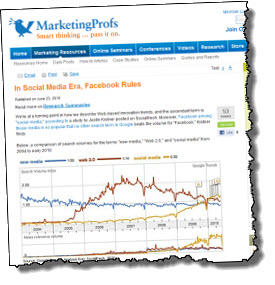
A great recent example is Marketing Profs’ In Social Media Era, Facebook Rules. The data is fascinating; but the methodology, and the tool used, is even more so. Screen Shot

This particular post, for example, uses Google Trends to illustrate the comparative rise and fall of the common phrases. You can see at the bottom of this post how the trends chart shows the rise and fall of the three terms “new media, web 2.0, social media.” You can look at the chart here – taken from that post, which, in turn, highlights research done by Justin Kistner posted on socialfresh. He’s saying that social media is the new third wave of the Web, and he uses the Google trends search and news charts to illustrate. I hope you can see it on the chart below. In Web searches, on the top, “new media” gradually fades from 2004 to now. “Web 2.0” goes up fast in 2005 and 2006, but peaks, and then falls. “Social media” goes up gradually, but seems to be accelerating. In Web news reports, on the bottom, social media is taking over.

Line charts

That’s done with Google Trends. Try it. Go to the Google Trends Web tool and start typing in search terms to see what the whole online world has been looking for, and finding, for the last few years. Try it with the terms “hamburger, sushi” and then with “Twitter, blogs” and you’ll see what I mean. I like what I see for “accountability,” which I think is increasing in importance these days.

This is a great tool for thinking, and planning. Educate those guesses.

Klout Puts Metrics Into Social Media Management

I really like klout.com for three good reasons: 1.) it’s about measuring online influence and I’m big on metrics as a key element of business planning; 2.) it’s a great example of a strong startup based on need — entrepreneur Joe Fernandez building something he wanted to use, and getting VC funding; and 3.) they released a new 2.0 version today (VentureBeat covered it … and there’s more detail on the Klout blog).

Metrics are the best possible drivers of good business planning processes and collaboration, because metrics can make feedback, the toughest part of management, almost automatic. Klout offers metrics on social media influence, so you can go beyond just counting followers or friends or whatever. True, I also like Klout because my daughter is marketing manager there. But I’ve been advocating this kind of social media metrics for a long time. Here for example is what I wrote about metrics just two days ago on Small Business Trends, which led  to a discussion of metrics and measurement and better ways to evaluate performance:

I’ve seen objective metrics, like sales, costs, expenses, calls, subscriptions, downloads, visits, page views, minutes per call, or unique visitors work pretty well, especially when they’re part of a regular planning process. I still remember how well the metrics worked in my first job, as an editor for United Press International, when they gave us scores for how many  newspapers used our stories instead of Associated Press.

So, with that in mind, here’s a (relatively) new facility to put numbers behind your social media efforts. Think about this as a tool for managing Twitter performance (if you don’t see the video, click here for the source site.)

http://blip.tv/play/AYHf9QwC

So the magic here is that Klout gives you a numeric score for your Twitter presence. I’m pleased. I’m a 45, which is 90th percentile. Sure Guy Kawasaki’s at 100, but my 45 beats a lot of people I know and respect. (What? Me competitive?).

So if you’re dealing with social media performance for a team, in business, maybe you can set goals for Klout scores and then follow up. Include the Klout score in plan review sessions.

What’s your score? What’s going to be your score goal for your management metrics?

Traveling With iPad Alone

I’m writing this post from a hotel in San Francisco, using my new 3G iPad (propped against the wall on the desk) and an Apple Bluetooth keyboard.

This was supposed to be a quick trip, Friday to Monday, helping my youngest daughter move from Palo Alto to San Francisco. It was going to be a lot of work, leaving not a lot of time for blogging, browsing, or email. And the iPad, although not as useful as a normal laptop, is so much more fun. And I’ve already done one week-long trip carrying both the iPad and a MacBook Air, which felt like some sort of ironic defeat of cool new technology. So I decided to do this one with just the iPad, no laptop.

Here are some random discoveries I’ve decided to share:

  • The iPad is irresistibly entertaining. Maps, apps, videos, books, and I haven’t even got a single game, but it’s still that entertaining. I’m not sure it’s a business tool, but it’s definitely a delightful travel companion.
  • The battery life is sensational. It really does last like 10 hours.
  • The Bluetooth keyboard turns this iPad into an acceptable writing instrument. I’m a touch typist (does anybody use that phrase anymore?) and I almost think with my fingers on the keyboard. The iPad built-in keyboard is an acceptable compromise for data input and quick emails, but I need the tactile feel of the keyboard to write. And it fits in my backpack well enough.
  • I wish they’d add a Bluetooth mouse. I’ve read about somebody setting up a mouse to go with the keyboard to turn the iPad into a small laptop; but that required jailbreak and I don’t have the heart to do that with a brand new iPad.
  • I love the 3G. Usually I buy the $10-$15 per day Internet connection in the hotel, it’s a business expense, so it’s a no brainer. But because of the moving work, I didn’t even get back to the hotel until past 8 p.m., and I intend to leave first thing in the morning. So with the 3G I saved my company $12.95. My daughter’s new apartment doesn’t have the Internet connection set up yet, but with the 3G, we were still able to browse the Web for information.
  • I’m running into a lot of problems with the Safari browser on the iPad. A lot of things don’t work well. For example, in a previous hotel I needed to scroll a window of text to accept the hotel’s conditions for free wireless. On a laptop, it would have scrolled the text to the end and popped up a button to click for acceptance. The iPad wouldn’t scroll the window, so I couldn’t get the free Internet. Flash-based maps (and there are a lot of them) don’t work. It can be frustrating.
  • I love the pricing of iPad apps. I’m amazed that people complain about paid apps. The Apple word processing, spreadsheet, and slide deck apps are only $10 each. Mind mapping is $6. Guided navigation for $30. Lots of free apps. As a software entrepreneur, it scares me. As a user, it’s exciting.
  • The entertainment value, meaning the pure fun of iPad videos and books and apps and such, is unmistakable.
  • For real business, a laptop is better. The iPad doesn’t have multi-tasking, and doesn’t have a keyboard.

Conclusion: it’s a lot of fun. But it’s a luxury item, not a work tool.

(Image: from Wired Magazine)

What Amazon and iPad Teach us About Strategy

I love it: now when I buy a Kindle book from Amazon.com, I can have it on my iPhone, my iPad, my Mac laptop, my Windows laptop, my Mac Desktop, or my Windows desktop.

Kindle on iPadThis makes me feel like I really own the book. If I have a spare 10 minutes, just about wherever I am, I can read the book. It’s great usability. Great convenience.

And I love the business strategy implications. By making Kindle books available on every possible hardware device, Amazon chooses not to reserve them for people who buy the Kindle hardware. Is this a sacrifice? Helping competitors? Does the iPad make the Kindle less desireable? Yes? Does having Kindle books available on the iPad mean Amazon.com will sell more Kindle books? Yes.

On the long term, Amazon wins because it focuses on what it does really well. Kindle books become the standard. It’s called focus. And strategy is focus.

Invention is the Mother of Necessity

They say that necessity is the mother of invention, but in our world these days, it’s often actually exactly in reverse: invention is the mother of necessity.

broken light bulbFor example, before we had cell phones we survived without being able to call from anywhere to anywhere at any time. Phone calls happened only when we were at home, or in the office, or, in an emergency, from phone booths. And, amazingly enough, we all survived. And lived to tell the tale.

And yet today, now, we can’t live without cell phones. Try leaving yours at home or in the office some day, and getting through your day without it. Can you? Of course not. Invention is the mother of necessity.

The same  is true with email, SMS text messaging, even the Web connection. I shudder to even think of being cut off from the Web for an hour, let alone a day or longer. Perish the thought. And yet, amazingly enough, back in the 1980s and earlier we survived without the Web. See what I mean?

Spreadsheets, when they first came out in the early 1980s, made extensive budgeting and financial analysis relatively easy. Now we take spreadsheets for granted, and demand a lot more budgeting and analysis than we used to.

The early laser printers and page layout software made something we called “desktop publishing” suddenly accessible to the masses. Then it was unusual. Today we absolutely demand desktop publishing in everything we do, as a matter of course.

Invention is the mother of necessity.

(Image: snail race via Flickr cc)

What Business Plan Software Shouldn’t Do

The ideal business plan software doesn’t write your text or do your numbers. Instead, it helps you with the mechanics of managing the links between the different numbers, and the main topic outline, laying out the page if you need to print it, and giving you ideas, questions to answer, and suggestions.

Broken_Lightbulp_Flickrcc_snail_race[1] I just saw another blog post by somebody who ought to know better, knocking business plan software for writing people’s text. What would a programmer know about your business or what should be in your plan, the blog asks.

This is the logical equivalent of saying that word processing software isn’t a good tool for writing a letter, because what would a programmer know about the content of your letter? It’s a tool, for heaven’s sake. Done right, it doesn’t write your text. Of course not.

I get the feeling that people who have never used business plan software guess what it’s doing and then criticize their guess, instead of the actual software.

Or maybe it’s that they’ve seen those stupid ads all over the Web for business plans that write themselves, or just fill in the blanks and get financed, and similar dumb claims. That’s not business plan software any more than a purchased term paper is research or writing software.

(Image: Snail Race via Flickr cc)

Are You Kidding Yourself About Tools and Productivity?

Is this you?  Over and over again, you fall off on regular consistent organizational practices like to-do lists, emails, planning, backing up your computer … then you run across some cool new tool. You jump on the bandwagon enthusiastically, promising yourself that you’re finally going to get organized and stay organized. You spend happy hours reorganizing everything to fit the new tool. Then, over time, as the novelty wears off, you end up right back where you started, with the same problems.

And then you find a new cool tool and run the same cycle over again.

I will tell you that this is definitely me. I’ve done this all my life. I veer off to a new organization system like a dumb fish following a shiny new lure in the water. And I see other people doing it too, all the time, all around me. You don’t need a new spreadsheet, or to-do list software, or project planning system; you need to use what you have regularly.

I end up wasting the time it takes to reorganize to the mindset of the cool new tool, repeatedly, instead of managing to follow up on any one thing consistently over a long time.

And what works in the real world is not the tool, not any of the damn tools, but rather the following up. It’s the human behavior that matters, the good habits, consistently applying methods, not getting bored with it, not rationalizing out of it.

I apologize for mixing metaphors with this, but I can’t resist referring to the Rime of the Ancient Mariner, with “Water, water everywhere, and not a drop to drink.” Given the world we live in, computers and the Web, it’s something like: “tools, tools everywhere, and not a drop of productivity.”

What, Me Listen, Errr, Do I Have To?

I liked Sonia Simone’s refreshingly put The Surprising Old-School Secret to Blogging Success on Copyblogger yesterday. She’s talking about blogging, specifically, but the lesson applies all over the new world. I liked it when she starts with this…

About 80% of your blog’s success comes from “ass in chair” time. That’s the time you spend writing posts, editing posts, finding the perfect image, connecting with fellow bloggers, answering comments, and shaping up your SEO…

… because that’s my style. I don’t mind working long hours, particularly doing stuff I like, such as —  on the good days —  writing stuff on this blog. Give me a keyboard and an empty room and I’m happy to be the life of the hypothetical not-really-there party.

But real people, in real conversation? I don’t like it when Sonia reveals her hidden message:

Believe it or not, you can actually replicate this phenomenon by physically locating yourself in close proximity to another person, with each of you taking turns speaking. This is called a conversation.

Ugh. Where’s my keyboard? And, to make it worse, she rubs salt on that wound with this:

Spend enough time in these “real world” conversations, and you actually trigger the growth of new neural connections. You come up with new ideas. You challenge your existing ideas and take them in new directions. You learn.

This phenomenon is improved by another old-school technique, called listening. It’s like lurking, except the other person can see you standing there, so at some point you should probably say something.

I have to admit, I liked it better when success was 90% just showing up. I’m good at showing up. But listening? You’re asking a lot.

One of the funniest – and, like it or not – truest pieces I’ve read lately was Call Me! But Not on Skype or Any Other Videophone in Time Magazine a few weeks ago (and, happily, also posted online, which is why I linked to it here). Joel Stein nails it on what’s wrong with Skype: you have to pay attention to the other person. He says:

Skype breaks the century-old social contract of the phone: we pay close attention while we’re talking and zone out while you are.

As soon as you begin to talk, I feel trapped and desperately scan the room for tasks I can do to justify the enormous waste of time that is your talking.

How embarrassingly true that is. And now we have experts on Copyblogger, one of the best blogs about blogging, telling us the secret to blogging success might be actual real conversations with live people instead of keyboards. And listening?

Brave new world? Maybe not. Maybe just that same old world, but with more people than ever.