Category Archives: Reflections

Heartfelt Advice for Young Fathers

My five kids are all grown up now, doing well thanks, and as I look back on things related to parenting I think I’ve discovered something worth sharing. It’s about dad time with young kids.

Our oldest was born in 1972 and our youngest in 1987, and in our case, during those 15 years a lot of things changed.

With the younger ones I was a lot more involved in the gritty details, like giving them bottles in the middle of the night, and changing diapers.

With the older ones, in contrast, I just wasn’t there that much. We lived in Mexico City, I worked much longer hours, there were no computers for productivity, and I’d leave home at 7 a.m. and get back at 8 p.m. My wife had more help too, because her family is from Mexico City.

We moved back to the United States from Mexico in 1979. I discovered computers and modems and worked much more at home. And my wife needed a lot more help because she was alone with multiple children. So I discovered babies and toddlers and diapers and all that from a radically different point of view.

What happened was that those kid chores, diapers and bottles and all, that nobody thinks they want to do? Dads who do that win big. My older adult children and I get along fine, thanks, so that’s not the real difference. What I regret, simply put, is what I lost out on by not spending more time with my older ones too, when they were babies and toddlers.

Social norms have changed, I’m happy to see, so the involved dads are much more common now than they were 40 years ago. My own son and my son-in-law are both very involved fathers giving a lot of quantity time. So maybe this is just old news. But I’m saying that I learned the hard way that you dads who don’t do this are missing out. You’re not winning your way out of chores; you’re losing their way out of a really great part of your own life.

(Image: Reggie Fun/FlickrCC)

The Relationship Value of Anger

Anger isn’t always bad for a relationship. It is bad for your health, debilitating, and dangerous. It does make you dumber. Like substance abuse, it clouds your judgment. But still, sometimes, a burst of anger can have some benefits.

Like a thunderstorm, it can clear the air.

Like the clutch in a manual transmission, it can pull tightly meshed metal things apart so they can adjust, change, and reengage; so it changes gears.

It can pull things that are too tightly wound apart, so they can adjust, reposition themselves, and come back together in better alignment.

The aftermath of anger can be a readjustment that ends up for the better.

Not that I’m in favor of getting mad at somebody; I’m not. I’m just saying that the anger cloud can sometimes have a silver lining. I’ve seen some situations in which the cleared vision, the changes that came from anger, were good.

Even in those cases, looking back, it’s too bad they didn’t just go straight to the adjusted vision without suffering the anger first.

(image: tizz66/Flickr cc)

An Old Man to Admire

He might be the man I most admire. He is certainly that among the men I’ve actually known. And he’s a model for us all. Frank D. Berry

My dad, Frank D. Berry, MD, turned 91 last Fall. His four children are in their 60s and 50s. He still plays tennis twice a week, and golf on occasion, and he’s on the web every day, watching the business news, political news, discussions, ideas, and the world. He voted for Goldwater and Reagan as a middle-aged conservative, and for Gore and Obama as an older liberal. He’s always had the ability to change his mind. He put up with me being a hippie in the 60s when he was a conservative. He puts up with my brothers being conservatives, now that he’s a liberal.

He hasn’t lost his razor-sharp wit or his intellect, but he’s lost his quick reflexes, and most of his hearing (except on the phone), so he compromises with his limitations. He plays triples in tennis instead of doubles when he can, because he hits everything that he can reach, but he can’t reach like he used to. He settles for shooting in the high 40s for nine holes now, even though he used to shoot 70-something for 18. He drives a steel blue mini-cooper when he drives, but he doesn’t drive much any more, just back and forth from his home — the same one I grew up in, and I’m 63 — to the club, and to the corner store, and sometimes the video store.

He never smoked. He has always — except on nights before surgery — had a drink or two before dinner. He has never stopped getting regular exercise.

My dad has been a quiet hero for a lot of different people at different times. At the height of his career as an Ophthalmologist, History of El Camino Hospital, Mt. View, CApeople flew from all over the west, up from Los Angeles and down from Seattle, to have him do their eye surgery at El Camino Hospital in Mt. View, California. He was one of the first in his generation to do lens transplants. He was the first chairman of the first committee to create El Camino Hospital.

He was a straight-A student who went from a small mill town named Milford, in Massachusetts, to Holy Cross and then Tufts medical school. 1944Captain Frank BerryHe was also the starting guard in high-school basketball (he scored 32 points in one game), and second baseman on the AAU team that won the state championship in Fenway Park. That was back in the middle 1930s when baseball was the national sport and the state championship put little Milford on the map. He was an army doctor during World War II.

He quit his medical practice at 65 to care for my mother, then his wife of 43 years, who died of cancer when he was 69. And now he’s caring for Liz, his wife of 22 years, now 87, struggling with the skeletal effects of aging. He was 70 when they married, and she was 66. We thought it was one of those December romances because they met a few months after their respective spouses had died. If so, that December’s been a long one.

My dad is the model of teaching by example. He’s always given his best at whatever he does. He loves competition, but he honors winning with quiet dignity and losing with grace. He’s never booed an opposing team, and he’s never lost a game on purpose, because that would disrespect the opponent. He tells the truth, he listens extremely well, and — only if you ask him to — he tells you exactly what he thinks. He made his own career out of skill and intelligence, and when he could, as he gained stature, he focused on the parts of Ophthalmology that he liked — the surgery — and left the rest for other doctors.

Today, on Father’s Day, I’m thinking about an important lesson my dad has to teach me and every father.

He has always given advice the way everybody should. His advice has no baggage. You take it, or not, and he’s okay with simply having shared what he thought was best. He gives it truly like a gift, meaning that once given, it’s yours, not his, and there’s no hard feelings about what you do with it. I love that. I wish I’d always done that as well as he has.

Folk Wisdom Reversal: Necessity Isn’t the Mother of Invention

This will be hard for anybody under 50 to believe, but there was a time when word processing and spreadsheets were a real productivity advantage.

Are you old enough to remember Visicalc, or maybe SuperCalc? In the very early 1980s, most business people still did budgets with paper and calculator. The spreadsheet power user was way faster than anybody else. It was a great secret weapon for early adopters. It was a huge productivity boost.

Now, of course, we take it for granted. People throw multi-worksheet budgets around like nerf balls. If you’re not done in an hour, well, what’s wrong with you?

It was the same back then with word processing. Are you old enough to remember WordStar? That was power when the competition was working with typewriters. Now, you write fast … so what? So does everybody. Go write your big email and come back in 10 minutes.
Then came desktop publishing in 1985. Can you remember Aldus Pagemaker and the first Apple Laserwriter. It was amazing. Any one person could compete with the graphics department.

And slides? There was Aldus Persuasion, replaced later by Microsoft PowerPoint. When I was with McKinsey Management Consulting back in the early 1980s our office had more graphic artists than consultants, because they had to produce the slides that amazed the clients. How long has it been since anybody was amazed by a slide deck?

Do you see what I mean? At first it’s slick and powerful, doing something way faster than the old way of doing it. And that’s productivity at its best. But soon the advances are taken for granted. The bar of expectations goes up, and you spend the same amount of time.

Which is why the saying is reversed. In these cases, it’s not like it’s supposed to be, necessity as the mother of invention. Invention becomes the mother of necessity.

Does All Of This Improve Productivity?

That’s an interesting question. Ten years ago I would have been tempted to say no, that it hasn’t improved productivity.  More recently I’ve changed my mind.  Running a company makes me sure that we benefit from the power of more detailed budgeting, and running through the daily process of management makes me pretty sure that business documents are generally better communicators with desktop publishing than without.

And the new world of social media, infinite communications possibilities, authenticity and content quality threatening to become more powerful than huge advertising budgets?

What do you think?

(Image: JuditK/Flickr cc)

Memorial Day, Draft Lottery, Reality TV, Flags

(This was first posted here three years ago.)

I woke up yesterday in Portland (OR), in a condo near the top of W. Burnside. The area has a series of cemeteries, dark green rolling hills, breaking up the otherwise thickly forested landscape. It had rained all night, so there was a thick mist cushioning the quiet hills. It was early Sunday of Memorial Day weekend, not a lot of cars around, very quiet. Through the mist I could see the U.S. flags dotting the graves on the hills. Random patterns. A lot of the graves have flags today.

Later in the day we drove by, commented on the flags. How many from this century, Afghanistan, Iraq? Hard to tell. They’d be so young, somebody said.

Whether they died in 1943, or 1969, or 2007, they were all so young.

Switch to reality television. 1969. The draft lottery. They put the 366 possible days of the year in transparent plastic eggs, one each for each possible birthday. The put them all into a giant transparent barrel like we see in lotteries these days. They spun the wheel. They drew a date. Those of us born on that date got a number.

My number was 243. I didn’t get drafted. I didn’t go to Vietnam.

By 1969, most of us opposed the Vietnam war. We talked about what we’d do if drafted. Al became a conscientious objector, emptied bedpans for two years. I was engaged to be married, but that was not going to get me out of the war. But a January birth date did.

It turned out later that somebody did a statistical analysis on the draft lottery and the dates. They started on January 1 and threw them in from there day-by-day to December 31. The later birthdays tended to be on top. Or so I read later.

But we didn’t oppose the people, our peers, who fought. Whether it was their choice, or not.

Few in my generation chose to go to war. One who did, who graduated with me from Notre Dame, chose ROTC. Traveling around Europe, he collected military paraphernalia. His father was in the army. His grandfather had been in the army. He volunteered to be a helicopter pilot, and he died in Vietnam. In his helicopter. We weren’t that close, I heard about it later. My memories of him are of a 20-year-old kid having a wonderful time during a year in college abroad, laughing, drinking Austrian beer, learning; as alive as any memory could be. What a terrible loss.

Memorial Day, patriotism, flags, wars. Protests, anti-war, opposition. Memorial Day isn’t about war, or politics, or patriotism, or whatever might be the opposite of patriotism. It’s definitely not about flags. It’s about young people who died, and the people left behind who loved them. And all the people who endured it, risked their lives, went through the hell of it, for whatever reasons.

I lucked out. I won the reality TV of the last half century, the 1969 draft lottery. And I thank God for that. And honor and respect the ones who went, for whatever reasons. And hope that we can end the present war without causing chaos, and more death and suffering; and that we never fight another war again.

Big Problem: We Don’t Know We’re Wrong Until Later

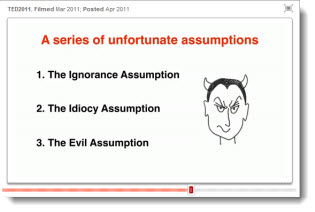
You should find 17 minutes to watch this TED talk by Kathryn Schulz, “wrongologist,” author of the book Being Wrong, in this TED talk called On Being Wrong.

We know, intellectually, that we’re sometimes wrong. Of course we make mistakes. But when we’re wrong, while we’re wrong, we don’t know it. She says:

It does feel like something to be wrong. It feels like being right. I call this error blindness.

We’re taught, she says, that getting something wrong means there’s something wrong with us. We’re conditioned.

http://video.ted.com/assets/player/swf/EmbedPlayer.swf

But here’s a real problem:

Trusting too much in the feeling of being on the correct side of anything can be very dangerous. This internal sense of rightness that we all experience and feel so often is not a reliable guide to what is actually going on in the external world.  And when we act like it is, when we stop entertaining the possibility that we could be wrong …. this is a huge practical problem, but it’s also a huge social problem.

So what do we think when someone disagrees with us?

  1. They are ignorant
  2. Or they are idiots
  3. Or they are evil

So our thinking we’re right causes all kinds of problems. It keeps us from preventing mistakes when we need to, and it helps us to treat each other terribly.  She suggests this one:

The miracle of your mind isn’t that you can see the world as it is; it’s that you can see the world as it isn’t.

This talk builds steadily upwards. I love her quote from St. Augustine: “I err, therefore I am.” And she talks about how being wrong leads to great ideas, art, stories, and, ultimately, being human.  We love being wrong in stories. And she comes to a very strong finish, that I won’t spoil here, but I will say, you should spend these 17 minutes.

And just in case you don’t see it here on the site, or if you’d rather watch it in a larger view, here’s the link back to the original: Kathryn Schulz: On being wrong | Video on TED.com.

This New Year’s Resolution is About Time

On this last working day of this year, staring 2011 in the face, I’m reminded: Time is the scarcest resource. Don’t waste it.

In the 1987 Wall Street movie, as they board his private jet, Gordon Gekko tells Bud Fox:

Real wealth is not having to waste time.

Meanwhile, somebody suggested to me that we can all tell our real priorities by tracking how we spend our free time.

Sure, like you probably do too, I spend most of my time getting work done, sleeping, eating, traveling, and so on (no Gordon-Gekko-like wealth for me). But how much of my free time do I spend on the people and pursuits I value most? How would my downtime like television compare to time for relationships, or exercise, or writing, or reading? How would that look for you?

But that line of thought gets ugly fast.  Let’s move on.

And do you allow enough time for settling things? Do you get enough silent time to hear yourself think? How much time are you alone without the txt, email, music, video, or web? How much time are you alone with people you care about?

So what’s my resolution? I’m working on it. Give me some time.  

Can You Pick the Entrepreneurs From the Crowd?

It’s almost two years now since I had a go at listing traits of entrepreneurs. It started with somebody else’s 10 signs you’re probably an entrepreneur list and then I came up with my own list, a few days later, 10 Traits of Successful Entrepreneurs. winter scene

And even a couple of years later, I still like that list. As a holiday gesture*, I’m reproducing it here, on this post. This is my list from 23 months ago:

  1. There’s a lot of talk about P-words: passion, perseverance, and persistence. I mistrust all three. A lot of unsuccessful entrepreneurs have them just as much. You have to have some variation on these traits, but you can have all three and still fail. You and I both know people who never made it and never stopped trying. My favorite P-word in entrepreneurship is planning, but that’s just me. Stubbornness is good too, even without starting with P.
  2. I like empathy, as in understanding how other people think and feel about things. Empathy leads to understanding what the people you sell to want, what they need, how they think, and how to best reach them. It’s hard to imagine somebody building a company without being able to put themselves in the buyer’s state of mind.
  3. A sense of fairness. For dealing with vendors, customers, and employees.
  4. Transferable values. This is closely related to the sense of fairness. I just don’t see people building businesses without believing in what they’re doing.
  5. Willingness to work hard, shoulder to shoulder with other people. Cliche, but true: the harder I work, the luckier I get.
  6. Knowing what they don’t know. To me that’s much more important than what you do know.
  7. Listening carefully. Shutting up.
  8. Vision for what they can build. Imagining a happy future. Dreaming.
  9. Making mistakes. You have to deal with failure. Keep pitching.
  10. Jumping viewpoints, like from short- to long-term in an instant, mixing those viewpoints together. That’s like dribbling, keeping your eyes up while managing the ball at your feet.

That list also produced several very good comments. They add a lot.

Since then, I’ve been following these traits of entrepreneurs, watching the research, and the more I get into it, the more I doubt the whole idea. Sure, it’s fun to write about. But what makes us entrepreneurs is that we don’t fit molds. Regarding risk, leadership, passion, work-life balance, goals, and so many other things, the truth is we’re all over the personality trait map.

(* Holiday sounds like some kind of a gift from me to you, when it’s actually just revisiting some older posts, quite possibly because of LDMDD (Late December Motivation Disappearance Disorder — a phrase I first heard from Steve Woodruff on Twitter. So I’m admitting, the holiday gesture is self serving.)

(Image credit: Steve Weber/Shutterstock)

Thanksgiving: Gratitude is Good For Your Health

Today is the Thanksgiving holiday in the United States. It’s supposed to be about getting together and giving thanks.

My contribution to the Thanksgiving holiday is to recommend a Google search on the correlation between gratitude and health. It turns out that there are indications that being thankful is good for us all.

Of course that’s not just for today, the holiday. That’s all year.

And here’s my picture for the Holiday, courtesy of Shutterstock photos, by Inigo Cia. This is a view of Half Dome from Yosemite Valley.

What You Don’t Know About Second Life Can Hurt You

Recently I heard this called “the second life.” You might have heard the phrase “midlife crisis.” And you’re probably aware of baby boomers turning 60, and boomer entrepreneurship. Retirement? Golden years? Hooey.

Amazing fact: Humans have existed for a few million years, but it’s only in the last century or so that we have this second life. In 1900 the average life expectancy was 47 years, and only 1 in 25 people reached 60.

Think about it: most of us spend our first adulthood marking a living, pairing up, building careers, raising children, and having not a spare moment to think about anything but work, kids, problems, and getting by. We hope we’re developing and growing, but we don’t have a lot of time to reflect.

Then, in what seems afterwards to have been in a blink of an eye, you’re 50 something, and wondering what’s next. Maybe you buy into retirement, and the lure of the golden years, and maybe not. But when you reach 60 you still have a life expectancy of another 25 years or so. And that’s a lifetime. A second lifetime.

I don’t buy the golden years idea, sitting around, beaches and rocking chairs … normal people need something to do. And it has to be something they believe matters.

A couple of Saturdays ago I attended a seminar given by James Hollis, author and psychologist, during which he brought up his version of the second life. It was an interesting day. Hollis has done a lot of writing, analysis, speaking, and teaching about how we deal with the second life. This seminar was built around his latest book, what matters most.

I think I’ve been lucky. What I do now — this blog, twitter, several books, speaking, and teaching — seems as important to me as what I used to do. And I really like it. I posted earlier here Why I’ll Never Retire, and I’m sticking to it.

But what about you? What are you going to do with your second life?