Category Archives: Marketing

Sad Commentary on Spam and Direct Sales

A sad moment in my ‘Start Your Business’ class; or perhaps I should say a sad realization.

I asked the class who buys from spam emails, and who buys from those excruciatingly insulting and stupid voicemail messages they leave on your phone. The point is that somebody must buy from them, because otherwise they wouldn’t continue.

The answer came from a woman in class who’s been working with handicapped people. "Mentally handicapped people buy that way," she said, sadly. "They prey on the sick, the old, and the slow."

I guess that’s probably true. It would explain the mystery of it. 

Update: On-Demand Softwide Retail Growing in the UK

In January I visited with Daniel Doll-Steinberg of  Tribeka Ltd., an innovative UK software retailer with a new idea for the channel, and posted An Old New Channel for Software on this blog. I was impressed. I’ve been following software retail since 1993, and there certainly seems to be some room for change.

So here’s an update on that story. PC Retail Magazine says On demand will change UK retail.

On demand retail is set to explode in the UK over the next year according to a report by Screen Digest. It suggests that the DVD side of the industry will be worth $1 billion alone by the end of 2012.

The report comes out just months after On Demand opened its first concession in Border’s Oxford Street Store, while Tribeka COO Stephen Precious stated that the firm is aiming to have the increase in the number of stores operating its SoftWide technology into double figures before the end of this year.

“At the end of the year we’re hoping to have installations reaching into double-digits in the UK and Europe.” And it’s looking increasingly likely that it will succeed with Precious telling PC Retail that it is currently in negotiations with some of the biggest names in UK and European retail, with some expected to be rolled out before the end of summer.

It’s nice to see something solving real problems: a compromise between giving customers software to browse in person, in the store, but without requiring normal inventory handling. It really is “on demand” and I think it makes sense.

Reminder: Good Retailing Still Works

We were walking around Granada last week, enjoying some free time, waiting an hour or so for it to be supper time, when we came across a store selling beautifully wrapped and packaged and classified and marketed and displayed chocolates. Here’s an iPhone picture:

And I apologize, it’s not a great picture but it was a bit on the sly since the owner (I can’t image why) was nervous about this strange man taking pictures with his cellphone. I’m not adding name or address or much detail, out of respect for his wishes.

It was a reminder to me about how important design and presentation are in retail sales. You wanted to grab and hold the very well wrapped and categorized packages. The chocolates were segmented very well into types, styles, tastes, and, in a way that seemed to work very well, gift and occasion types.

Well done!

A Free Downloadable List of Marketing Tips

Thanks to Anita Campbell of Small Business Trends for this. She’s been working for a month or two, gathering tips first from experts and contributors (me included) and then collecting a lot more from readers.

It’s 33 pages of tips for marketing, including relationship marketing, marketing strategy, selling, messaging, online marketing and social media. 

It’s all been packaged up tidily into a document for you to save, give to clients, print, post on your website — use it however you wish.  It is free of charge, of course.

100 Marketing Secrets – Download Your Copy | Small Business Trends

Book Titles, Irony, Mirror on Mirror

She’s right. It is ironic. I got an email over the weekend from Kelly Erikson of Maximum Customer Experience.

Did you get my comment in your "potential spam" filter a couple of days ago regarding the No A–holes Rule? Of course once you’ve hit submit it’s gone into the ether, and when it gave me an automated message that it had marked it I laughed and sent a follow-up saying how funny that in a discussion about spam filters a totally innocent comment on your article should get marked, but since it hasn’t been cleared by you, two days later, I was wondering if you’d checked for it.

No, I hadn’t seen it. I had seen her very brief comment about spam filters — that’s still there — but that’s all. She responded:

There was a real comment (you know, well-thought-out, adds to the conversation, etc….), which the auto-responder said it was "marking as spam" to have you look at later for moderation. So I assumed you have a spam box that you have to go through to find my comment. No?

No. I went back to check. The comments filter had cleaned it all out, left a record showing the name and time, but the comment text was empty. Disappointing. I was curious. Happily, Kelly filled in the blanks:

If not then it’s lost. The little comment was posted two seconds afterward, to giggle about the first comment having to wait to show up. I never thought the first one would get deleted without you getting a chance to check it, but if it says marked as spam for the author when what it means is deleted without consideration, then that’s ridiculous.

The funny thing about it, which I alluded to in my short comment, is that I never use rough language in business or in the Internet where everything lasts forever, so I used — for portions of the two words I did reference, obviously the title of the book you were discussing, which I had already looked through at the bookstore, decided I liked, but not enough to support the author’s use of the "look at me" title, and the title of Mark Stevens’ Your Marketing S–ks, which I own but keep in a paper cover on my bookshelf, so I won’t have to explain to my daughter why I own a book with language I don’t allow in the house on its cover (it’s essential, that’s why).

I used no rough language in my comment but it got "filtered" anyway. Too ironic.

So there we have it. I’m still very much in favor of a provocative title to go with a good book, which is the case here, but I also continue to have my doubts about a title that will get held back in programmed filters.

The silver lining is Kelly’s blog has some good stuff. For example, in Pain Points in Experience Design, subtitled Just Tell Me Where It Hurts…, she has a very practical list of starting-point questions to start the brainstorming for a pub looking to increase its business.

Technorati Tags: ,

An Old New Channel for Software

When I was a market researcher think-tank person, in the early 1980s, I predicted that bookstores would be a natural channel for software. Twenty-some years later, I was wrong and I’ve been wrong for decades. I hate that. But here’s a new twist, which might make me right (although still wrong, because 25 years later doesn’t really count. That’s along the lines of the dead clock being right twice a day.).

Imagine you’re browsing at Borders, the bookstore, or one of the competitors. Do you look for software? Would you, if software were there? How about browsing for software when you’re stuck in a long-connection limbo at an airport?

Did you ever see a software kiosk? They had them in the 80s in some early computer stores, and they tried them again in the 1990s. Our software was in an experiment with Kiosks in CompUSA at one point.

The idea was about having a large selection without taking up shelf space and clogging inventory. But it didn’t work. I think the problem was that people liked to browse the shelves, and see the packages. Pick up the package, look at it, take it to the counter, pay, take it home, install. Or so it seemed to go.

So I was intrigued to see a new variation on this idea, one which combines the browsing function with the rapid-inventory convenience, coming up in London. during my visit earlier this month I met with Daniel Doll-Steinberg and others at Tribeka Ltd, which is the inventor of this new software channel. It’s already in Heathrow airport, and will be up soon in Borders.

The idea is that lots of titles are on display, for browsing, in their smaller dvd-case sized packaging. You go to the counter and as you pay for your selections, the system in the background creates the master install disk. So the store can carry a very large selection, you get to browse, and you still go home — or onto your plane — with the software package in hand.

So you get to preserve the benefit of browsing and packaging, while also having the efficiency of instant inventory on demand.

There’s a new test going up soon in the Oxford Street London store of Borders. This one will be like a store within a store, offering software to Borders browsers in one of its larger, more well-trafficked stores. The Borders test location will offer 1,500 titles.

I think this is a very interesting new old idea, and I hope it works. As a software buyer, and user, I like it. As an occasional Borders browser, and someone who spends too much time in airports, I like it. As a software publisher, I like it even more.

No, Starbucks, Don’t Try to Please Everybody

Sometimes the best target marketing is understanding who isn’t your target market. To be strategic, you have to know when to say no. Which means Starbucks ought not to be worried about the people who buy coffee in McDonald’s instead. Know when, and to whom, to say no.

Consider this quote:

I don’t know the secret to success.  But I do know that the secret to failure is trying to please everybody.

In that context, consider this news item I picked up from the Entrepreneur Business Blog. Starbucks is testing coffee for $1 and free refills. According to the news item, they’re concerned about McDonald’s opening up coffee bars.

Ok, what? I use Starbucks a lot in my teaching and seminars, as a symbol of smart marketing that sells affordable luxury, not just coffee. Starbucks, I’ve been saying for a while now, understands the importance of price positioning. Starbucks, I’ve been saying, understands that their customers want a place to meet, an affordable luxury, a reliable and consistent high quality, and that their customers don’t want coffee in McDonald’s.

So now Starbucks is worried about cheap coffee in McDonald’s? Say it isn’t so. It was bad enough that they put their brand on coffee on airplanes that can’t possibly be really good because the logistics are so difficult. Now they’re taking away one of my more useful examples.

Hence, that quote above, which is one of my favorites. And also one of the all-time-great short blog posts, on Seth Godin’s Blog. The title is The more people you reach the more likely it is that you’re reaching the wrong people, and the whole text is “who vs. how many.”  Right on.

C’est La Vie. You Never Can Tell

The title line is from one of my favorite Chuck Berry songs (I hope he’s a relative, but I don’t know) (I like the Emmylou Harris version too):

C’est la vie say the old folks. It goes to show you never can tell.

So I’m doing the old folks line today. Here’s a local club that looks either dead or dying. I wonder, as I go by, what their story might be, with the darkened windows and apparently empty space. It was a brewery restaurant near our Palo Alto Software office for a few years, we lunched there often, but that died. Before that it was an auto dealership, but that died. Bad luck? Bad location? Bad management? It seemed like a good location with a hitch in parking, and it seemed like a good restaurant. Then, for several years now, it seemed like dead or dying.

Then I discover (thanks ‘Chelle) that it’s actually a very successful nightclub haunt. Cool, I guess; I like surprises. But it also means I’m not very good at guessing who’s doing okay. Take a look at the place:
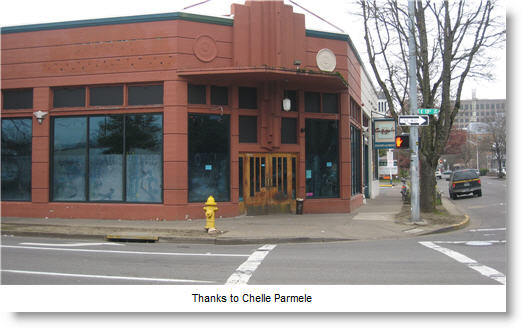
No signage, dark windows. Who’d think it was really hopping? I guess you can tell I don’t get out much at night. I thought it was always empty. But I discover that it’s successful and trendy. Last month the local Eugene Register Guard reported:

"Crowds are starting to understand the Indigo District’s new role in the music scene. Teenagers have gone there to bounce around to the frenetic hip-hop of Pigeon John or sit quietly in the corner to listen to David Bazan. The mix of fans is reminiscent of the WOW Hall, although the Indigo is not quite as crowded, at least not yet."

Okay, I stand corrected. Maybe anonymity during the day leads to success at night. I’ve posted recently on the importance of knowing who isn’t your target market. Maybe they needed to make it clear that I’m definitely not their target market.

Like I say, I like surprises. Do things your own way, be different, and you have the essence of strategy. Or, as I’ve written elsewhere, simply, strategy is focus. Consider this quote, from the Eugene Weekly:

[Owner Justin] Gibbs acknowledges that the legacy of the Indigo District involves a rather schizophrenic past. When the bar first opened its heavy, wooden doors, the menu advertised a business lunch, gourmet coffee and bar food served long into the night, well after the liquor stopped flowing.

"The new direction has refined the scope of what we’re trying to do," he explains. "When we first started, it was like ‘It’s a restaurant, it’s a bar, it’s a music venue, it’s an Internet café.’ We were going all day every day with just me managing. And as much as I loved being a restaurateur, it happened at the expense of doing music. That’s my primary passion."

So success involved more focus. Ironically, keeping me and people like me out of the loop probably helped. Quoting the Eugene Weekly again:

In the last year, the Indigo District has been keeping primarily evening hours, hosting music regularly, throwing raging dance parties and "doing a few things well," as Gibbs would say. After trying out so many types of business plans and suffering some low points, he and his staff are excited to settle into being "a music venue that serves food and drinks and does club nights."

"We had some growing pains in the last year. 2006 was an awkward point between being a new bar and an established bar. We had to adjust our vision."

This new vision will capitalize on what Gibbs refers to as the "cross-pollination between hip hop, rock and electronic" emerging in the independent music scene. He hopes that by bringing bands who blend the best of the best musically, the Indigo District will, by extension, provide the optimal nightlife experience for those committed to keeping the funk alive in Eugene.

Which is obviously working. What is it, stealth marketing? I go by there a lot, I read the local paper every day, but I hadn’t seen it. The target market, however, had seen it. C’est la vie.

Don’t Tell me Not to Buy, Tell Me Why

If you’re going to be bad-mouthing a vendor on your blog, tell me why. Otherwise it’s kind of insulting. Give me the details. Let me know what happened.

I’m curious. And besides, we all get a gossipy pleasure in hearing what they did to you.

But the title of this post was "don’t buy from [so-and-so, computer company]" and the total post was "one word: nightmare."

Just "one word: nightmare" doesn’t empower me, the reader, at all. It makes me a tool, an accomplice in a threat. I can’t help imagining the exchange: "If you don’t give me this, or do that, I’m going to write about it on my blog."

Let me be the judge. Tell me what happened.

Note: I’m leaving the details out, not referring to the actual blog, because I’ve had no contact with the vendor in question and don’t want to leverage the negative.

5 Ways to Generate Healthy Change

In a thoughtful post on Duct Tape Marketing today, John Jantsch offers an answer to an important question: "How do I grow my business?" He titles that "The Ultimate Secret to Business Growth."

I talk to business owners every day that want to take their businesses to the next level, but are puzzled as to why its so hard. They push and work and expand and contract only to find themselves right back where they found themselves last year.

This leads him to recommend change.

Change is the ultimate secret to business growth. Actually change isn’t that hard, but we seem wired to find ways to make it so.

It is sort of a paradox in business too. To get to some level of growth, you’ve got to be consistent long enough to develop some positive brand awareness, to move past that level, you’ve got to change what got you there.

The first change that may be necessary for growth is to start looking at change as a positive element of your success.

Which takes him to a list of five recommendations:

    1. Get Uncomfortable on Purpose! – Your wealth, your success, will correspond directly with the size of your mindset. Get in front of an audience and speak, write for an industry publication, start blogging, network with prospects, write personal thank you notes.
    2. Get and Give New Skills – Read everything you put your hands on. Become known in your industry for some specific expertise and show others how to do it. Teaching something is the fastest way to get better at it yourself.
    3. Get Bigger Ideas – Tear your products and services apart. Look for ways to approach an industry problem like no one else can or will. Your ideas don’t have to really be that big as long as they are world altering. Come up with one idea this year that makes someone say you are nuts – and then go do it.
    4. Get Value – No matter what you offer, it can be better. Heap more and more on your products and services, give stuff that no one expected you to give. Add services over and above what was agreed upon. Force people to talk about how incredible you are.
    5. Get What You’re Worth – If you do any of the steps above, you will be more able to do this. Raise your prices. Choose to work with fewer clients at much higher rates. Sell based on value, not on time.

He finishes that piece with a question: "How do you systematically embrace change?"