Category Archives: Marketing

Freedom Cheddar

I like this label. My wife bought this cheese yesterday at the local farmer’s market that runs on Tuesdays in the summer. I apologize for the quality — not the best scan — and in case you can’t read it, the main text block on the label reads:

"Freedom from hunger & thirst, freedom from discomfort, freedom from fear & distress, freedom from pain, injury & disease, freedom to express normal behavior."

Not bad for a piece of cheese, no?

Reading Consumer Reviews

I’ve taken to reading reviews more than ever lately, trusting the wisdom of crowds and all. I’ve had to buy more electronic stuff (had to? No, wait a minute, that’s got to, in my case, I love it) so I’ve done the standard treks through amazon.com, cnet.com, and the main computer stuff review sites.

I’ve been seeing two kinds of standard, identifiable, non-objective reviews that would seem to throw the standard tools (how many stars in amazon.com, for example) off. Watch for these red-flag reviews that skew the database: 

  • The vendor or the vendor’s best friend. Short reviews with very little detail and very high grades or stars are often submitted by company employees or friends. You can usually spot them. Look for repeated key phrases, tag lines, and marketing text. They obviously mean less than real consumer reviews. 
  • The revenge review. The company wouldn’t give a free upgrade to an old version, or the product didn’t work with a 10-year-old computer, or it was out of warranty, or somebody having a bad day argued with somebody. You can spot these too, because they’re usually about some incident, with lots of detail about the incident, and very little about the actual product that is supposed to be reviewed.

It seems like I’m having to read past the summary, and look at the specific reviews, reading details, to be able to reach some conclusions. Too bad, I think, because we should be able to throw out some of the obvious ones and then look at the star summary of the rest.

Exclusivity – Love it or Leave It!

Exclusivity. Don’t you love it? You tell everyone you know, and then — damn — it’s not so exclusive any more.

I got invited today to be a member of the BNET Global Knowledge business Professional Advisory Panel, which sounded really good in the email subject line. I like BNET. Which reminds me, I don’t think I’ve mentioned that site on this blog yet, but I should have. It’s related to the Harvard Business School and is generally a great resource with interesting articles.

Which is all cool, and to be invited to join the advisory council … except … oops! The email was addressed to “Dear BNET reader.” Pop, there goes the old ego. Never mind.

It’s a lot like getting an invitation to join who’s who addressed to “Dear Occupant.”

Earlier this year I was invited to join the Forbes.com business blogger network (you can see the icon on the sidebar) and that made me really happy until I clicked on the link (try it if you’re curious) to discover that Forbes.com is advertising for bloggers to be included. Goodbye exclusivity.

Seth Godin had a good post on that same subject, unfortunately also ego deflating, but spot on. Catchers and throwers, from a couple of months ago.

I had an interesting interaction along these lines this week. A woman named Jennifer Rosini at Forbes sent a note that read:

Hi ,

You are invited to join the new community of the high quality business and financial bloggers from Forbes.com. Our community – the Business and Financial Blog Network, will launch shortly.

I wrote her back, pointing out that she hadn’t even bothered to pretend it was a personal note… just a mail merge missing my name.

Come on, people, flatter me. That works much better.

“I sent the club a wire stating: Please accept my resignation. I don’t want to belong to any club that will accept me as a member.” —Groucho Marx

Brands: Like It Or Not

For Bud Light, it’s beer, cheap, cheap beer, and crap and drunk and football and others. For Apple, it’s design, cool, ipod, mac, and others. For Exxon, evil, gas, oil, spill, valdez, with some additional disaster, and spill, and so on. These are word associations, by the public. 

This is at brand tags, a database-driven routine of tags for words people associate with major brands. I heard about it from Sabrina at MommyCEO, who picked it up from Seth Godin.

For example, see what comes up with McDonalds. It’s a cloud tag, meaning that the more often a word is used, the bigger it appears. I started clicking around.

What a great illustration of branding, the way certain words, and ideas and images associated with words, stick with a brand.  Like it or not.

The Blue Sail

We were in one of those tourist markets. You know the type: handicrafts, souvenirs, blankets, and small-scale art. They have them everywhere, or at least wherever tourists gather.

We were browsing, killing time, when a man came up to us, interrupting nothing, and offered us a card with an address to a restaurant.

"It’s better than the Blue Sail," he said. We took the card, and he disappeared. We had never heard of the Blue Sail.

Twenty minutes later, another guy came up to us, plugging a different restaurant, but, according to what he said, this one too was "better than the Blue Sail."

That happened one more time over the course of the afternoon. Another restaurant better than the Blue Sail.

Conclusion: you guessed it. Although we had never heard of it before, we went for dinner that night at the Blue Sail.

Insight: Software Alone Won’t Do It

Consider this:

In my experience, it’s not the lack of software that causes frustration for small business owners, rather the frustration stems from the over-abundance of software and features available.

That’s Bill Brelsford over at Small Business Marketing Tips & Strategies in his post last week, Software Alone Won’t Cure Your Marketing Blues. Bill looks at a list of marketing frustrations cited by small business in a survey published at Inside CRM.

  1. Too difficult to follow up with cold, warm and lukewarm leads consistently and efficiently 
  2. Can’t properly track and manage prospects and customers 
  3. Need to integrate online and offline marketing efforts 
  4. Poor email deliverability 
  5. Too much manual grunt work in the sales and marketing process, no automation 
  6. Can’t track sales activity 
  7. Lack of centralization, too many different programs and systems 
  8. Too costly to maintain servers and IT staff 
  9. Too difficult to manually manage multichannel campaigns 
  10. One-dimensional marketing

Reviewing that list, Bill points out that process and strategy should come first, before the software. Items 1,2 and 6 on that list are issues of procedure, and discipline, not tools.

They can easily be handled with a Big Chief Tablet, a #2 pencil, and a consistently executed process.

Then there are the items that a software vendor would add to the list, and finally, Bill concludes:

I don’t want to sound like I’m anti-software, far from it. I have just found that a great source of frustration comes from purchasing marketing automation tools before there is a marketing plan or processes to automate. As I mentioned in this previous post, I think the right approach is to have a process first, and then pick the right tools to help you automate that processes.

Well said. And I think that same logic applies to other tools in business, not just marketing automation.

Politics, Advertising, Magic

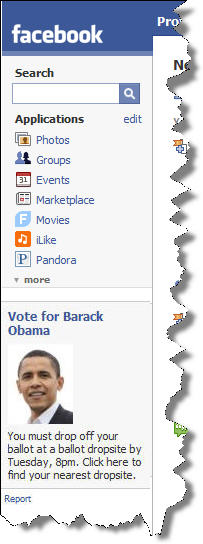
As I start my rainy Western Oregon day today, cup of coffee in hand, I checked Facebook — not my normal behavior, but one of my daughters mentioned she’d commented on a picture I posted — and there was Barack Obama on the front page.

Today is our deadline, in Oregon, for voting. We all vote by mail. Today at 8 pm is our deadline. Most of us have already dropped the ballot in the mail. I tossed my ballot into the downtown drop box yesterday evening.

To me that’s another reminder of how cool the Web is, how much we can target our ads if we’re really doing it right. For those of you who grew up with the Internet, you have to realize that just a couple decades ago advertising was like fishing. We had to choose the medium, make the ad, and then hope. Like throwing a line in the water. And we rarely got to know. The waters were murky.

Contrast that with this ad. First, it knows I’m in Oregon. Second, it knows today is our deadline. Third, it knows I’m likely to vote for Barack because I’ve identified my politics (part of the Facebook profile).

Living in the times we do, we suffer the down side of it all, the war, global warming, tough times. At least we should occasionally step back and enjoy the magic of it too. And this, the ability to tailor an ad that exactly to the audience, is magic.

Customer Service

It’s hard to write about customer service. Most of the blog posts I see talk about what it isn’t, not what it is. Most of my posts on the topic are bad examples. Negative examples are more fun. And easier to come by.

Paul Brown’s Toolkit column, a regular in The New York Times’ Small Business webpage, focuses on For Customer Service this week.

This one caught my attention this morning because it actually includes, of all outrageous things, a definition of what customer service is:

Writing on sbinfocanada.about.com, which offers resources for small-business owners, Doug Howardell of ACA Group, an alliance of consultants, says his group defines customer service as “the ability of an organization to constantly and consistently give the customer what they want and need.”

He also cites some additional positive suggestions from allbusiness.com about how to do it.

Why Didn’t I Think of It Award for Retail Packaging

Great packaging. My wife Vange picked this up at the local health foods store, and showed it to me yesterday. I don’t know what’s in it, or how good it feels, or whether or not it works; but I don’t care. The product name, the jar, and the label made me like it.

The Jar The Label

I’ve been dealing with retail marketing for 15 years now. I’m amazed how much of the marketing boils down to the package itself. In software, it’s the box. Things you might not think of, like how much it weighs, make a big difference. Every nuance matters. For many smaller companies, their main message is the package itself.

For more on this one, here’s the website:

Little Moon Essentials – Soak Your Tired Old Ass!