Category Archives: Business Mistakes

Build Yourself a Compatible Goals Filter

Suggestion: on any kind of business relationship, take a step back, open your eyes, and look for compatible goals.

For example, one variety of hell is a startup with founders and investors having different goals. Differences on how to achieve goals are hard enough. You can talk out those differences. But when investors want one thing, and founders something else entirely, there’s trouble brewing. Companies can aim for growth, profits, or cash flow independence. Everybody involved should agree.

Use the framework of compatible goals to look at small business team members and compensation. That can be as simple as targets for gross margin (price less direct cost) instead of just sales. Years ago I hired an honest, ambitious, hard-working salesman with a compensation package tied to sales. He hit the sales targets by pricing deals so close to below cost that we didn’t have enough money to cover overhead. That was my fault, not his.

Use creative compensation schemes and bonuses. How can you make the goals of the customer service people compatible with the overall company goals? What do you do about targets, metrics, and bonuses? What about product development, as in programming? Editing? The more thought to compatible goals, the more likely to succeed.

You should also use the framework of compatible goals to look at business alliances. Do you want the same thing as those people from the other company? Can you both find a win? Are your goals for this deal compatible with theirs? Asking deeper questions about goals can lead to better, more useful negotiations.
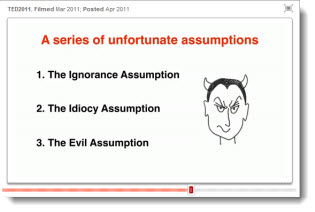
Big Problem: We Don’t Know We’re Wrong Until Later

You should find 17 minutes to watch this TED talk by Kathryn Schulz, “wrongologist,” author of the book Being Wrong, in this TED talk called On Being Wrong.

We know, intellectually, that we’re sometimes wrong. Of course we make mistakes. But when we’re wrong, while we’re wrong, we don’t know it. She says:

It does feel like something to be wrong. It feels like being right. I call this error blindness.

We’re taught, she says, that getting something wrong means there’s something wrong with us. We’re conditioned.

http://video.ted.com/assets/player/swf/EmbedPlayer.swf

But here’s a real problem:

Trusting too much in the feeling of being on the correct side of anything can be very dangerous. This internal sense of rightness that we all experience and feel so often is not a reliable guide to what is actually going on in the external world.  And when we act like it is, when we stop entertaining the possibility that we could be wrong …. this is a huge practical problem, but it’s also a huge social problem.

So what do we think when someone disagrees with us?

  1. They are ignorant
  2. Or they are idiots
  3. Or they are evil

So our thinking we’re right causes all kinds of problems. It keeps us from preventing mistakes when we need to, and it helps us to treat each other terribly.  She suggests this one:

The miracle of your mind isn’t that you can see the world as it is; it’s that you can see the world as it isn’t.

This talk builds steadily upwards. I love her quote from St. Augustine: “I err, therefore I am.” And she talks about how being wrong leads to great ideas, art, stories, and, ultimately, being human.  We love being wrong in stories. And she comes to a very strong finish, that I won’t spoil here, but I will say, you should spend these 17 minutes.

And just in case you don’t see it here on the site, or if you’d rather watch it in a larger view, here’s the link back to the original: Kathryn Schulz: On being wrong | Video on TED.com.

Pitching Your Business: How Not to Answer A Tough Question

Imagine a meeting room in a hotel. You’re an entrepreneur talking to five potential investors. You present their new business with a slide presentation. This is your pitch.

The pitch goes perfectly well until it gets to the financial projections. They’re bad.  They are embarrassingly over optimistic. They cast doubt over the entire presentation.

So, when the investors question the financials, how do you respond?

The wrong answer: blame the financials on the outsider who did them. Take no ownership and no responsibility. Do you realize how bad this makes you look?

The right answer:  Acknowledge the problem and ask for as much information as the investors are willing to give you about what’s wrong with them. Promise a thorough revision as quickly as possible. If you can – use good judgment, this might not be appropriate – suggest that unrealistic financials are a lot easier to fix than poor product-market fit or a less-than-stellar management team.

Isn’t it obvious why one is better than the other?

(Image: istockphoto.com)

Better a Shattered Dream Than a Lived Nightmare

This past Saturday I was talking about business planning to a group of Oregon food business entrepreneurs when one of them asked: shattered dreams

But what if you do the business plan so well that it shatters your dream? What if you need more money than you can get? What if it just isn’t going to work?

First, rethink the plan. If it’s a good plan but takes more resources than you can muster, see if there’s a smaller piece of it you can do. Consider how you might team up to get more resources. Maybe you can’t do the full restaurant downtown, but you could get part of the way with a less-capital-intensive catering business. Look sideways to related areas. Maybe you can’t create an electric car all by yourself, but you can become a dealer.

And then, if it really isn’t going to work, if you can’t revise the plan smaller, or team up, drop it and be glad you did. The heartache of giving up the dream is nothing compared to the heartache of losing your job, your house, or your lifelong relationship over it. Thank God you figured that out in time.

Better a shattered dream than a lived nightmare.

(Image: AiMvBaEnR/Shutterstock)

Do You Trip on the Tools in Your Own Business?

Think of the quick comedy scene where a guy steps on a rake and bonks himself in the face with a handle.  rake accidentGot it? Now ask yourself whether or not you’re bonking yourself with the tech tools in your own business.

For example, do you switch your to-do list software instead of working the list? I do it too. Instead of solving our real problem, which is time management and prioritizing tasks, we get halfway there and change tools.

I’ve done it for decades now. I jump from browser to browser, then fuss with the add-ons. I change my email client software, and re-do the folder  instead of answering emails. I go from one blogging solution to another. I change the photo organization software instead of organizing my photos. I’ve even changed the word processing software I was using to fool myself into believing I’d get more done with the new one.

Do you do it? I see it all the time with other people. We’re lying to ourselves, playing with new toys instead of bearing down and making our own systems work. The real problem is discipline and consistency, and instead of solving that, we do just the opposite. We change the tools.

I woke up today with this on my mind because I’ve been preparing for this evening’s Dumb Ways Smart Entrepreneurs Fail in Using Technology, a free webinar for Ramon Ray and his Small Business Technology series.  You can register any time before it starts, 5 pm PDT, 8 pm EDT, later today.

(Image: bigstockphoto.com)

7 Ways The Nice-Person Boss is Bad for Business

So why is being too nice a business problem? What’s wrong with that, specifically?

Yesterday Jill Geisler offered this list of problems on the Poynter Institute’s website:

  1. Your ideas get overshadowed by others in the organization who are more assertive about making their cases.
  2. Workplace problems fester as you postpone dealing with them.
  3. Mediocrity flourishes as you hold back from challenging underperformers.
  4. Needed change is delayed as you hesitate to nudge people out of their comfort zones.
  5. You do other peoples’ work when they complain about schedules, shifts or duties.
  6. Bullies and bigmouths win.
  7. You can lose respect — from your bosses, other managers, your staff — or all of them.

I wish I’d had this list last Fall when I posted Nice People Can be Bad Bosses Too on this blog. I wrote then:

I think I did this wrong myself. I think I let being a supposed nice guy interfere with my managing a company. You can’t be liked by all and also optimize performance. Sure, some people work best when left alone and encouraged, but – hard, ugly truth – others lose interest and grow entitled. Good bosses deliver both positive and negative feedback. Good bosses make the company better. Whether they’re liked or not.

Jill said that better than I did, with her list.

10 Ways to Improve Team Management and Grow a Business

I’ve been traveling a bit, which means time for reflection on long plane flights. I’ve also been talking and thinking about management, what it takes to make a small business grow larger, and what it takes to manage teams better. Here’s a list I wrote up in off moments.

  1. Find people smarter than you are, hire them, and let them run. It’s no coincidence I put this first. You need ideas, interaction, a vibrant, creative environment. If you’re always the smartest person in the room you’re probably delusional, and quite possibly the dumbest.
  2. Develop ownership inside the team. By ownership I mean being really in charge of something, so you care about whether it works or doesn’t. If you’re key team members don’t swell with pride when things go well and dig in deep to change things when things go poorly, you’re screwed. Do they wait for your lead on everything? Then they don’t own anything, and nothing good is going to happen.
  3. Embrace mistakes and educated guessing. People afraid of making mistakes can’t operate. If they don’t acknowledge bad results, and don’t care, get rid of them. If they do acknowledge bad results and they bear down to solve problems and do better, make sure they know that you know that. You want people to guess and keep trying. Good decisions have bad outcomes sometimes.
  4. Improve customers’ lives. Don’t just keep shouting the same old stuff. Find something your team can do that’s good for your customers. Make your customers’ lives better. Do that on your own terms of course, within your own business area.
  5. Rally the team around the ideas. People will work for something they believe is worth doing because it makes the world better. Believe that, live that, and other people will join you. It’s not about sales growth and profits unless you own the company and plan to sell it. Until then, it’s about doing something that matters.
  6. Develop a SWOT analysis. It’s pretty simple. Get the team together and do bullet points for strengths, weaknesses, opportunities, and threats. Strengths and weaknesses are internal, opportunities and threats are external. It gets people thinking about strategy.
  7. Focus the business sharper. You’re probably trying to do too much, too broadly, for a way-too-generalized type of customer. Focus your vision. Bear down hard on something your business can do really well.
  8. Know the core customer story down to your bones. Your business is a story about doing something people need and want, and doing it better. It’s about helping people. Invent a best-case customer and make her a story in detail. Maybe it’s real, maybe it’s fiction, but it has to feel so real you could script an all-day conversation.
  9. Find numbers for everybody and live them and own them. Not just dollars in sales or costs or expenses; find the real numbers your team members can live with, take pride in, improve, and (point 2 above) own. That might be page views, clicks, links in, meals served, trips, engagements, conversion, calls, presentations, whatever. Give everybody numbers. Make an environment in which people care about their numbers, check them daily, hurt when they’re bad, feel good when they’re good.
  10. Plan, step, look, listen, plan, step, and so it goes. It’s a planning process, not just a plan. Start with SWOT, focus on strategy, list assumptions, develop the numbers, and then track, review, revise, and plan again. That’s what we call management.

(Image: istockphoto.com)

The Secret to Micro Managing Is …

… questioning decisions after they’ve been made. That’s commonly called second guessing. Also, using hindsight. It’s about “shouldofs and “wouldofs.”

When you second guess decisions you’ve delegated to somebody else, they won’t make decisions for you again. They’ll ask you. They’ll ask you every detail. And you’re doomed to micromanagement. And it’s your own damn fault.

Do you want to be a manager? Do you want to delegate? Do you want to lead? If so, once you’ve entrusted something to somebody else, you accept the results. If they decided wrong, you either accept that you might have decided wrong too, or perhaps they got bad results from good decisions, and you support them, or never delegate to them again, or fire them.

It’s up to you. And think about this: if you’re the boss and nobody ever makes decisions, they all ask you every frustrating detail, it’s probably not all of them. It’s you.

Do You Do This At Meetings? I Hope Not.

It’s been such a delight these last four years since I focused on blogging and escaped from most of the business meetings. I openly confess. I don’t like meetings. Sure, there’s the rare exception, when a group of like-minded people discuss interesting ideas. I’ve been in meetings where people are excited, ideas bouncing about, lively discussions, brainstorming, and that’s great. hippo

But it’s so damn rare.

One of my dear mother’s favorite expressions was “if the shoe fits, put it on.” Just writing that makes me miss her. See if you fit either of these descriptions.

The runaway train

You don’t see it as easily when it’s you, but if you watch for it, you’ll see it all the time. One person is introducing a thought, gets a few words or a sentence into it, and pauses. Then another person — the runaway train person — seizes the pause and starts talking.

Lots of people pause when they talk. There are good reasons to pause. But when the runaway train comes roaring in and takes the conversation over, the group never gets the wisdom of the person who talks slowly.

It’s worse when you’re the boss. People don’t complain about the boss interrupting. Right. And, gulp, I was the boss for a lot of years. Oh-oh.

The drone

Then there is the person who goes on and on and on and on and on and … you get the idea. Interrupting is rude, so you sit there, and when at last, after what seems like forever, the whole monologue seems to be winding down, then you hear, to your horror and the horror of everyone else in the meeting:

In other words…

Which means the whole thing is going to start up again.

It’s worse when you’re the boss. People don’t complain about the boss going on and on, right? And, gulp, I was the boss for a lot of years. Oh-oh.

Conclusion: pots and kettles

I know, it’s pots and kettles. I’ve done both of them, and I hate both of them. Don’t think for a minute, because I’m writing about this, that I think I don’t. At best, I try not to. When I think about it.

But I do hope this reminder will help you do better at your meetings. Do you have some suggestions? The talking stick, something like that? Something you’ve done to make meetings better, to avoid these two problems? I’d love some suggestions. And, if it helps, print this out and post it on a bulletin board, or in the conference room. Make it a gentle reminder to all.

Endorse Me, You Gypsy Savage, Endorse Me!

On the one hand, who likes big government? The FTC, Federal Trade Commission, sounds like the feds. Gear up your paranoia. On the other hand, who likes fake endorsements? And then — can I borrow your hand to make the third hand, please — wow! How can we resist highlighting this:

theifOn Monday the FTC published a bulletin with the catchy title: Firm to Pay FTC $250,000 to Settle Charges That It Used Misleading Online “Consumer” and “Independent” Reviews. Here’s a summary, direct quote from that document:

The Learn and Master Guitar program promoted by Legacy Learning and Smith is sold as a way to learn the guitar at home using DVDs and written materials.  According to the FTC’s complaint, Legacy Learning advertised using an online affiliate program, through which it recruited ‘Review Ad’ affiliates to promote its courses through endorsements in articles, blog posts, and other online editorial material, with the endorsements appearing close to hyperlinks to Legacy’s website.  Affiliates received in exchange for substantial commissions on the sale of each product resulting from referrals.

I’m glad they got them. Fake endorsements are dishonest, they dilute real endorsements, they pollute the Web, and they tarnish the wisdom of the crowd. So hooray for the FTC, catching the spoilers who make it worse for everyone else. Get those evil-doers.

But then, wait, what was that? This is a more direct quote from the same document:

According to the FTC, such endorsements generated more than $5 million in sales of Legacy’s courses.

Now that worries me. I can subtract $250,000 from $5 million in my head, without needing an accountant or even a calculator. It comes to $4.75 million. What’s wrong with this picture?

My thanks to Anita Campbell who pointed on Twitter to Geno Prussakov’s blog post on this.

(Image: Oleg Golovnev/Shutterstock)