Category Archives: Current Affairs

Why Not Grant Visas To Promote Startups in the US?

Vivek Wadhwa’s column on the Washington Post site is titled America’s Irrational Immigration Fear. He goes into the background about visas for entrepreneurs and technology innovators, and some of the problems involved. It’s good background information, based on a July 18 report from the Brookings Institution. Here’s a summary of the findings:

Report authors, Neil Ruiz, Jill Wilson, and Shyamali Choudhury, concluded that the government could be stifling innovation by limiting H-1B visas and not taking into account local demand for highly-skilled workers. Demand for these visas has far exceeded supply nearly every year for the last decade. Additionally, the government has been indirectly taxing U.S. R&D and innovation by imposing hefty visa fees, which range from $1,575 to $4,325 depending on employer size — plus $1,225 for expedited (read: timely) processing, according to the report.

The short video here (Vivek in the middle) talks specifically about the H1-B visa, but the high point is Vivek suggesting we should have a “startup visa” that allows entrepreneurs to come into the country. I second that motion. 

http://c.brightcove.com/services/viewer/federated_f9?isVid=1&isUI=1

(In case you don’t see the video, click here for the source)

The Best Country in the World

On July 4 we celebrate Independence Day in the U.S. I like the sentiment expressed in this HBO series, from about the third to the eighth minute 3 (3:23 to 8:00). And please stay with it through the positive portion, after the rant, beginning at 6:44). This is from a new HBO series called The Newsroom, which was first broadcast June 25. It’s written by Aaron Sorkin, who also did West Wing and Studio 60, shows I consider thoughtful as well as entertaining. I loved the first episode, and so did most critics; but in respect of full disclosure, some complained that it was too much Aaron Sorkin diatribe.

http://www.hbo.com/bin/hboPlayerV2.swf?vid=1265865

By the way, I’m intrigued by what HBO is doing with the video here. It isn’t stolen. I got it off the HBO website which offered the embed code free, meaning that you are welcome to watch the full episode here or on a lot of other sites (I assume) that chose to embed it. That’s an interesting marketing/commercial decision, no?
Enhanced by Zemanta

Sheryl Sandberg Named To Facebook Board Of Directors (Finally!)

Consider this a quick update, something that was obvious from the beginning: my post Sheryl Sandberg Named To Facebook Board Of Directors (Finally!)

Yes, I agree. Finally. And I’m glad to say I was on that bandwagon with Facebook Needs At Least One Woman on Its Board, which I posted here and on the Huffington post last April. 

In case you weren’t aware of that bandwagon, Facebook went public with seven men — all very well qualified, all deserving, all men with a lot to offer, to be sure — on its board. But not one woman? In 2012?

I’m glad to see they’ve taken this step in the right direction. How can any highly visible company fail to find at least one woman in a seven-member board of directors? After all, the purpose of a board of directors, Wikipedia says, is to govern the organization, establish broad policies, review the CEO, and answer to stakeholders for the organization’s performance. That purpose isn’t better served with at least one woman in the seven-member board? I don’t believe that. Do you?

Congrats to Facebook, and it was about time. 

(Image courtesy of Women 2.0)

Be a Fly on the Wall as Wall Street Crumbles

I watched Too Big to Fail last night. It’s a 2011 made-for-HBO movie that makes a great drama taken (or so it seems) from actual events. I watched like a fly on the wall as then Treasury Secretary Henry Paulsen and others dealt with the financial meltdown of 2008. movie poster

The first reason I liked it was just plain drama. Entertainment value. Plot, suspense, people in crisis, real tension, frustrations, failures, and outcomes. It’s a reminder that there is real drama in politics, crisis, business, finance, and people making tough decisions that affect a lot of people. Even if all the action is in offices and conference rooms. It doesn’t take car chases and crime stories to make drama and suspense. Talking, just plain talking, can be extremely dramatic when real outcomes are at stake. 

The second reason I like it was that it rings true. It feels like watching  real history, closeup, behind closed doors, as it happened. I can’t say how accurate it is, but it has no trouble splicing in real news coverage of real events. It starts with the fall of Lehman Brothers, continues through the next few weeks, the negotiation of the big banking bailout. It’s a strong cast (James Woods, John Heard, William Hurt, Cynthia Nixon, Paul Giamatti, Kathy Baker, and a surprisingly long list of other stars). And they play real people (Paulsen, Timothy Geitner, Warren Buffet, Ben Bernanke, and CEOs of a dozen top financial institutions, among others). 

I checked it out on IMDB and the highlighted reviews don’t sound that great, but it has a 7.2 star rating, which is very high. 

(Image: courtesy of moviegoods.com, which sells posters)

Whoops! New PR, New World

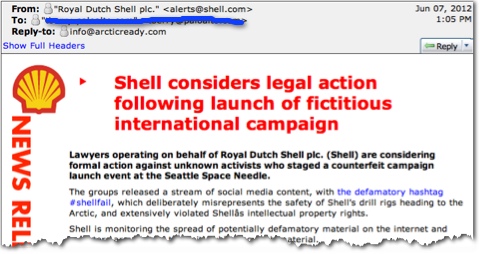
Oh dear. Those nasty activists. It looked at first like PR gone bad. me thinking it was dumb of Shell Oil to send a press release huffing and puffing about “activists” making fun of it. It looked like a press release. Curse you, activists! And like that. Shell is supposedly considering suing. The press release says: 

“These people have gone to great lengths to mislead the public about the age and reliability of our Arctic vessels, and otherwise damage Shell’s credibility,” said Smith. “Shell can obviously not allow this sort of misinformation to proliferate, and we are taking the firmest legal measures against the perpetrators of this campaign.”

It talks about an evil social media campaign using the hashtag #shellfail and other supposed sins. It also links to the offending website, arcticready.com.

So I went to visit the website, which is serious spoof. How clever of these “activists,” I thought, and how dumb of Shell Oil. And a nice spoof, even a collection of funny ads and a make-an-add game going on too. 

But there’s the rub. I went back to the press release to discover that the email with the supposed press release is also a spoof, by the same activists. So Shell’s not as dumb as this campaign makes it look. But, on the other hand, the campaign is smart, clever, and effective. Brave new world. 

Here’s a picture of the email press release supposedly from Shell Oil:

I can’t work up any sympathy at all for an oil company drilling in the arctic. But also, wow, these are very effective tactics. No? 

Memorial Day, Draft Lottery, Reality TV, Flags

I woke up yesterday in Portland (OR), in a condo near the top of W. Burnside. The area has a series of cemeteries, dark green rolling hills, breaking up the otherwise thick forested landscape. It had rained all night, so there was a thick mist cushioning the quiet hills. It was early Sunday of Memorial Day weekend, not a lot of cars around, very quiet. Through the mist I could see the U.S. flags dotting the graves on the hills. Random patterns. A lot of the graves have flags today.

Later in the day we drove by, commented on the flags. How many from this century, Afghanistan, Iraq? Hard to tell. They’d be so young, somebody said.

Whether they died in 1943, or 1969, or 2007, they were all so young.

Switch to reality television. 1969. The draft lottery. They put the 366 possible days of the year in transparent plastic eggs, one each for each possible birthday. The put them all into a giant transparent barrel like we see in lotteries these days. They spun the wheel. They drew a date. Those of us born on that date got a number.

My number was 243. I didn’t get drafted. I didn’t go to Vietnam.

By 1969, most of us opposed the Vietnam war. We talked about what we’d do if drafted. Al became a conscientious objector, emptied bedpans for two years. I was engaged to be married, but that was not going to get me out of the war. But a January birth date did.

It turned out later that somebody did a statistical analysis on the draft lottery and the dates. They started on January 1 and threw them in from there day-by-day to December 31. The later birthdays tended to be on top. Or so I read later.

But we didn’t oppose the people, our peers, who fought. Whether it was their choice, or not.

Few in my generation chose to go to war. One who did, who graduated with me from Notre Dame, chose ROTC. Traveling around Europe, he collected military paraphernalia. His father was in the army. His grandfather had been in the army. He volunteered to be a helicopter pilot, and he died in Vietnam. In his helicopter. We weren’t that close, I heard about it later. My memories of him are of a 20-year-old kid having a wonderful time during a year in college abroad, laughing, drinking Austrian beer, learning; as alive as any memory could be. What a terrible loss.

Memorial Day, patriotism, flags, wars. Protests, anti-war, opposition. Memorial Day isn’t about war, or politics, or patriotism, or whatever might be the opposite of patriotism. It’s definitely not about flags. It’s about young people who died, and the people left behind who loved them. And all the people who endured it, risked their lives, went through the hell of it, for whatever reasons.

I lucked out. I won the reality TV of the last half century, the 1969 draft lottery. And I thank God for that. And honor and respect the ones who went, for whatever reasons. And hope that we can end the present war without causing chaos, and more death and suffering; and that we never fight another war again.

Baby Boomer Entrepreneurs: Trick or Trend


Thanks to the Wall Street Journal’s 8 Monday Morning Must Reads I discovered USA Today’s Older entrepreneurs find new niche in startups. This doesn’t surprise me at all, but it was good to see it in print. The quick summary:

Over the past decade, the highest rate of entrepreneurial activity belongs to the 55 to 64 age group, according to a study by the Kauffman Foundation, a Kansas City, Mo.-based entrepreneurship institute. The 20 to 34 age bracket has the lowest rate. Kauffman’s latest study shows that about 23% of new entrepreneurs in 2010 were in the 55 to 64 age group, compared with 15% in 1996.

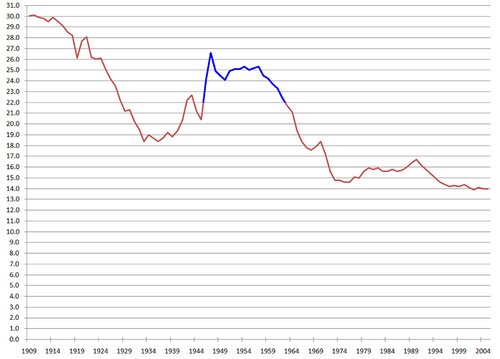
Much as I like these numbers, there’s a bit of a statistical ruse here. Basic demographics. there’s The trend may not be anything more than the influence of sheer numbers. Take a look at this chart:

US Birthrate

The line there is births per year, and the pop up in the line, the blue portion, is the baby boom years. The so-called baby boomers — me included — were born from 1946 to 1958. They are the blue portion of that birth rate line above. So in 1996 we were 50 to 38, and therefore not included in the 55-64 stats. In 2010, however, we were 64 to 52, right in the sweet spot of the statistics. So it might easily be that the pop in the stats isn’t a change in trends, but a reflection of higher numbers of people in the 55-64 age group.

On the other hand, I hope it’s not just statistical distortion. I’d like to think it’s a reflection of increasing longevity and a decline in the strength of the myth or retirement. I think retirement is a social tradition developed in the past for very old people; to a lot of the baby boomers, me included, it’s a nightmare. But careers change and life changes around the ages 55-65, as kids grow up and careers stagnate. And a 60-year-old competent person has another 20, 30 or more years of life expectancy. That’s a long time to sit in a rocking chair. For my part, I posted here just last week about me getting involved in new startups. And I’ve posted here before on how much I don’t want to retire, ever.

Furthermore, there’s a bit of a push and shove in these statistics. Try leaving a job and getting another when you’re 55 to 64. Good luck with that. So you build your own job. And more power to you.


(image: wikipedia)

Is The Very Idea of Designing Tech Products for Women Insulting?

(note: I posted this on the Huffington Post first, just about 10 minutes ago)

Maybe it’s because I’m father to four daughters, maybe because of simple fair play, but if you read my stuff I’ve been a chronic complainer about the relatively low numbers of women in high tech and tech in general. And I don’t believe it’s because the women like it that way, either. So why then does Don’t Be Afraid To Go Pink: Designing Great Tech Products For Women on TechCrunch today make me nervous?

My answer starts with a true story: in the late 1990s, at Palo Alto Software, we had a team brainstorming session to deal with the problem of under representation of women in among our Business Plan Pro users. The team at the time was half women, and for the record, our company is 49% women owned.pink tech

But that brainstorming session turned up nothing but bad ideas. Business planning is a great example of something that has no gender specificity. Most of the suggestions made were unintentionally insulting to women, as if being female means you plan your numbers less, or are more intuitive or less rigorous, which is a crock. Pink packaging? We did take it to heart with our packaging, putting the image of a happy female user all over the back of the box. But that was it. Business planning has no gender component.

The TechCrunch post has five suggestions, starting with don’t be afraid to go pink. Say what? Here’s how post authors Sarah Paiji and Sanby Lee explain that point:

We don’t mean that your product literally has to be pink. However, you shouldn’t be afraid to make a product that is only for women, and to signal this through your aesthetic and branding. For our mobile shopping app, we chose a name and color scheme that was decidedly feminine. We had men complain that they didn’t feel comfortable using the app, or posting in a community dominated by women. But that’s the point — we didn’t want men as our initial audience.

That bothers me. I think we have to make some logical distinctions here.

First, some products have gender specificity. Clothes, sporting goods, personal hygiene for example: of course they’re different for men or women.

Second, some content has gender specificity. Obviously some television programming, movies, magazines and other media have gender behaviors built into them.

So if you put these two assumptions together, then there’s absolutely nothing troublesome to me about gender-specific products where there are gender differences, and gender specific marketing that takes advantage of those differences, whether for gender-specific product or not, to focus market dollars more effectively. Sure, they advertise beer on football games and tampons on soap operas. So what?

But I really don’t like trying to build gender specifics into products that don’t have them. Very few tech products are inherently gender specific. Maybe the authors’ shopping app is, but if so, it’s one of a very few. And for the most part, trying to design tech for women ends up, well meaning or not, assuming women are dumber than men. Which is a dumb assumption.

Which I think we see in that post. After making that first point, the authors follow with 2.) resist feature overload, 3.) find the key influencers, and 4.) enable discovery. How are those factors gender specific? I’m a man, and I don’t want feature overload, I get influenced and I influence, and discover is good for me. How are those points women centric?

Then, finally, fifth of five: have women on your team. Doh! Of course! The work force is 50-50-ish, then so too should be every team on every company that isn’t doing gender-specific product. And I don’t mean by law, or forced by anybody; but rather, just common sense and a natural process over time.

(Image: istockphoto.com)


Was it Social Media That Defeated that Bad SOPA/PIPA Bill?

I was delighted to read Vivek Wadhwa’s take on Social media’s role in politics on the Washington Post:

vivek_on_wapo.jpg

To frame this battle properly, a loosely organized group of Internet leaders outwitted a well-funded lobbying organization. And they did so in grand style, convincing dozens of lawmakers to reverse their votes virtually overnight.

he goes on to liken this phenomenon to the voice of the people in Egypt and then the rest of the Middle East last Spring. But also something else altogether, this:

A sleeping giant — the technology world — finally rose. Google, Mozilla, Reddit, O’Reilly Radar, Wikipedia, and thousands of other Websites rose up to protest PIPA and SOPA.

I like the idea that the defeat of SOPA/PIPA are, like the political changes in the Middle East, due to changes in possibilities and the way people work together. I’d like to think that in this case technology is in a broad scope it’s like what happened a generation or so ago when Mahatma Gandhi, and a few years later Dr. Martin Luther King, changed the relationship between individuals and governments by establishing the power of the public non-violent protest. Isn’t that similar? Disenfranchised, silenced people discover a voice.

Was it social media that defeated SOPA/PIPA, or people suddenly getting annoyed and complaining?

Mine isn’t the greatest analogy, either: It works way better with the Arab Spring than with SOPA/PIPA, because in the first case it did seem like a collection of voiceless individuals; but in the second, that so-called sleeping giant was hardly voiceless. Just distracted, perhaps. Looking in the other direction, and then suddenly confronted with a threat.

Either way: hooray!

Thanksgiving: Gratitude is Good for Your Health

Today is the Thanksgiving holiday in the United States. It’s supposed to be about getting together and giving thanks.

My contribution to the Thanksgiving holiday is to recommend a Google search on the correlation between gratitude and health. It turns out that there are indications that being thankful is good for us all.

Of course that’s not just for today, the holiday. That’s all year.

And here’s my picture for the Holiday, courtesy of Shutterstock photos, by Inigo Cia. This is a view of Half Dome from Yosemite Valley.

(Note: I did this post last year, but it’s Thanksgiving morning, and I still like it, and it’s still appropriate.)