Category Archives: Angel investment

Finding Your Financing: Is Angel Investment Realistic?

I was talking to a group of determined entrepreneurs, a food business boot camp in Corvallis, Oregon, and finishing up on business plans when one of them asked me:

What do you recommend for getting angel investment?

I recommend that unless you have a good investment opportunity, you don’t waste your time. cash pile

What’s a good investment opportunity?

  1. First, it has to be something scalable, defensible, that can grow. That means it’s either a product business, or one of those web services that scale easily. Can you add sales without adding employees? That’s a good clue to scalability.
  2. Second, you need people on board with experience in startups. It’s tough if you’re just beginning, but investors worry about risk and nothing reduces risk like having some experience. If you haven’t been involved in a startup, it’s really almost impossible to get investors to take a chance on you. Look for partners or team members who’ve had some startup experience. Ironically, having failed with a startup isn’t always bad; failure is better than no experience at all.
  3. Third, you need a believable exit strategy. And you need to be able to convince investors you really want that. Investors don’t want just a small piece of a healthy growing business; they don’t make money unless that business wants to be sold in a few years, meaning it gets acquired by a larger company, and investors get to convert their ownership back into money.

The hard part, as a speaker talking to entrepreneurs, is entrepreneurs want encouragement. But then when I think of how much time and effort some people spend trying to get investment that’s never going to happen, I try to just tell the truth.

If You Can’t Get Funding, It’s You, Not Them

You can’t get your new business funded? Damn, that’s disappointing. But does it prove that the world is unfair? All those other people get funded and you don’t? Or that the world is stupid?

I don’t think so. I think what it proves is that you don’t have the deal right. Investors don’t want it. Advisers don’t think you’re ready. Fix it or forget it.

Investors don’t buy into your business out of fairness, respect for your idea, or because they know you and like you; they invest in your business because they believe the money they spend buying a piece of it today has a fair chance of becoming a lot more money later. Investment is about business, plain and simple. And it’s their money. They have every right to say no. They are not a public service.

Yesterday I posted A Seasoned Angel Investor Highlights These 4 Factors here. Factor number one is previous startup experience. And yes, there is a catch 22 problem:no experience means no funding, but without funding, how do you get the experience?

It’s a trick question. If you don’t have any previous startup experience, don’t blame the world, get some. Work with a startup. Get partners who have experience. Maybe scale down the plan. Bootstrap it.

If your plan can’t get funded, don’t blame everybody else. Change the plan.

A Seasoned Angel Investor Highlights These 4 Factors

This was interesting. The speaker, Wade Brooks, is executive director of the Willamette University MBA Angel Investment fund. A couple of nights ago as he shared notes and research with members of the Willamette Angel Conference. blocksThese are the top four things Wade and his group looks for in the companies his organization is considering for investment:

1. Entrepreneurial expertise

They want people who have been there, team leaders who have been through the experience of a startup. Wade says there’s no getting the kind of experience they need without going through it.

2. Affordable loss

Affordable loss is about planning, expense control and careful management.  “A little bit of money goes a long way,” he says, when a company is careful with it. If there were no loss, they wouldn’t need angel investment at all; but a big loss means trouble.

3. Early “yes” answers

Ideally, that means people are saying “yes” to sales, and signing contracts. That doesn’t always happen, but there can be yes answers to major allies, distribution channels, beta users, and so on. The best validator is early sales.

4. Milestones met

Wade talked about “a history of performance.” That’s a matter of setting goals and meeting them. He said the company that consistently exceeds its milestones is very rare, but very good to have. Sometimes his group will redo the projections on their own, come up with substitute numbers, and then, even if the substitute numbers are smaller, they still credit the company for making those lesser numbers, if they do.

Wade and his group work with Dr. Rob Wiltbank, who has one of if not the largest database in the world on return on angel investment. The program at Willamette University is impressive — MBA students, with the help of a lot of advice, guidance, and mentoring, are actively involved in making angel investment decisions. The group participates in several of the angel investment groups operating in Oregon, and makes multiple investments every year.

Case Study: Vizme, Adaptation, and Living with Facebook

I’ve been watching vizme.com since I first saw the demo about a year ago. It struck me as immediate coolness. Imagine being able to mix up a combination of online video and pictures that play when clicked, representing a topic, theme, idea, or brand; and putting that onto your blog or Facebook page as something like an icon (it’s actually bigger than an icon, but circular, as shown here) that plays when clicked.

To give you an idea, I went over to vizme.com and picked up a token for sharing. If you click the image here, a vizme token, it should take you to some person’s creative work patching together SuperBowl commercials from YouTube. In this case, it’s a lot like a YouTube playlist, but it’s a dark background and a much more direct, less cluttered, interface. I could share it on Facebook, Twitter, or, like here, on a website. And it’s free.

I’m interested in Vizme for several reasons: It’s in Eugene, OR, so it’s local to me. It entered the Willamette Angel Conference investment contest last year, and I’m a member there, so I got to watch the pitch. It didn’t win, but it did get my vote on the first ballot. I like Dan Mayhew, one of the three founders. I think it’s a cool idea, well implemented.

vizme logoPerhaps most important, though, is the principle of adaptation. While I’ve been watching, the vizme founders have gone up and down in sophistication of the interface as they went through early users and had to make changes. They’ve had to adapt to changes in the Facebook interface that (entirely by accident, without any bad intentions on Facebook’s part) changed the way the tokens work. And they’ve been scrambling for angel investment, testimonials, advisors, and interface adaptations to fit the changing face of social media. And their revenue model has been revised and adapted several times.

And, as a great example of what happens in the startup world, life goes on. Facebook changes, vizme adapts. Users work with it, suggest changes, and vizme adapts. Those changes affect the revenue model, and vizme adapts.

For a second opinion on that, you might read Will Vizme Revolutionize The Way We Share Content? over at FastGush.

Top 10 Business Plan Mistakes #8: Making Financing the Goal

Top 10 Logo

(Note: this is the third of a 10-part series listing my revised top 10 business planning mistakes. The list goes from 10, the least important, to 1, the most important.)

It’s just too damn bad that so many entrepreneurs assume to start a business you do a plan, get financed, and then you start. As if the goal of the plan is getting financed; and as if the getting financed is the win, regardless of financed how and by whom and on what terms.

And that’s a big mistake. You should choose investors as carefully as you choose a spouse.

Contrary to the myth, winning the investment isn’t always a win. Getting investment from the wrong people isn’t a win. It’s a recipe for disaster. Marrying your company with incompatible investors can turn a dream into a nightmare. And yet so often when you talk to entrepreneurs they seem to think that just getting that investment is the same as winning the race. Find somebody to say yes and you’ve succeeded.

Not all good businesses make good investments for outsiders. Investors need exits in 3-5 years, while lots of good businesses aim for forever, not just 3-5 years. And entrepreneurs often want independence, while investors usually feel like bosses. They are owners. Some of the best businesses are bootstrapped, meaning they don’t get outside investment. They use their own funds, or early sales, and they grow more slowly but without requiring other people’s money. And some successful businesses are financed by loans, which increases the risk, but doesn’t dilute ownership.

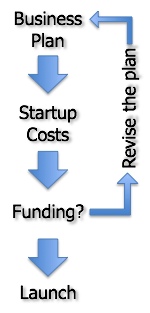
I say let the nature of the business, and the goals of the entrepreneur,  determine the financial strategy regarding investment. Some businesses simply can’t sprout without healthy amounts of outside investment. Others have no good reason to even think of investment. And most are in between, with investment a matter of what the owners ultimately want. And there is what I’ve called the Startup Sweet Spot, the natural right level of financing for the startup, based on what it actually needs to develop right, which may or may not require outside funding. As in the diagram here to the right, the plan estimates the ideal startup costs level, and if funding for that isn’t available, then you revise the plan.

The correct goal of the planning process is to help the entrepreneurs determine what their startup really requires, and to help them look at options for growth, so that they can decide whether or not they even have something that will interest investors. And, if they do, then also of course whether or not they want investment. Then, if the entrepreneurs decide they want or need investors, then the planning helps communicate the business to the investors, and that becomes a starting point to deciding whether or not the founders and the investors are compatible.

Our Angel Group Chooses to Invest in Healthy Natural Organic Intimacy Products

I fear you’d have to know the quirky nature of Eugene, Oregon, my home town, to understand how well the choice of our local angel investor group matches the area. Some people call Eugene “Berkeley North.” We have to have way more health foods stores, organic foods, and natural products per capita than any national average; and more Birkenstock, and more gray ponytails behind bald heads.

Good Clean LoveSo it’s not a complete surprise that the winner of the Willamette Angel Conference angel investment was Good Clean Love, offering all-natural intimacy products in a market that is dominated by petrochemical-based products. This is what people in this town call “Eugenian,” a natural product produced by a company built on values.

This company reminds me of Coconut Bliss, another local success story, which went from founding to successful exit in less than five years, built around the values of natural and organic and healthy. I posted the Coconut Bliss story on my other blog just a few weeks ago.

Good Clean Love won over an impressive field of startups. As one of the investors, I can tell you that the deliberations were very tough because we did in fact have several very strong companies to consider. If you’re curious, take a look at the conference recap here.

The choice may surprise you if you look at those other companies. But for me, the lesson here is being different, building around a story, credibility, and staying local. This is a good story of local investors believing in local companies.  And developing the local area without sacrificing investment potential.

(And that brings up an interesting conflict of interest point, since I’m one of the angel investors, that means I now have an investor interest in Good Clean Love. Just so you know.)

Big Mistake: Huge Unbelievable Sales Numbers

Jeffrey Moskovitz added an important comment to my big mistake post from last week:

I read an blog yesterday, written by someone I respect, who asserted that investors know and even EXPECT that projected sales and profits will be overstated. Aware of this expectation, the entrepreneur plays the game by inflating the numbers, fully aware that the investors will give the numbers a “haircut,” and everyone will be happy.

Jeffrey didn’t think so and I agree with Jeffrey. Emphatically agree. The idea that everybody winks at inflated numbers is a really bad idea.

My view on this hasn’t changed at all, even as years passed and I moved from entrepreneur seeking investment to angel investor reviewing business plans as part of an angel group. Here’s the way the process works, step by step:

1. Is the sales forecast believable?

Sales forecast credibility is a matter of several factors: understanding the market, size and structure of the market, selling process, channels, decision making, and so on. Granularity is really important, like the details of distribution, margins, buying points, actual names of potential buyers. Real sales already made, letters and testimonials from customers or distributors, are also important. Real Web forecasts, page views, conversion rates, and so on, are important.

If the sales forecast isn’t credible, then investors lose interest in the rest of the numbers in the plan. An unbelievable forecast voids profitability, cash flow, and supposed future valuation and investor return. The process stops.

It is true that a dumb forecast doesn’t necessarily kill potential investment. If there’s good product-market fit, scalability, defensibility, growth potential, management team, and so forth, then bad numbers are forgivable. But a bad forecast is a huge negative.

2. If so, then is profitability believable?

One of the most common errors in business plans, almost pervasive, is unbelievable profitability. As soon as projected profits go over industry averages, I disbelieve the rest of the numbers. In some rare cases (one that I posted about here Monday) entrepreneurs have real justification of those high numbers. But those are uncommon. Most of the time, it means the entrepreneurs don’t understand the business. They’ve underestimated expenses.

Even without researching the specific industry, no industry averages profits much higher than 10%. Most are closer to 5%.

If profitability isn’t believable, then I stop reading the numbers. I have no interest in cash flow or future valuation if profitability is off.

3. If so, then is cash flow believable?

Only if both sales and expenses are believable, do I look at cash flow. Does the cash flow plan recognize the impact of industry and accounts receivable? Does it show the need for investment?

And from there, to be honest, I’m back looking at larger factors, like product-market fit, management, defensibility, and scalability. I still don’t put much stock in what the business plan says the investors will get as return on investment. ROI and IRR projected out five years is an academic exercise, not a real decision factor.

No, You Can’t Just Pull Numbers Out of The Air

Question: I’m in the process of writing an Internet startup business plan to present to prospective investors. The site isn’t live so I don’t even have a basis for speculation with respect to the financials. I would essentially be pulling numbers out of the air. Being that the Internet business as it pertains to advertising revenues is so mercurial, is it feasible to present the plan without having the financials included? If not, how can I make more realistic financial assumptions?

My answer: No, you won’t get anywhere presenting a business plan to investors without financials. I’m glad you asked me instead of just moving ahead with that idea.

Every new business, including a website business, has to be able to present a reasonable forecast if it’s going to hope to get an approval from outside investors. And it can never be “pulling numbers out of the air.” The assumption is that before you start a new business you have some idea how it’s going to work, based on some experience. If you have no idea, no investor wants to even share the same elevator with you.

In this case, the website business, you need somebody on your team who can project website traffic and sales based on real experience with search terms, search engine optimization, Google ad words and its competitors, conversion rates, and so on. Your traffic doesn’t get pulled out of the air, it’s a function of what you plan to do and what you plan to spend. Know your key search words and the traffic those words and phrases get for others, right now. Know reasonable conversion rates. Make estimates based on real assumptions about real variables.

For more information on this, you could try:

Big Mistake: On Business Plans, Cash, Investment, and Whose Peace of Mind Matters

This seems so strange to me. My business plan marathon has turned up several plans calling for way more money than the plan itself says it needs. How can that happen?

For example, a plan calls for $3 million investment for 2010 and its projected cash balance at the end of 2010, and again at the end of 2011, never goes below $2.5 million.

Why would investors ever say yes to that? They’re being asked to take money from their bank account and put it into some startup entrepreneur’s bank account instead; and there it sits. Unused.

That’s just strange. Sure there’s uncertainty, but don’t tell investors you want their money in your bank account. Do a “use of funds” table if you have to, and lay out where the money is going.

And if it’s in the cash balance at the end of the year, then you didn’t need it. Revise your plan. Sure, a reasonable cushion is fine, but I’ve seen a bunch of them this year, asking for money that ends up all, or mostly, in the end of year cash balance. That doesn’t work.

There’s supposed to be a match: the investment is as close as possible to what the company needs to grow on. The money is your best guess on what you need to spend to launch the company. It doesn’t sit in the bank.

If your business plan cash flow has disproportionate ending cash balances, then the fix is obvious. You should be asking for less money from investors. You’ll suffer less dilution.

Yes, I know, there are people out there advising entrepreneurs to seek more money than they think they need. That’s not horrible advice, if you have the kind of startup that can pull those amounts in. But hey, please, don’t insult your readers’ intelligence: show the money being spent on growth. Don’t show it in your projected cash balance.

True story: at one of the business plan contests I’ve judged (and I won’t say here which, or when) one of the contestants was challenged by one of the judges:

“But why do you need $600,000,” he asked? “Your plan doesn’t support that.”

“Oh, I know that,” the entrepreneur answered, “that’s peace of mind money. I need a cushion in case things go wrong, so I can sleep at night.”

The room went silent. After a pause, one of the other judges said the obvious:

“So you’re asking us to write you a check from our money so you can put it in the bank as your money?”

That’s a true story.

10 Requests From Your Business Plan Reader

I’ve started my business plan marathon season again. Between now and the end of May, I’ll read several hundred business plans: some for my angel investment group (Willamette Angel Conference), and others for judging business plan contests at the Universities of Oregon, Texas, Rice, Princeton, and Notre Dame.

paperworkI’d like to use the famous T.S. Eliot line from The Wasteland: “April is the cruelest month.” The trouble is that I like reading business plans, so that wouldn’t fit. I posted about his last year around this time, and here I am again, reading plans.

What does seem appropriate, however, is my plea to business plan writers, wherever you are, if you’re going to produce a plan that I have to read:

  1. Convert it to PDF please. I hate those big honking bound documents. They weigh a ton. Most of my business plan judging involves planes, hotels, and airports.
  2. Give my aging eyes a break. Learn the definition of presbyopia and then reflect on the demographics of angel investors and business plan judges.
  3. Make it about the business, not the science. I want to see target markets, channels, sales, costs, exit strategies, defensibility, scalability, and things like that. Unless it’s software or Web stuff, where I’m more at ease, I’m not going to read or understand your science. I’ll look at your experience and degrees and I’ll take your early sales, testimonials, and such as validating your science.
  4. Summarize well. Make sure you hit the high points. Don’t ever let me finish a summary without knowing what you’re selling to what market, why they’ll buy it, what it does for them, how much money you think you need, how fast and to what sales level you can scale up, strengths, core competence, and a quick sense of your team.
  5. Tell me stories. Make me understand what problems you solve, for whom, and how they find you. Make that story credible. Give me some real examples, real situations, real people, and make it believable.
  6. Show me milestones: milestones you’ve achieved, and milestones you need to achieve.
  7. Don’t give me dumb profits. If you’re going to generate margins at twice the average industry levels, then you better have a convincing reason for why that’s possible. When I see huge profitability, it doesn’t make me think you’re going to be amazingly profitable; it makes me think you don’t know the business you’re in.
  8. Show me your patents if you have them but if you do, show me something about how defensible they are (if at all) and make sure your projections include legal expenses to defend them.
  9. Show me that you know something about cash flow: inventory management if you have products, receivables and collection days.
  10. Think of your reader. We don’t all have hundreds of plans to read, but whether it’s for angel investing or a business plan contest, we do all have a good number.

(Image: AVAVA/Shutterstock)