Category Archives: Angel investment

Apples, Oranges, and Making Startups Pay to Pitch.

I hate it when people push issues way too far, diluting their points by overextending them. Stretch your generalization net too far and you catch a lot of innocent fish along with the sharks. Do that and you kill your own argument.

For a great example of that, Jason Calacanis’ rant against startups having to pay to pitch investors. You can click here to read it. He’s very angry at businesses charging startups fees of thousand of dollars to pitch investor groups. I agree with him. I also dislike most (but not all) of the mostly-web-based listing services that charge startups hundreds of dollars to list themselves somewhere were investors will see them.

By the way, for a rant-free and more balanced discussion of the same problem, click here for Lora Kolodny’s summary on NYTimes. com.

But my beef with Jason’s rant is his total lack of distinction between thousands of dollars as a pay-to-pitch fee, charged by for-profit middle-men companies, and the normal fees of tens or hundreds of dollars charged by angel investment groups as part of the pitching process. That’s like apples and oranges. And the oranges are getting smeared with the bad apples.

I read, cringing,  as Jason and his followers (in the comments) seethe with anger at entrepreneurs being forced to pay anything, in any context, to present to investors. And that’s way off base. You simply can’t lump these pitch predators and their big fees with the hundreds of angel investment groups and community organizations that charge tens or hundreds of dollars to cover real costs.  He’s got so much sound and fury, without making some important distinctions. It’s scary.

Let’s take a real-world case, one that I know well. I’m a proud member of a local angel investor group that charges the startups who enter our annual business plan competition $199. We’re not exploiting anybody. Not one of us ever sees a dime of the entry money. It goes to support the costs of the event, including the location, coffee and such, collateral. It’s controlled entirely by the organization itself, a collection of non-profit civic groups trying to contribute to small business development in our local area. Where’s the harm in that?

While a few of Jason’s commenters hint at this kind of distinction, the general feel is about as friendly as an angry mob with torches and pitchforks.

So there’s the problem. Generalize that pay-to-pitch is exploiting startups, and you make the world harder for well-meaning groups of investors that are giving startups a pretty good deal. So why not make the distinction, apply some gray tones instead of all black and white, and make a better point? Oh dear, all those nerdy pointy-headed distinctions are so undramatic.

Just to make sure, I asked a local entrepreneur, Nathan Lillegard, president of Floragenex, who describes himself as “as someone who has paid way too many fees to talk to people about my company.” He said:

“A truly dedicated entrepreneur finds just as much value in the experience of pitching as in the investment payoff. If an event, like the WAC can help startups improve their pitch, enhance their skills, and make at least one useful connection, then it’s worth a small fee to participate. If, on the other hand, all that the entrepreneur gets is a quiet crowd and no feedback nor chance to network, then I wouldn’t pay $1 for the privilege of talking to a room full of people with money.  Caveat Emptor! It’s up to the entrepreneur to know that there is a cost to raising money and these types of events can be a very efficient way to meet lots of potential investors, just one of which can change their world as they know it.”

And if you’re a startup anywhere in Oregon, especially in the southern Willamette Valley, and you have an interesting business with a good chance to grow, and a real exit strategy, then pay no attention to that angry man behind the curtain, and please apply to pitch to the Willamette Angel Conference. And yes, it will cost you $199.

(Image credit: istockphoto.com)

True Story: My First Experience in Angel Investing

Today’s a good day to post on my angel investment experience, because this afternoon I’ll be speaking to a group on this subject in Corvallis, Oregon. What I want to do is just describe how it went for me, one set of eyes, one viewpoint, without making any generalizations about the rest of the world of angel investing.

Last February I joined Willamette Angel Conference (WAC), an angel investment group in the southern Willamette Valley, including Eugene and Corvallis. Here’s what happened. 

  • It started for me with the discovery, in early February, that the buy-in price was $5,000 plus $250 in fees. I always thought of angel investment as a matter of putting $50K or $100K or more into a startup. But I could manage $5K.
  • The group entity was an LLC of which every member had shares depending on how many $5K shares he or she signed up for.
  • I had to certify that I’m an “accredited” investor. Nobody audited my books or anything, but I did have to sign a paper guaranteeing that I met the Securities and Exchange Commission (SEC) guidelines. Details of that here. The point is that this is a very risky investment, and you have to be able to just plain lose that money.
  • I got access to Angelsoft.net for the WAC group. There were 43 potential investments submitted to the group by late March.
  • We – about 25 members, each of whom had at least one $5K share in the group — met in the evening every Monday in April. In our first meeting we narrowed the 43 plans to 13 (we had aimed for 15, but there was a natural break at 13). In the next two meetings, we studied the 13 remaining plans. We listened to pitch presentations by the entrepreneurs, and asked questions. We divided into smaller teams to visit their offices, if possible, and talk to them. In the last April meeting, we chose five finalists, and divided into groups, again, to look at them in more detail.
  • In a last evening meeting in early May, we shared additional information on the five finalist companies.
  • At an all-day event in middle May, we heard presentations again along with an audience of several hundred people, and voted a winner.
  • My wife an I now have a small equity share in CenterSpace Software, of Corvallis, the winner we (the investor group) chose.

From my point of view, as someone who’s raised VC money for my own company and been on the board of a company that raised VC money and went public quickly, has taught entrepreneurship and consulted to VCs, and has mentored a lot of startups, and judged business plan competitions, it was an extremely satisfying role reversal to sit on the investor side of the table. I enjoyed the meetings thoroughly. I read the business plans, paid attention to the pitch presentations, asked questions, and enjoyed meeting and working with the other investors. This was all good.

I liked this experience so much that this autumn I agreed to be investor chair for next year’s version.

If this sounds interesting to you, look for local angel investment groups in your area. Ask your Chamber of Commerce. Browse the Web. Go look at Angelsoft.net.

(Photo credits: Willamette Angel Conference)

Angel Funding Waiting for the World to Change

Ever since I started in high tech in 1979, angel investment has been an amorphous, thoroughly disorganized, ad-hoc phenomenon that occurred somewhere between friends and family, on one end of a scale, and with venture capital, on the other. It was hard to find and hard to describe. People were selling lists of angel investors to entrepreneurs who were looking for investment.

I can’t say that the system worked; actually, I can’t even call it a system. Angel investment just happened. Securities law severely restricts the process of looking for investors, and, furthermore, also limits who is legally allowed to invest. An accredited investor has to meet minimum wealth requirements.

Last week I had a chance to talk at length with David Rose, founder of angelsoft.net. He  guest posted on this blog last Spring. Meanwhile, I’m getting more involved in my local angel investor group (Willamette Angel Conference), and using angelsoft.net software more. And David told me he’s continuing to bring angel groups together, and organize. So I’m hopeful about that.

The long-term dream is a smoothly working market bringing startups together with investors who understand the risks, have money, and want to invest it.

There are at least these three problems to solve:

  1. Organizing the information into a market-like system. Angelsoft.net is making real progress. Startups get an orderly application process, angel investors and groups of investors get better deal flow, and there’s more information for both sides. Also thefunded.com continues to add to its database of founder reviews of investors. Not to mention how much more information about angel investors is now available easily through simple Web searchs.
  2. Legal restrictions. And here I’m not sure how long it will take, or even if a solution is necessarily a good thing. It’s not simple. Restrictions on soliciting investors and qualification hoops for investors were made law back during the Great Depression because people were getting swindled. The law regarding information is way behind technology. The assumption that wealth is equal to sophistication in startup investment is questionable.
  3. Processing investment opportunities. I’ve been meaning to post for three months now about Revolutionizing Angel Funding on The Emergent Fool. That post, by Kevin Dick, talks about setting up a system to process startup deals automatically, using an online screening process. I’ll be watching that one. I’m not convinced that the way angel investors process deals, one by one, case by case, is really a significant problem. But it’s an interesting idea.

Overall, I’m intrigued by how much organization has happened in the last year or two.

I do believe there’s an opportunity for healthy disruption in this marketplace. It may be something like what kiva.org is doing for microlending, or what prosper.com was doing for peer-to-peer lending before (gulp) it got a cease and desist order from the Securities and Exchange Commision (SEC). On one side, a lot of people who know what they’re doing would like to invest in some selected startups. On the other hand, a lot of startups would like to work with investors.

The toughest part of all this is securities law. A lot of what might really make a huge difference in organization of angel investment is on the brink of breaking laws governing fishing for investors. I’m waiting, cautiously optimistic, to see how this develops. And how long it takes.

3 Steps to the Startup Sweet Spot

Every startup has its own natural level of startup costs. It’s built into the circumstances, like strategy, location, and resources. Call it the natural startup level; or maybe the sweet spot.

1. The Plan

For example, Mabel’s Thai restaurant in San Francisco is going to need about $950,000, while Ralph’s new catering business needs only about $50,000. Sweet Spot The level is determined by factors like strategy, scope, founders’ objectives, location, and so forth. Let’s call it its natural level. That natural startup level is built into the nature of the business, something like DNA.

Startup cost estimates have three parts: a list of expenses, a list of assets needed, and an initial cash number calculated to cover the company through the early months when most startups are still too young to generate sufficient revenue to cover their monthly costs.

It’s not just a matter of industry type or best practices; strategy, resources, and location make huge differences. The fact that it’s a Vietnamese restaurant or a graphic arts business or a retail shoe store doesn’t determine the natural startup level, by itself. A lot depends on where, by whom, with what strategy, and what resources.

While we don’t know it for sure ever — because even after we count the actual costs, we can always second-guess our actual spending — I do believe we can understand something like natural levels, somehow related to the nature of the specific startup.

Marketing strategy, just as an example, might make a huge difference. The company planning to buy Web traffic will naturally spend much more in its early months than the company planning to depend on viral word of mouth. It’s in the plan.

So too with location, product development strategy, management team and compensation, lots of different factors. They’re all in the plan. They result in our natural startup level.

2. Funding or Not Funding

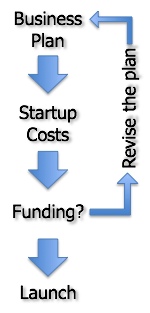
There’s an obvious relationship between the amount of money needed and whether or not there’s funding, and where and how you seek that funding. It’s not random, it’s related to the plan itself. Here again is the idea of a natural level, of a fit between the nature of the business startup, and its funding strategy.

It seems that you start with your own resources, and if that’s enough, you stop there too. You look at what you can borrow. And you deal with realities of friends and family (limited for most people), angel investment (for more money, but also limited by realities of investor needs, payoffs, etc.), and venture capital (available for only a few very high-end plans, with good teams, defensible markets, scalability, etc.).

3. Launch or Revise

Somewhere in this process is a sense of scale and reality. If the natural startup cost is $2 million but you don’t have a proven team and a strong plan, then you don’t just raise less money, and you don’t just make do with less. No — and this is important — at that point, you have to revise your plan. You don’t just go blindly on spending money (and probably dumping it down the drain) if the money raised, or the money raisable, doesn’t match the amount the plan requires.

Revise the plan. Lower your sites. Narrow your market. Slow your projected growth rate.

Bring in a stronger team. New partners? More experienced people? Maybe a different ownership structure will help.

What’s really important is you have to jump out of a flawed assumption set and revise the plan. I’ve seen this too often: you do the plan, set the amounts, fail the funding, and then just keep going, but without the needed funding.

And that’s just not likely to work. And, more important, it is likely to cause you to fail, and lose money while you’re doing it.

Repetition for emphasis: you revise the plan to give it a different natural need level. You don’t just make do with less. You also do less.

Do Business Plan Contest Winners Make It in the Real World?

Craig from trackster.com asked me last week in a comment he added to my Willamette Angel Conference post:

I was wondering with all these business plan competitions that you judge, how many winners or even non winners have you seen turn into successful companies? Are there any examples that you could give?

Yes, a lot of these companies make it. It’s more like half than the one in 10 portion you’d think from the classic assumptions.

I’ve seen lots of these companies launch and become successful, in a much higher proportion than the classic assumption of one or two of every 10.

For example, take a look at this page from the Rice Business Alliance, which has run one of the best of these contests since 2002. The graph here shows the success rate for all of the 166 ventures entered in the Rice contest from the beginning. The trend is very clear. The Rice Alliance says that since 2001 (quoting their website):

  • 66 of our past Rice Business Plan Competition teams are successful business start-ups
  • 192 business teams from national and international schools have participated
  • More than $90 million in capital raised by Rice Business Plan Competition participant companies

Although they make the raw data quite as accessible as the Rice Alliance does, the University of Texas’ Moot Corp, the oldest and most respected of these contests, has to have a similar success rate. I say that because I’m involved with both and the plans and the people are excellent in both. And Moot Corp does post a very long page full of specific successes, with a lot of details. I saw all of the companies they have there from the 2007 and 2008 contests, and I’m not at all surprised that they’ve made it.

I particularly liked cQue, which recently landed a contract with the San Francisco Giants to revolutionize ticketing technology; and Evapt, an automated billing system for software as a service; and several dozen others. They are up and running, they are raising money, they are making it.

To be fair, these two competitions tend to be the best of the best. The entrants are carefully selected. Most of them have won local or regional contests. They are grad students and people in the real world. I’m also involved in some less ambitious business plan contests, like ones for undergrads, that don’t produce a lot of real companies.

And this year I’ve added angel investment, which is a different thing entirely. Like the major academic contests, it is about business plans, ventures, presentations, questions and answers, investors’ points of view, exit strategies, and so on. Unlike the academic contests, there are no MBA requirements, and no faculty advisors.

And specifically, the angel group I’m in, the one I posted on last Thursday morning: there were five finalists that presented to the group. All five of them are very real companies already, even thought they want and in some cases need angel investment of $125K. All five will be there a year from now. The one with the lowest need and least ambitious forecast, a software company called CenterSpace, won the investment. But the four others that didn’t win, led by my personal favorite, Zapproved, have good future prospects. That was also Zaps Technologies, Wicked Quick, and Floragenex. All of these are going to survive and grow.

Angel Investor Conference

Today I’ll be listening to pitches at the Willamette Valley Angel Conference, voting on which of them ends up with the $125K investment.

I’m one of 25 members. We started with 43 plans and narrowed them down to five finalists. We’ve broken into groups and done additional work on each of the finalists. Today we hear them pitch again, for the second time, and award a winner.

One additional finalist will be chosen from a group of wild card entries.

It’s a good group: interesting companies. It will be hard to decide.

New Entrepreneurial Seal of Approval

Adeo Ressi doesn’t like what he calls a slanted field on the deals entrepreneurs get from investors. He says (I’m quoting):

Honestly, I think that the entrepreneur gets a raw deal today, and that this has gotten a lot worse since I started in 1994. Entrepreneurs are victims of a lot of predatory and exploitative behavior.

This has been bad for a while, but it’s gotten much worse. And it hurts the country, and the economy. We need to fix the availability of capital for entrepreneurs.

That led to The Funded Founder Institute, a four-month, $450 program to run selected entrepreneurs (including, by the way, wanna-be entrepreneurs) through weekly sessions with mentors and experts, ending with a certification that should smooth the path to investment. Microsoft BizSpark scholarships are available too, to pay the $450.

Adeo is serious about smoothing the path for founders. He says:

If we could eliminate all the headaches that the modern bureaucratic layering adds to start a company, and allow these founders to focus on the core business challenge, the likelihood of success increases dramatically. We want them learning how to do it right.

A brief interruption before I go on: this looks like a really good program to me, even though it’s brand new, and not certified formally by anybody else. Adeo has a good reputation, knows a lot of the right people, and he’s done some important things before. I think the certification he’s offering is likely to be very valuable. So if you’re interested apply now. Applications close for the first session, which starts this month, May 9. The application costs $50.

Look at some of the mentors already on board. Several are major Web names, founders or CEOs of Scribd, Mahalo, Socialtext, and so on. And Adeo told me has many more, including other mentors as well known as some of these, in the wings.

Adeo himself gives this program a lot of credibility. He’s the founder and main force behind TheFunded.com, a site I’ve posted about before, entrepreneurs reviewing investors. He got his skeptical view of investors the hard way, building companies. Game Trusts, one of his more recent efforts, won $15 million in venture capital and exited with acquisition by Real Networks.

He’s serious about leveling the playing field. The institute has posted sample startup documents including suggested deal terms more favorable to entrepreneurs than most. And the institute is offering to arbitrate disputes.

It’s also taking a piece of the action, which it’s hoping to reinvest in the long-term health of the program. Adeo says there will be warrants, linked to equity, as a “vehicle of valuable attribution.” That’s for “value as a sign to the mentors and the founders. And 60% of the warrant value goes right back to the participants. The remaining 40% is held by the institute as a value play.”

Turning Good Advice into Bad News

Imagine, if you will, this scene:

You are in a group of angel investors talking with entrepreneurs looking for funding. Or you are in a group of venture competition judges giving feedback to teams after the judging is over. The entrepreneurs listen intently, nod, they’re understanding, and then suddenly one or more of their faces change, crestfallen, disappointed, cheated. Something that was just said triggered an immediate reaction:

But we put that in, they say, because so-and-so (the last angel group they talked to, or the judges of the last contest they entered) recommended it.  We specifically changed our plan to accommodate feedback. And now your feedback is in exactly the opposite direction.

I see it a lot. I’ve seen it for years in the judging of the venture competitions. Lately I’ve seen it in reviewing potential angel investments.

For example, one that comes up a lot is whether you go for the broad sweeping expansive view of future market potential, which some groups like and other groups tag as lack of focus or realism.

I like focus myself. Keep it manageable. Narrow targets. Getting to $5, $10, $20 million in three or five years, but more in control. More realistic.

A lot of other judges want to see a bigger pot of gold at the far end of a more distant rainbow. “How do you get to hundreds of millions?”

So they go for big, because the judges say so. Then the next time, it’s “but you have too many targets; you’re doing too much.” And then there’s that look again, the disappointment. We’re supposed to do what the last judges suggested.

More About Angelsoft.net and Angel Funding

(I posted Organizing Angel Investors Monday on Up and Running about positive developments in angel funding. David Rose, CEO of angelsoft.net, added the following as a comment to that post. Although I haven’t had guest posts on this blog, David’s comment is worth it. And I’ve been using angelsoft.net for a while now, I know it’s good. So I’m posting David’s comment here as if it were a guest post.)

Tim, you are absolutely correct in your observations about what’s happening in the angel world. Historically, angel investing has tended to be a personal, haphazard thing, with entrepreneurs and angels finding each other almost by chance. During the dot-com boom, however, angels in various cities who repeatedly found themselves in the same deals began to organize into semi-formal groups, in order to share deal flow and expertise, and pool their funds to make larger investments.

After the crash, when venture capital firms effectively stopped funding during the ‘nuclear winter’, the Kauffman Foundation, dedicated to supporting entrepreneurship, figured that the best way to help entrepreneurs was to jump start angel investing (which, as you know, accounts for more startup investing annually than all VCs put together.)

So Kauffman convened a summit meeting of the major angel groups from around the country, and out of that arose the Angel Capital Association, the professional alliance of angel groups, and the Angel Capital Education Foundation, which trains angels and entrepreneurs in best practices. This past week we held the 2009 ACA Summit in Atlanta, at which over 300 leading angels and group managers from around the country got together to meet each other, share best practices, and work on syndicating deals.

At the same time the ACA was being formed, many of the angel groups were in need of a solution to help administer their organizations, encourage collaboration among angels, and enable cooperative investments both among groups, and between angel groups and VCs. Thus arose Angelsoft, which today provides the back-end infrastructure for virtually the entire global, organized angel investment community. Five years after its founding, Angelsoft supports 17,000 accredited investors in 450 angel investment groups in 45 countries.

While Angelsoft is not a ‘matching service’, nor does the company itself make investments, the platform functions much like the CommonApp for college admissions. The difference is that because the vast majority of angel groups use the system to manage their deal flow and collaboration internally, there aren’t parallel systems. So if an entrepreneur applies for funding to a group using Angelsoft, they’ll be working on an Angelsoft-powered application no matter how they got to the group in the first place.

This provides a number of advantages, among which is the need to only fill out an application once. After that, applying to any other Angelsoft-based group is a matter of a single mouse click. And entrepreneurs can find groups that invest in their type of company by using the Kayak-like sliders in Angelsoft’s investor search engine at http://angelsoft.net/startup-tools/investor-search.

Another by-product is that for the first time entrepreneurs have some visibility into the often-murky operations of angel groups. Because Angelsoft powers all the group’s processes, the system can provide entrepreneurs with statistics including how many other companies have applied for funding this month, how long it typically takes the group to review a submission, what percentage of applicants to a group actually get funded, and so forth. For example, check out the profile page for New York Angels, my home angel group here on the east coast, at http://angelsoft.net/angel-group/new-york-angels

Finally, one of the coolest things is that with all the angel groups on a single platform, Angelsoft is now also being used by other parts of the early stage industry, including, as you pointed out, VCs. Over 50 venture funds use Angelsoft to process their deal flow, and many of the leading venture law firms, such as DLA Piper and Cooley Godward, are beginning to use the platform to refer clients to angel groups and venture funds for consideration.

We are living in a fascinating time with fast moving changes in every area, and the expansion and growth of the Internet promises to bring some much needed order to the chaos of early stage funding!

-David S. Rose
CEO, Angelsoft
Chairman, New York Angels

Your Profits Are Way Too High!

Business plans everywhere. I’m reading, annotating, filling in score sheets, and getting cranky. I explained that on this blog last Monday.

So what’s with the unrealistically high profitability projections? This year it seems like I’ve discovered a new 50-50 rule of profitability in business plans, as in, 50% of the plans I’m looking at project 50% or higher profits on sales.

That reminds me of a song my youngest daughter used to play: “That Don’t Impress Me Much.”

Occasionally a very successful startup will come up with something so new that it can, for a while, chalk up very high profit margins. That’s extremely rare. Out here in the real world, though, nobody really makes much more than 5-8-10% or so profits on sales. The real startups might make 15% or even 20%.

Projecting 40%, 50%, and even 60% profitability on sales doesn’t tell me you have a great business; it tells me you haven’t done all of your homework. You’re underestimating cost of sales, expenses, or both.

I find this particularly galling in business plans with some social implications, related to health care, or education.

What would I like to see instead? First, find out average profitability for the industry you’re in. Put that number into your plan. Then explain why your company’s projected profitability is higher. Proprietary technology, specialty niche market, new processes? Okay, I can take that; just be aware of what the normal is, so you know what you’re up against. Please.

Standard financials are available from several vendors, for less than $100 per industry (and here I can’t resist adding that they’re bundled with Business Plan Pro, my company’s software product. Sorry. I’m an entrepreneur. I can’t help it.) You can also get those from Oxxford Information Technology, or the Risk Management Association (RMA).

Anyhow, that’s my opinion.