Tag Archives: business planning

Top 10 Business Planning Mistakes #7: Buying Instead of Building

(Note: this is the fourth of a 10-part series listing my revised top 10 business planning mistakes. The list goes from 10, the least important, to 1, the most important.) It drives me crazy: I see all those ads for prepackaged business plans, with preposterous claims like “investor-proven” and “guaranteed success” and “just fill in the blanks.” And then there’s that big myth that you can farm out a business plan as if it were soybeans or potatoes, delivered when done. don’t buy a business plan. Build your own.  Every business is unique. Your goals, how you define success, your resources, your strategy, your team, your target market, and your business offering are always unique. There’s a post on this blog called Sample Business Plans Suck, a rant about people thinking a sample business plan is anything but just an example to generate ideas and show them what a finished plan looks like. There’s another post on this blog called My Worst-Ever Consulting Engagement,  a true story of how three entrepreneurs thought having a business plan was a problem solved, whether they knew what it said or not. So, if you wanted to take a trip, would you hire somebody to plan it for you? Would you buy the trip plan? If you wanted to take up golf or tennis, would you hire somebody to take lessons for you? If you wanted to get in shape, would you buy some diet and exercise?

(Image: Snail Pace/Flickr cc)

Top 10 Business Plan Mistakes #8: Making Financing the Goal

Top 10 Logo

(Note: this is the third of a 10-part series listing my revised top 10 business planning mistakes. The list goes from 10, the least important, to 1, the most important.)

It’s just too damn bad that so many entrepreneurs assume to start a business you do a plan, get financed, and then you start. As if the goal of the plan is getting financed; and as if the getting financed is the win, regardless of financed how and by whom and on what terms.

And that’s a big mistake. You should choose investors as carefully as you choose a spouse.

Contrary to the myth, winning the investment isn’t always a win. Getting investment from the wrong people isn’t a win. It’s a recipe for disaster. Marrying your company with incompatible investors can turn a dream into a nightmare. And yet so often when you talk to entrepreneurs they seem to think that just getting that investment is the same as winning the race. Find somebody to say yes and you’ve succeeded.

Not all good businesses make good investments for outsiders. Investors need exits in 3-5 years, while lots of good businesses aim for forever, not just 3-5 years. And entrepreneurs often want independence, while investors usually feel like bosses. They are owners. Some of the best businesses are bootstrapped, meaning they don’t get outside investment. They use their own funds, or early sales, and they grow more slowly but without requiring other people’s money. And some successful businesses are financed by loans, which increases the risk, but doesn’t dilute ownership.

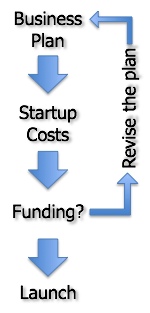
I say let the nature of the business, and the goals of the entrepreneur,  determine the financial strategy regarding investment. Some businesses simply can’t sprout without healthy amounts of outside investment. Others have no good reason to even think of investment. And most are in between, with investment a matter of what the owners ultimately want. And there is what I’ve called the Startup Sweet Spot, the natural right level of financing for the startup, based on what it actually needs to develop right, which may or may not require outside funding. As in the diagram here to the right, the plan estimates the ideal startup costs level, and if funding for that isn’t available, then you revise the plan.

The correct goal of the planning process is to help the entrepreneurs determine what their startup really requires, and to help them look at options for growth, so that they can decide whether or not they even have something that will interest investors. And, if they do, then also of course whether or not they want investment. Then, if the entrepreneurs decide they want or need investors, then the planning helps communicate the business to the investors, and that becomes a starting point to deciding whether or not the founders and the investors are compatible.

Top 10 Business Plan Mistakes #9: Pitching Without Planning

(Note: this is the second of a 10-part series listing my revised top 10 business planning mistakes. The list goes from 10, the least important, to 1, the most important.)

I’m guessing that the idea of doing a pitch – meaning a slide deck driving a presentation, about 20 minutes’ worth maximum – instead of a business plan is popular mainly because of a huge misunderstanding. People mistakenly think of a business plan as a big honking document, difficult to do, unwieldy, and off putting. So they want to do anything they can to avoid it. Then in walks somebody who ought to know better saying no, you don’t need to do the plan, just do a pitch.

A pitch without a plan to base it on is like a movie without a screenplay. It makes no sense. The pitch is summarizing the plan.

Whether or not you show a plan document to anybody, whether that somebody sees the pitch and not the plan, the plan is your most recent take on what’s supposed to happen, and both the pitch and the document are outputs of the plan. A pitch slide deck summarizes a plan. It doesn’t stand alone.

In the angel investment group I’m a member of, we read summaries first, then watch the pitches that survived the first cut. But nobody gets serious interest without having a business plan, and a pitch without a plan shows up like a sore thumb. As soon as people start asking questions, the pitch alone doesn’t answer them.

The plan itself isn’t a document, or a slide deck, or a memo; it’s what’s going to happen, and why. It’s a combination of strategy and specific steps to implement strategy. It makes the connections between the different functions and relationships in the business. And usually it lives on a computer.

Those documents, the pitch presentations, and the summary memos, even the elevator speech? Those are all just output of the plan.

Top 10 Business Plan Mistakes, #10: It’s Not a Hurdle

I’ve decided I need a new top 10 list for business planning mistakes. This isn’t the first I’ve done and I hope not the last either, but it’s a good thing to give these lists a fresh look every so often. And this morning I do a workshop on this topic as part of the Bend Venture Conference in Bend, Oregon; so it seemed like a good time to do it.

I’m doing it like Letterman does, starting with number 10, least important, and counting up to number 1, most important.

No, a business plan isn’t a hurdle you have to get over. That’s just wrong. It’s not a one-time thing. You don’t want to finish your business plan ever. When your business plan is done, your business is done.

A business plan isn’t a thing, like a document, that has lasting value when it’s built. It’s a process. The first plan is the first step in the process. You should review it every month, and revise it as often as your assumptions change.

My first business plan book, written in the late 1990s, carries the title Hurdle: the Book on Business Planning. My bad. Sorry about that. It’s no coincidence that my second one, done two years ago,  is The Plan-As-You-Go Business Plan.

I still like that first book, although not as much as the more recent one. But I hate its title.

(image: istockphoto.com)

3 Things Acrobats Teach us About Business Planning

Maybe I’ve overdosed on Cirque du Soleil when I’m thinking about the net and business planning instead of the show. But I did. I was watching the beautiful trapeze artist spin gracefully through the air, twisting and turning, then tuck and land in the net. And that (the net, not the artist) made me think of good business planning.

1. How the Net Absorbs Change

The net changed instantly as she dropped into it. It reacted to her weight, lowering the surface on one side, but all the connections, the cords and knots and such, remained connected.

Business planning, done right, does the same thing for your business. When change hits, if you have a plan, then it has already connected the interdependencies, so you can see them better and respond to change faster.

When the big recession hit in 2008, companies with business plans and good business planning process were able to adjust to the drop much more quickly than their competition. Sales dropped suddenly. The companies with good planning process turned to their plans and quickly adjusted costs, expenses, marketing, and so forth to deal with the change. The ones without good planning had to dig into their business details during the crisis to develop and understand the connections. With planning, the connections are there, so you adjust them.

As we climb slowly back out of the recession, planning will help again. This time it will be positive adjustments, as assumptions change for the better. I hope.

2. The Soft Landing

With the Cirque du Soleil shows, the net isn’t just a safety net sitting there in case somebody messes up; it’s part of the routine. It’s the landing. It’s like the pool for the high divers.

Good business planning is an easy landing for managing your business better. Like the net, it connects the various parts of the business. It also builds you the metrics and accountability you need to keep on top of all the moving parts, and the tasks and the people.

As change happens, you compare it to the plan, so that you can see it happening, work with it, and move with the change. You capitalize on opportunities and avoid threats. That’s a lot like a soft landing.

3. Artistry and Beauty Take Planning

I’m glad to report that I broke my reverie and turned my attention back to the show. They do it so well, so artfully, that they seem to be graceful flying creatures by their very nature. But no. Planning, rehearsals, choreography, more rehearsals, working it out over and over, every step of the way; that’s what makes it so beautiful.

And it all works very well. Like we want our businesses to work.

(Image: copied with my thanks from www.barry.ca, website of Barry Cordage Ltd., which sells the nets in the picture.)

On Teaching Business With Business Plans

Remember that old saying about teaching people to fish, instead of giving them a fish? That applies to business planning as well: don’t give a person a business plan, help them do their own instead.

I’m in San Antonio Texas today attending the annual conference of the Association of Small Business Development Centers (ASBDC), where I did a workshop yesterday on using the business plan as a teaching tool. It reminds me how I got into this business planning specialty in the first place. It was because the business planning brings together everything that’s important in a business, from strategy to market to metrics to numbers.

All of which reminds me once again that what works to help people with business planning is to help them develop their own plan, to teach them how, rather than just to do a plan. What you want as an end result is somebody who can use planning process to run the business. It’s not about having a one-time-use document, it’s about planning over the long term, which means regular plan-vs.-actual review, course corrections, and management.

Keep it on the computer. Update it often. And when you need to show it to somebody, that document you print: that’s output, not the plan. It’s an image of what the plan was on the day that you printed it.

And, for teaching entrepreneurship, the business plan is a great way to give a student a full view of what it takes to start and grow a real business.

Business Plan, Marketing Plan, or Both?

“if I have a marketing plan, do I need (or want) a business plan too?” Good question. And so is its opposite question too, “if I have a business plan, do I also need (or want) a marketing plan?”

As for a lot of these planning questions, you’re going to get different answers from different people. There’s no consensus on this.  But here’s my answer:

  1. Marketing is critical to business, and every business plan has a lot of marketing plan in it. There’s no need to keep the marketing separate from the rest of the planning. The marketing plan is an extremely important part of the business plan. No need to do it separately.
  2. That is, however, unless you are one of those people who are responsible for marketing, but not for the whole company. You don’t manage cash or financial strategy or ownership of the business. Then your job is marketing and related functions like sales and customer service and branding and social media and SEO, and so forth. You ask for the resource, and somebody else reviews, prioritizes, and gives you that resource or a reason why not. You probably have to manage expenses and show how they relate to sales and the health of the company. You probably have to show how those expenses make good business sense. You should probably be doing marketing planning, not the whole business planning; just your subset.

So to me, at least, the marketing planning is different from the business planning because it’s a subset. It doesn’t deal with financial health or financial strategy. It should have projections for sales, cost of sales, and sales and marketing expenses. It doesn’t project overall cash flow or the projected balance sheet. It probably deals with personnel, but just the related personnel, not the whole company personnel or larger personnel strategies.

Somebody just asked me that in email.

In Planning, Not All Metrics Are Created Equal

This is an important point. More and more I’m focusing on metrics as a vital component of any useful business planning process, but then I read Entrepreneurs: Beware of Vanity Metrics from Harvard Business Review, which warns of …

… the curse of vanity metrics, numbers which look good on paper but aren’t action oriented: website hits, message volume, or “billions and billions served.” They look great in a press release, but what do they accomplish?

Metrics are magic, or at least that’s what I’ve written in a number of places, related to business planning. But maybe I should have written good metrics, or valid metrics. Metrics as measurement become accountability, which becomes management. Build the metrics into your planning process, and you have better management, better steering, and better teamwork. Not just dollars, but metrics you can track, and metrics that are specific to different jobs, functions, and goals.

Good metrics might be sales, costs, expenses, trips, seminars, ads placed, publications, leads, presentations, posts, tweets, retweets, calls, minutes per call, incidents per serial, and so on. You need things you can track.

But vanity metrics happen all the time. Those are the numbers that look good but come after the fact, without a direct link to cause or performance. I’ve used vanity metrics often enough to know. When preparing a presentation, find a number that looks good, and pretend that it shows progress.

Cool … but is that what you were aiming for?

(Image: 3DDock/Shutterstock)

No, You Can’t Just Pull Numbers Out of The Air

Question: I’m in the process of writing an Internet startup business plan to present to prospective investors. The site isn’t live so I don’t even have a basis for speculation with respect to the financials. I would essentially be pulling numbers out of the air. Being that the Internet business as it pertains to advertising revenues is so mercurial, is it feasible to present the plan without having the financials included? If not, how can I make more realistic financial assumptions?

My answer: No, you won’t get anywhere presenting a business plan to investors without financials. I’m glad you asked me instead of just moving ahead with that idea.

Every new business, including a website business, has to be able to present a reasonable forecast if it’s going to hope to get an approval from outside investors. And it can never be “pulling numbers out of the air.” The assumption is that before you start a new business you have some idea how it’s going to work, based on some experience. If you have no idea, no investor wants to even share the same elevator with you.

In this case, the website business, you need somebody on your team who can project website traffic and sales based on real experience with search terms, search engine optimization, Google ad words and its competitors, conversion rates, and so on. Your traffic doesn’t get pulled out of the air, it’s a function of what you plan to do and what you plan to spend. Know your key search words and the traffic those words and phrases get for others, right now. Know reasonable conversion rates. Make estimates based on real assumptions about real variables.

For more information on this, you could try:

Business Plans are Never Done

If your business plan is finished, your business is finished.

I’d like to think that this is obvious, but a lot of people don’t get it. A business plan isn’t supposed to be finished, ever. If it’s useful to your business, then you keep it alive. You review it regularly. You check assumptions and how they’ve changed. You compare plan versus actual results and make course corrections.

It’s supposed to be like the farmer’s axe: the handle’s been replaced 10 times and the blade three times, but it’s still the same axe.

Like that axe changing its parts, expect your business plan to change. Parts of it will be replaced as reality rears up its ugly head and messes with assumptions. But the plan goes on and on.

For example, Palo Alto Software is 22 years old. The business plan has never been finished. We take a fresh look at it once a year, and review plan versus actual results every month. When we discover that assumptions have changed, we review the changes and the impact of the changes, and adjust the plan.

Maybe 10 or 15 times in 22 years, we’ve had to dress up the plan and send it to somebody outside the company. We did that to get the merchant account initially, to set up a commercial line of credit with a bank, and when we were looking at possibly taking on investors. Each time we needed to present a plan, we took the real plan — the live plan — and we reviewed, edited, formatted, and produced a document. And that document, once produced, is no longer the plan. It’s just the dressed-up view of the plan as it existed that particular day.

So the plan lives on. Unfinished. 22 years later.