Tag Archives: business plan

Reflection: 10 Lessons Learned in 22 Years of Successful Bootstrapping

(I posted this about two years ago on Small Business Trends. I’m reposting it here today because this is a good time of year for this kind of reflection. And maybe also for not writing a new post. Tim )

Last week a group of students interviewed me, as part of a class project, looking for secrets and keys to success. They were asking me because after 22 years of bootstrapping, my wife Vange and I own a business that has 45 employees now, multimillion dollar sales, market leadership in its segment, no outside investors, and no debt. And a second generation is running it now.

Frankly, during that interview I felt bad for not having better answers. Like the classic cobbler’s children example, I analyze lots of other businesses, but not so much my own. As I stumbled through my answers, most of what I was saying sounded trite and self serving, like “giving value to customers” and “treating employees fairly,” things that everybody always says.

I wasn’t happy with platitudes and generalizations, so I went home that day and talked to Vange about it. Together, we came up with these 10 lessons.

And it’s important to us that we’re not saying our way is the right way to do anything in business; all businesses are unique, and what we did might not apply to anybody else. But it worked for us.

1. We made lots of mistakes.

Not that we liked it. At one point, about midway through this journey, Vange looked at me and said: “I’m sick of learning by experience. Let’s just do things right.” And we tried, but we still made lots of mistakes. We’d fuss about them, analyze them, label them and categorize them and save them somewhere to be referred to as necessary. You put them away where you can find them in your mind when you need them again.

2. We built it around ourselves.

Our business was and is a reflection of us, what we like to do, what we do well. It didn’t come off of a list of hot businesses.

3. We offered something other people wanted …

… and in many cases needed, even more than wanted. You don’t just follow your passion unless your passion produces something other people will pay for. In our case it was business planning software.

4. We planned.

We kept a business plan alive and at our fingertips, never finishing it, often changing it, never forgetting it.

5. We spent our own money. We never spent money we didn’t have.

We hate debt. We never got into debt on purpose, and we didn’t go looking for other people’s money until we didn’t need it (in 2000 we took in a minority investment from Silicon Valley venture capitalists; we bought them out again in 2002). We never purposely spent money we didn’t have to make money. (And in this one I have to admit: that was the theory, at least, but not always the practice. We did have three mortgages at one point, and $65,000 in credit card debt at another. Do as we say, not as we did.)

6. We used service revenues to invest in products.

In the formative years, we lived on about half of what I collected as fees for business plan consulting, and invested the other half on the product business.

7. We minded cash flow first, before growth.

This was critical, and we always understood it, and we were always on the same page. See lesson number 5, above. We rejected ways we might have spurred growth by spending first to generate sales later.

8. We put growth ahead of profits.

Profitability wasn’t really the goal. We traded profits for growth, investing in product quality and branding and marketing, when possible, although always as long as the cash flow came first.

9. We hired people slowly and carefully.

We did everything ourselves in the beginning, then hired people to take tasks off of our plate. We hired a bookkeeper who gave us back the time we spent bookkeeping. A technical support person gave us back the time we spent on the phone explaining software products to customers. And so on.

10. We did for employees’ families as we did for ourselves.

Family members — not just our own family, but employee family members too — have always been welcome as long as they’re qualified and they do the work. At different times, aside from our own family members, we’ve had two brother-sister combinations, an aunt and her niece, father and daughter, and husband and wife.

And in conclusion…

Bootstrapping is underrated. It took us longer than it might have, but after having reached critical mass, it’s really good to own our own business outright. It might have taken longer, and maybe it was harder — although who knows if we could have done it with investors as partners — but it seems like a good ending.

Family business is underrated. There are some special problems, but there are also special advantages too.

Enhanced by Zemanta

Creativity Contest: Fun Way to Say Business Planning. With Prizes.

Here’s a challenge: Donna Maria of INDIEBusiness asked: what’s a fun way to say business planning? That’s the tweet you see here, which I saw a few minutes ago as I sat down looking at the Willamette River drinking my coffee and starting my day. tweet

I think I know exactly what she means. Business planning should be vibrant, creative, flexible, rapidly changing, as fun as writing a story and then figuring the steps to make that story come true. But when you say “business plan” way too many people shudder, thinking of a long boring task leading to a long useless document. Dry and boring, like she says.

But then think of some time in your life when you were dreaming about something you wanted to make happen. “Gee, maybe we could … ” is a fun way to think. “And what about if we …” That’s brainstorming, problem solving, inventing new things. “And then we could …” And it’s strategy as focus, finding your identity, building a new life, controlling your destiny.

There are many different meanings for the phrase “business plan.” That’s too bad, because a lot of people think of that dry boring thing and miss the fun thing.

I answered her tweet with one of my own, keying on the idea of dreaming, but Donna Maria has a deeper point: the phrase is worn out. We need a new one. What’s a better way to say “business planning” that doesn’t sound like the dumb old fashioned business plan?

So let’s call it a contest, and give it a prize: I’ve got a free copy of Business Plan Pro Premier edition, or a year of http://www.liveplan.com, or a year of emailcenterpro use (your choice) for anybody who can come up with a fun way to say “business planning.” I mean a new, interesting, better phrase. I titled my last book The Plan As You Go Business Plan, but honestly, I want something better than that. One, two or three words.

Send me your suggestions on twitter with @timberry, or use this form.

When Is a Business Plan Not a Business Plan?

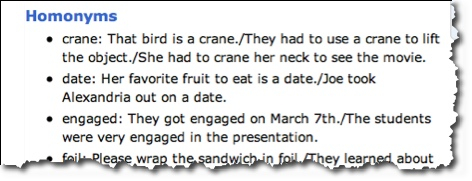
This has been bugging me for a long time now: It turns out that the phrase “business plan” is a homonym, exactly as in these examples from yourdictionary.com:

homonyms

Just like the different meanings for crane and date, there are at least two completely different meanings for the two-word phrase “business plan:”

  1. Business plan: what’s supposed to happen in a business. This normally includes priorities, strategy, assumptions, milestones, responsibilities, sales forecast, expense budget, and cash flow.
  2. Business plan: a document used to summarize a business to serve as part of the process of seeking investors or applying for a commercial loan.

Why does this matter? Because I see both of these two distinct meanings coming up in business conversation all the time, constantly confusing people. For example, when successful entrepreneurs tell pollsters they didn’t have a business plan when they started, they’re using definition #2 here. When smart business advisors play down the use of the business plan, they are also talking about that second definition, not the first.

I’ve been starting to distinguish the two meanings in my own work by writing about “business planning” for business plan definition #1, and “business plan document” for business plan definition #2.

That first-definition business plan is about optimizing management. It includes regular plan vs. actual review, course corrections, and managing rapid change. It doesn’t assume that there’s virtue in sticking to a plan for no other reason. It lives on your computer. The slide deck, the pitch, and the document are output of that plan. It’s Plan-As-You-Go business planning.

The second-definition business plan is something like sales collateral; it’s business goal is communicating a deal to investors, or supporting a loan application. It’s important to a subset of businesses that are seeking investment or commercial loans. I see a lot of those in my work as a member of an angel investment group and a frequent judge at business plan contests.

These are very different things, these two definitions of business plan. They are homonyms. And that confuses business discussions about business plans and business planning. Do you agree?

Closing the Loop: How Planning Is Management

A couple of weeks ago the editor of my entrepreneur.com column poked me sideways a bit with the suggestion that I explain how planning is management. He said (I’m paraphrasing):

What do you really mean when you say planning is management? It’s not immediately obvious. Can you explain how a business plan becomes better business management?

Which led to How Business Planning Leads to Better Management, published yesterday.

The key is going from strategy to numbers:

In order to chart your path, you’ll need to define long-term goals. Think broadly about how you see your business in several years. From there, get specific. You’ll want to establish milestones for when you want to accomplish certain goals, and know who you will want to carry them out. Go beyond sales, costs and expenses, and look at what really drives your business. It might be conversions, page views, clicks, meals, trips, presentations, seminars and other engagements.

And then, more important, you track and manage those numbers. You set a regular review schedule and manage performance based on the numbers in the plan plus the difference between plan and actual results.

Can you see the management brewing? Tracking and analyzing numbers can help you manage the work behind the numbers. You’ll be in a better place to recognize and highlight what’s working and what isn’t working for your business and your team. Managing your business successfully requires more than just praise and pats on the back. Sometimes it means focusing attention on problems, helping people solve them if possible, discussing and embracing mistakes, and, in the worst case, weeding out people who don’t care about bad results. This can all be accomplished more efficiently when you have a plan in place.

So that’s why planning, done right, is management. It’s controlling your destiny and steering your company. And that’s not just a plan, a single, use-once plan; no, it’s planning process. It’s regular use, review, and revision, that makes planning management. Like Eisenhower said: “the plan is useless, but planning is essential.”

Business Planning Isn’t About Pages

Somebody asked me about a one-page business plan. That’s a fashionable idea, and can certainly be a useful exercise. I’ve written in this space how a one-minute elevator speech, for example, can be a useful exercise. And obviously a pitch deck and a pitch presentation can be useful too.

Summary is good. Everybody should be able to summarize their career in a single page, and everybody should be able to summarize their business plan in a single page too.

But that one-page summary isn’t a plan, it’s a summary. You might use it to communicate a plan on high level. It may be useful, but it doesn’t replace planning.

And for the record, that 10-page business plan, or the 20-page or 50-page business plan, those aren’t plans either: they’re output. They are a snapshot of what the plan was at one time. By the time you’ve printed them out, if there’s good planning going on, they are already out of date.

So what’s planning? it’s a process that starts with a plan and continues with regular review and revision. It’s a combination of strategy, review process, assumptions, dates, deadlines, responsibilities, metrics, accountability, and management. It helps you steer your company.

It’s not one page, or 10, 20, or 50. It’s what’s going to happen, when, why, who, and how much.

Top 10 Business Planning Mistakes #1: It’s Planning, not Just a Plan

(Note: this is the tenth and last of a 10-part series listing my revised top 10 business planning mistakes. The list goes from 10, the least important, to 1, this one, the most important.)

Planning is vital for your business. Start with a business plan and a regular review schedule, then track results and changing assumptions and revise the plan as needed to accommodate a changing world. The value isn’t in the original plan, but rather in the planning that follows, which becomes steering your business.

Planning isn’t just a business plan. It’s business management. The real benefit comes from setting up the assumptions and the links between strategy and specific actions, plus the metrics, and the task assignments. As assumptions change – and of course they will – having the plan already in place increases the power of revisions.

Planning, like steering and management, isn’t just a map and a destination; it’s constant course corrections, the original route map subject to modifications for real time events. So it’s more like a GPS system with real-time traffic and weather information, so you can adjust the route.

That business plan isn’t the end in itself; it’s just the first step. Expect it to be wrong, and plan to revise it. What you’ll gain is controlling your own business destiny prioritizing, setting up metrics, managing change, and steering your business better.

In the illustration: plan vs. actual becomes steering and management.

(image credit: Jiri Hera/shutterstock.com, istockphoto)

Top 10 Business Planning Mistakes #5: Doing It All

(Note: this is the sixth of a 10-part series listing my revised top 10 business planning mistakes. The list goes from 10, the least important, to 1, the most important.)

Let me start this with one of my favorite quotes:

“I don’t know the secret to success; but the secret to failure is trying to please everybody.” Amen to that. In fact, you can package that up and call it small business strategy 101.

And I’ve written about the displacement principle in small business:

In a business, everything you do rules out something else that you can’t do.

And this fits very well with what I call strategy:

Strategy is focus. It’s as much what you aren’t doing as it is what you’re doing.

One of the most common worries I get as I sit as a judge in business plan contests, or more recently in a group of angel investors as a member, is the problem of too many moving parts. That comes back to you can’t do everything.

Trying to do everything usually leads to doing nothing very well.

(Image: istockphoto.com)

Top 10 Business Planning Mistakes #7: Buying Instead of Building

(Note: this is the fourth of a 10-part series listing my revised top 10 business planning mistakes. The list goes from 10, the least important, to 1, the most important.) It drives me crazy: I see all those ads for prepackaged business plans, with preposterous claims like “investor-proven” and “guaranteed success” and “just fill in the blanks.” And then there’s that big myth that you can farm out a business plan as if it were soybeans or potatoes, delivered when done. don’t buy a business plan. Build your own.  Every business is unique. Your goals, how you define success, your resources, your strategy, your team, your target market, and your business offering are always unique. There’s a post on this blog called Sample Business Plans Suck, a rant about people thinking a sample business plan is anything but just an example to generate ideas and show them what a finished plan looks like. There’s another post on this blog called My Worst-Ever Consulting Engagement,  a true story of how three entrepreneurs thought having a business plan was a problem solved, whether they knew what it said or not. So, if you wanted to take a trip, would you hire somebody to plan it for you? Would you buy the trip plan? If you wanted to take up golf or tennis, would you hire somebody to take lessons for you? If you wanted to get in shape, would you buy some diet and exercise?

(Image: Snail Pace/Flickr cc)

Top 10 Business Plan Mistakes #8: Making Financing the Goal

Top 10 Logo

(Note: this is the third of a 10-part series listing my revised top 10 business planning mistakes. The list goes from 10, the least important, to 1, the most important.)

It’s just too damn bad that so many entrepreneurs assume to start a business you do a plan, get financed, and then you start. As if the goal of the plan is getting financed; and as if the getting financed is the win, regardless of financed how and by whom and on what terms.

And that’s a big mistake. You should choose investors as carefully as you choose a spouse.

Contrary to the myth, winning the investment isn’t always a win. Getting investment from the wrong people isn’t a win. It’s a recipe for disaster. Marrying your company with incompatible investors can turn a dream into a nightmare. And yet so often when you talk to entrepreneurs they seem to think that just getting that investment is the same as winning the race. Find somebody to say yes and you’ve succeeded.

Not all good businesses make good investments for outsiders. Investors need exits in 3-5 years, while lots of good businesses aim for forever, not just 3-5 years. And entrepreneurs often want independence, while investors usually feel like bosses. They are owners. Some of the best businesses are bootstrapped, meaning they don’t get outside investment. They use their own funds, or early sales, and they grow more slowly but without requiring other people’s money. And some successful businesses are financed by loans, which increases the risk, but doesn’t dilute ownership.

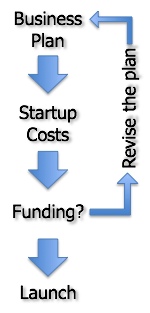
I say let the nature of the business, and the goals of the entrepreneur,  determine the financial strategy regarding investment. Some businesses simply can’t sprout without healthy amounts of outside investment. Others have no good reason to even think of investment. And most are in between, with investment a matter of what the owners ultimately want. And there is what I’ve called the Startup Sweet Spot, the natural right level of financing for the startup, based on what it actually needs to develop right, which may or may not require outside funding. As in the diagram here to the right, the plan estimates the ideal startup costs level, and if funding for that isn’t available, then you revise the plan.

The correct goal of the planning process is to help the entrepreneurs determine what their startup really requires, and to help them look at options for growth, so that they can decide whether or not they even have something that will interest investors. And, if they do, then also of course whether or not they want investment. Then, if the entrepreneurs decide they want or need investors, then the planning helps communicate the business to the investors, and that becomes a starting point to deciding whether or not the founders and the investors are compatible.

Top 10 Business Plan Mistakes #9: Pitching Without Planning

(Note: this is the second of a 10-part series listing my revised top 10 business planning mistakes. The list goes from 10, the least important, to 1, the most important.)

I’m guessing that the idea of doing a pitch – meaning a slide deck driving a presentation, about 20 minutes’ worth maximum – instead of a business plan is popular mainly because of a huge misunderstanding. People mistakenly think of a business plan as a big honking document, difficult to do, unwieldy, and off putting. So they want to do anything they can to avoid it. Then in walks somebody who ought to know better saying no, you don’t need to do the plan, just do a pitch.

A pitch without a plan to base it on is like a movie without a screenplay. It makes no sense. The pitch is summarizing the plan.

Whether or not you show a plan document to anybody, whether that somebody sees the pitch and not the plan, the plan is your most recent take on what’s supposed to happen, and both the pitch and the document are outputs of the plan. A pitch slide deck summarizes a plan. It doesn’t stand alone.

In the angel investment group I’m a member of, we read summaries first, then watch the pitches that survived the first cut. But nobody gets serious interest without having a business plan, and a pitch without a plan shows up like a sore thumb. As soon as people start asking questions, the pitch alone doesn’t answer them.

The plan itself isn’t a document, or a slide deck, or a memo; it’s what’s going to happen, and why. It’s a combination of strategy and specific steps to implement strategy. It makes the connections between the different functions and relationships in the business. And usually it lives on a computer.

Those documents, the pitch presentations, and the summary memos, even the elevator speech? Those are all just output of the plan.