Category Archives: Writing

Read Pam’s How to avoid being “fan boy” or “fan girl” advice

I was with my wife and son walking around the lower east side of Manhattan, where he lived, when we ran into an Oscar-winning movie star (no names in this one) having tea at some five-table place. My son said it was owned by Moby, and I still don’t know who that is, but it was smaller than your living room.

My wife wanted the autograph, my son and I shied at the thought of being so obtrusive. So we hung in the background while she went up, struck up a conversation, and she and that unnamed movie star congratulated each other on its being Mother’s Day. Which it was. And my wife had a much better time for those ten minutes than either of us dimwits (sorry Paul) in the background.

That’s almost off topic except that looking back on that little incident, my wife was better off and so was the movie star whose tea she interrupted, or at least I think so, they both seemed to have a very pleasant exchange. Hanging back, I’d guess, isn’t always the best option.

Moving to something more related to business and blogging (but you’ll see the connection) I remembered this chance meeting as I thoroughly enjoyed Pamela Slim’s post yesterday on Escape from Cubicle Nation, funny at parts — I clicked the link to her "possessed madwoman" photos — but also really getting at something that (I suspect) a lot of us occasionally run up against. Who wants to be that one who Pam calls "fan boy?" From the beginning:

Whomever you note on your "cool smart I wanna be like them when I grow up" list, you can and should look for ways to build relationships with them.

But, as creatures still stinging from the social dynamics of junior high, we can fall into "fan boy or fan girl traps" which not only make us feel insecure, but turn off the very people we are trying to impress.

So here are my tips, learned from the school of hard knocks:

So here’s the link to the rest of it: Escape from Cubicle Nation: How to avoid being "fan boy" or "fan girl" when building relationships with people you admire

Blogging: Business, Pleasure, Death Sentence?

It started earlier this week with a piece in the New York Times titled In Web World of 24/7 Stress, Writers Blog Till They Drop. Highlights:

Two weeks ago in North Lauderdale, Fla., funeral services were held for Russell Shaw, a prolific blogger on technology subjects who died at 60 of a heart attack. In December, another tech blogger, Marc Orchant, died at 50 of a massive coronary. A third, Om Malik, 41, survived a heart attack in December.

Gulp. I turned 60 in January. And I’ve done more than 450 posts in the last year, on this blog and several others. Am I brave, foolish, or both? Maybe I should do something safer, like fire fighting or sky jumping.

I think I’m (sort of) copying that response from John Jantsch, who posted I’m just dying to blog about this on Duct Tape Marketing: 

I started the story and I found myself looking around for the punch line, but I’m afraid they – the New York Times and Matt Richtel – were serious. Each paragraph was more bizarre than the next. I felt as though I had to have stumbled onto an edition of the Onion.

One of the comments on John’s piece is "Sounds like a late April’s Fool (sic). Good thing normal managers never are overworked or have heart attacks." To which John adds, "should have been." I’m with John on this. It should have been a joke. And I’m with him as well as he adds, on a more serious note:

Look, I’m not usually so negative on this blog, but I’ve grown very tired of the media’s characterization of blogging. There is no question that you can find people who have become so obsessed with something they get paid for that they do it death (see gamers, lawyers, miners, athletes, prostitutes.) 

In this case they found a handful of people with no life who are now being paid to have no life. So where’s the story in that?

Confession: I worked way too much during the formative years of Palo Alto Software. Try going into a third mortgage and $65,000 of credit card debt while not missing payroll. Blogging, in comparison, is a piece of cake.

One of the more meaningful responses to the piece (in my opinion) is Business or Pleasure, posted by Alan Johnston in Copyblogger. He was writing about writing, but I changed "writing" to "work" because it applies just as well:

A lot of people make the mistake of starting out by picking a niche they are not exactly passionate about simply because it pays well.

In other words, they are just in it for the money and somehow consider this a sound business model. It’s easy to show up day after day if the pay is good, right?

Sorry to burst your bubble there, but you couldn’t be more wrong. If you don’t like what you’re doing, your writing work will reflect that, no matter how hard you try.

Well said. Somewhere down in the heart of business, or maybe that’s entrepreneurship, is figuring out how to do what you like to do; because you’re going to do a lot of it.

(note: this was posted first on Small Business Trends, yesterday afternoon. I’m reposting here for readers’ convenience.)

Using the Blog Platform for Writing a Book

A week or so ago I finished a complete non-fiction book draft using a password-protected blog as the writing platform. I used my TypePad account, but it could have just as easily been in WordPress. I don’t know the other platforms that well.

I’d cite the blog for you and reference it, but it’s password protected until the publisher, Entrepreneur Press, decides whether or not we should just open it up. That’s a marketing question, theirs to decide, not mine.

The draft is about 80,000 words for The Plan-As-You-Go Business Plan, to be published by Entrepreneur Press and due out next fall.

Why? What were the pros and cons? The draft is done now, so I’ve been coming back up for air, thinking about it.

  1. The major advantage was access to the draft, to read, revise, and write more, from any computer with a network connection. I’ve been doing a lot of traveling lately, so that was important.
  2. I didn’t have to keep track of which copy was the latest, going through the hassle of not overwriting my work as I transferred Word *.doc files from one computer to another. The latest was always posted there.
  3. I found a way to make the structure work. The book is divided into six sections, each of which has 5-15 chapters. I made sections and chapters categories in the blog. It was easy to move things from classification to classification, as I changed my mind. (I do write following an outline, but as I write, the outline changes.)
  4. It was easy to order the appearance of the chapters by managing the dates posted. TypePad gave me the option of having the oldest post appear first, and then the rest in date order from oldest to newest, which was easy to deal with. Between the posting date and the categories, structure was easy to see and manage. Of course you realize you don’t actually post in order or deal with real dates posted; you set the date, artificially, with each post.
  5. I was able to back up frequently during the process using TypePad’s export blog feature. I saved those exports just in case of disaster.
  6. I used amazon.com’s S3 facility to save the illustrations in one place and refer to them uniformly as I did the draft.

The biggest disadvantage was having to get the whole thing into Microsoft Word, and printed up (the manuscript was 400 pages) to send to the publisher. I had somebody to help with that. It took her two full days of work.

Tip: Use a Slide Show Instead of an Outline

Some people who write books do it like I do. I keep thinking about the order of things, the structure, even as I write up the draft. This might seem disorganized, but it’s worked for me through a number of books and a lot of years. I adjust continually.

With the book I’m working on now, it’s even worse. My plan-as-you-go book is due early next month so I’m pretty deep into it, as you might imagine. I’m posting part of it on this blog, I’ve done interviews on it (links are on the sidebar), and I do presentations on it. And as I do, it changes. I reshuffle the cards. I can’t help it. I think rewriting and reshuffling is part of the interest in writing.

So today I realized how much I’m using the slide show as card deck as book reshuffler, so much so that I decided to pause briefly to make it a practical tip for you. This can help you with a book, a white paper, a long memo, or whatever. It’s really very simple: a card deck instead of an outline. In my case, much as I’m loving my new iMac, I’m still mainly on Windows with PowerPoint. Here’s the view:

Of course, I realize as I write this that you can’t make much out of that postage-stamp view of a book in process, but what’s happening is that I have almost all of the different segments of the book tied to pictures, which are slides. Each picture you see means a topic to me. A topic is usually like a significant piece of one of the 30 (or so) chapters.

My discussion about the elevator speech, for example. It’s pretty much written, so much so that I posted most of it as a 5-part series here on Planning Startups Stories, but I keep changing where I want to put it in my book. Yesterday it was in the heart of the plan section, where I talk about core strategy of positioning and differentiation. Today I moved it — that’s what prompted this post — down to the "dress it as needed" section, later in the book, where I’m trying to make the point that the plan is a core thing that you can then use to create an elevator speech, a pitch presentation, or a formal plan document, or none of the above, just use it to manage your company.   

I doubt I’m the only one who reshuffles content as the book gets closer to completion. Some writers would say that’s crazy, you should set the outline and follow it through until the complete first draft is done. I don’t. If you share that behavior, then you’ll probably like the way this works.

Why this instead of the standard outline? First, because it’s easier, for me anyway. I drag a piece from one place to another using the slide sorter view in PowerPoint. I can drag it back if I want, and I can drag a collection of pieces too, if I want. Second, because I’m working on my presentation at the same time. I’m off to New York tomorrow, and I give a workshop for SCORE in Eugene, Oregon next week, so I will use this presentation and I keep it conceptually linked to the book.

The one thing I miss is the ability to hang slides into an outline view by title, with a hierarchy built in. Aldus Persuasion, which was king of slideshow software before PowerPoint took over,  used to let me indent some slides underneath a section title holder, giving me a visual something like a standard outline, as an alternative to the slide view. PowerPoint’s outline view, however, (the illustration here) keeps them flat, all at the same level, and indenting a group of slides turns them into bullet points. For example, in the outline view at right, I’d like to make slides 14-16 subsets of slide 13 by indenting them. But I can’t. PowerPoint turns them into bullets on slide 13, essentially deleting them (at least it gives me a warning before it does, so I can reconsider).

I miss the combined power of the card deck (called slide sorter view) for some things, and a more powerful outline view for others. If you know a PowerPoint product manager, please send her or him the link to this post. Let’s get that into the software.

I keep thinking maybe Keynote on the iMac will do that, but I haven’t had the time to go explore yet.  My latest iMac is still barely a month old.

In the meantime, this is still so useful that I wanted to share it. And if it’s absurdly obvious, sorry.

Trigger Words and Censorship And Book Titles and Such

A book by any other name doesn’t necessarily smell as sweet. Or sell as well. Or sell as poorly. How much does a title matter on a blog post? On a movie? With that being so, I’m interested in the impact of the title shown here, on Bob Sutton’s extremely successful latest book. It’s an excellent book, by a well-liked and respected Stanford business school professor who’s written a number of important business books. It’s had a lot of impact too, as in buzz, reviews, commentary; and lots of published praise. It won a Quill Award for the best business book of 2007.

But the title puts me in a bind. Think about spiders, Web crawlers, quirky little programs that run around the Web scanning for words in the html code, and blacklisting sites that have those words. This is how the spam filter functions. What if you want to email a friend recommending this book. The spam filter says no.

There is no due process for Internet blacklists. Google "Internet blacklist" and you’ll find 17,600 items, most of them caught in the net and flailing desperately to get out. Get blacklisted on AOL, for example, and you’re cut off for a long time. You can’t email anybody with an AOL address. Try doing business like that. No due process means in extreme cases it’s one bad word combined with a word filter and, context be damned, you’re out in the cold.

For a moment let’s give the spam filters and Web crawlers and the like a break. Do you think they enjoy spending all day every day scanning for so-called "bad" words? Thankless job, but there is so much junk to be filtered … do we have to ask them to actually read and discriminate in context, now, so we can talk about a great book with a trigger title? We’re dealing with code here, and algorithms, and word screening. Don’t ask those program routines to evaluate context.

Earlier this evening I posted Do You Want to Fire Your Client on Up and Running. It’s about a common problem. Guy Kawasaki posted Is Your Client A Certified Orifice, which links to the Client from Hell Exam and Bob Sutton’s post on his blog about how to fire a bad client. I came up with my own story on dealing with bad clients; but that’s not the point of this post.

I wrote around that trigger word in the title. Guy called them "orifices." As I’m doing with this post, I showed a graphic of the title, and I hope that keeps me safe.

Bob Sutton, meanwhile, has a two-part post on Huffington Post that is both hilarious and chilling. He titles it Title Tales: Weird Censorship.  And it makes me feel small for not just using the title, like the Huffington Post does, and The New Yorker, and Time magazine, and several others. He has a list of 13 responses, from "we like the book but are afraid to say anything about it" to "repeat the word over and over again because listeners would enjoy it." Unfortunately, his list makes me fill silly for making a point of it.  His post in Huffington isn’t the only one around; he’s had several thoughtful posts on this issue, one from Publisher’s Weekly that goes into court ramifications. It’s a real issue.

It bothers me, however, to call euphemisms for specific screen words censorship. Fear of spam-filter and word screening problems is not the same as wanting to keep thoughts or ideas or information away from people. I’m not really saving you from the word a**hole by putting asterisks in, and we both know it. Spam filters have a real problem to solve, and word screening helps. 

Still, this is one of my longer posts, and it’s related to that other post. So it obviously bothers me. Fear of blacklists. And I can’t help but wonder, is the attention-grabbing title good for sales? Would the book have been better off with a different title? I don’t know. I’m just asking.

Somewhere in this discussion is the question of whether or not the language is worth the drawbacks. There is no asterisk-filled public dialog or bleeped out video as profane as fourth grade boys on the school playground. So why bother? If you need authentic dialog for your screenplay, then I get it, because that’s the way some people talk. But in the printed word, and especially the filtered and word-screened words, using another word instead is not such a bad thing. I think.

How Do I Spell Trivial?

I apologize. It’s the schoolteacher in me. I’m annoying and old fashioned. It’s a character flaw. But when somebody emails me and writes

“I have obtained legal advise from a patent professional…”

And, later on,

…how hard will it be to get some capitol investors to hear me out? 

That puts me off. It’s advice, not advise. It’s capital, not capitol. Is it just me? I can’t help noticing. I was raised that way. When I make spelling mistakes, it’s almost always by accident and I want to be corrected (thanks Steve).

I want to answer flippantly. Certainly it will be easier to get those investors to listen to you than to read your writing.

Sigh … sorry, I couldn’t help it.

Why My New Kindle is Like the Treadmill in the Basement

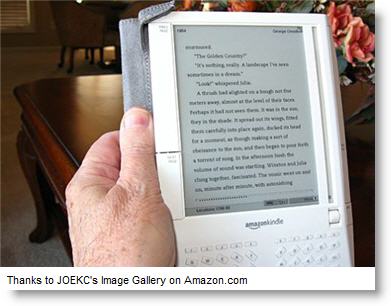
I’m getting used to my new Amazon Kindle. It finally arrived while I was gone the second week in January, and was waiting for me when I returned. So far it’s serving mainly as a reminder that I’m not getting as much time as I’d like to read. It’s functioning sort of like an unused exercise machine. I had a treadmill in the basement for several years. I’d go by it going in and out of the garage, each time remembering that I should get more exercise. But I didn’t get more exercise.

Aside from that rather personal note, which obviously isn’t the Kindle’s fault, my initial surprises were pleasant:

  1. It’s much smaller and slimmer than it looks like in the pictures. Even the pictures with the kindle in hand make it look bigger and clumsier than it really is.
  2. It really is easy on the eyes, quite comfortable even for 60-year-old eyes. The black type on gray (almost white) background is crisp and clear. I know I can adjust the type to make it more comfortable, but I’m still in the default.
  3. The wireless connection to Amazon.com is brilliant. It’s easy to use, intuitive, a great implementation of hardware and software.
  4. Most of the books available offer a first chapter free, so you can read a few pages before you decide whether or not you want to buy. I love this feature, which Amazon hasn’t advertised. I’m afraid I’ve bought a lot of books that disappointed me, and I’m curious, so this is a very useful feature.
  5. Pricing gives me some advantage in buying Kindle vs. buying regular books. Topping every book off at $9.95, for example.

And, of course, some minor disappointments:

  1. Some of those first chapters aren’t really first chapters; they’re like tables of contents. You don’t really get to read and decide. That’s what I found on several books, all of which were non-fiction, related to business planning. (Teri Epperly at Palo Alto Software is working with me to get my Hurdle:the Book on Business Planning into Kindle format; we’re going to make sure our first chapter is really the first chapter.
  2. This is a product that really could have used Apple-level design. While it is really small and easy to carry, the buttons and tabs and such are clunky, old-fashioned. No iPod designers on this project. I keep pushing next page and previous page buttons that I didn’t want to push.
  3. Not Amazon’s fault, but it occurs to me that the Kindle will have to power off during takeoff and landing on commercial flights. That’s a bummer. One of the best advantages of books is you can read them when you can’t do anything else, like during those airline moments. Can’t we establish that having the Kindle on, with its super low power and static technology, won’t crash the plane?

Finally, about pricing:

I would immediately buy a Kindle for two or three people in my family if it were priced at $199 instead of $399. The price strikes me as out of whack, sort of like that initial iPhone $600 price that went down a couple of months later. It’s an eBook reader, not a PDA, not a computer.

Still, there is something fundamental about keeping prices related to demand. Amazon couldn’t meet all the demand they had for early Kindle buyers. I ordered mine in early December, and I had to wait until early January. That’s not a time to lower prices.

Breaking the Rules of Grammar

I’m a hypocrite on this subject. I don’t easily forgive what I call bad grammar. Using then for than drives me crazy. Using the apostrophe for simple plurals, not possessive, makes me unhappy. I hate sloppy spelling. I react to that like spinach on your teeth or fingernails on the chalkboard.

But I like to begin sentences with "But". I like short sentences. Sometimes I like incomplete sentences.

For example, the first paragraph of Body Surfing, by Anita Shreve. I read this book over the holidays, on planes and on the beach. It was a good story and, in my opinion, good writing:

Three o’clock, the dead hour. The faint irritation of sand grit between bare foot and floorboards. Wet towels hanging from bedposts and porch railings. A door, caught in a gust, slams, and somewhere near it emits the expected cry of surprise. A southwest wind, not the norm even in August, sends stifling air into the many rooms of the old summerhouse. The hope is for an east wind off the water, and periodically someone says it.

An east wind now would be a godsend.

There are two sentences there that aren’t really sentences. Brother Salvador, who taught senior English at St. Francis High School in 1965, would have flunked the author for that. Which two, you ask? "Three o’clock, the dead hour" has no verb, so it shouldn’t be a sentence. "Wet towels hanging from bedposts and porch railings" has no verb –even if you thought "hanging" was the verb — and is therefore not a complete sentence. Brother Salvador did not excuse grammar or spelling errors. One single grammar or spelling error turned a 10-page paper from whatever it would have been to an F. Much as I hated that then, I’m still grateful today. He was a good teacher.  I got an F on a paper for using "it’s" instead of "its." I learned the difference.

Curiously, she could have corrected both grammatical errors easily. For the first, just add "It’s," as in "It’s three o’clock, the dead hour." For the second, changing hanging to hang, as in "Wet towels hang from bedposts and porch railings." But she didn’t. And I like it her way better.

I like crisp short sentences, even when they are so crisp and so short that they aren’t even sentences.

This reminds me of an encounter years ago with a talented copy writer named Cahill Brown (or Cal Brown) who produced the copy for the first red box with yellow pushpin design of Business Plan Pro, in 1996. He wrote tight copy that wasn’t always in complete sentences. He did bullet points. Easy to use. Powerful. Things like that. Collections of words that worked, sometimes words in sentences without verbs. For example:

You’ve put in the ideas. The words. The numbers. Now it’s our turn to make you shine.

Not a numbers person? Not to worry. We’ve input the formulas. Built the charts.

Writing like that made me and Teri Epperly (she was then our on-staff editor, now she manages a group of editors) nervous. Cahill answered our concerns with "It’s not writing, it’s copy writing. It doesn’t have to be correct; it has to work."

Right on.

Don’t Tell me Not to Buy, Tell Me Why

If you’re going to be bad-mouthing a vendor on your blog, tell me why. Otherwise it’s kind of insulting. Give me the details. Let me know what happened.

I’m curious. And besides, we all get a gossipy pleasure in hearing what they did to you.

But the title of this post was "don’t buy from [so-and-so, computer company]" and the total post was "one word: nightmare."

Just "one word: nightmare" doesn’t empower me, the reader, at all. It makes me a tool, an accomplice in a threat. I can’t help imagining the exchange: "If you don’t give me this, or do that, I’m going to write about it on my blog."

Let me be the judge. Tell me what happened.

Note: I’m leaving the details out, not referring to the actual blog, because I’ve had no contact with the vendor in question and don’t want to leverage the negative.

Like Breath Mints, Always Accept Editing

I’m surprised by Seth Godin’s post Editors from late last week. Particularly this sentiment:

Great products, amazing services and stories worth talking about get edited along the way. Most of the time, the editing makes them pallid, mediocre and boring.

Sometimes, a great editor will push the remarkable stuff. That’s his job.

The easy thing for an editor to do is make things safe. You avoid trouble that way. Alas, it also means you avoid success.

I say that not accepting editing is like not accepting a breath mint when somebody spontaneously offers. Think about it. The editor doesn’t understand what you wrote? Rewrite it.

If you wrote it, being understood is your responsibility, not the reader’s.

I’ve learned to like editors and like editing, but it took a while. Early in my career, when I was still a journalist, the editor had the last word. Sometimes I didn’t like the changes, but I had no authority. As time passed, I realized I’d had some very good editors — at BusinessWeek, for example, and at UPI — who made my work better. Among my editors at Hayden Books, McGraw-Hill, and Dow-Jones, some were annoying, some became friends, all of them made my books better. They didn’t rewrite, but they told me where they didn’t like it. Usually, but not always, I rewrote.

I’m surprised at how negative Seth’s comments sound. He’s an excellent writer, very concise, interesting, easy to understand, and right to the point. Has be been arguing with his editors?  How? Is there a more successful business writer in the last few years? Who has the last word in that relationship?