Category Archives: Technology

5 Things I Like About My Tablet Computer

(Note: this is cross-posted from Small Business Trends, where I posted it earlier today. Tim.)

I’m writing this on a crowded plane, New York to San Francisco, in middle December. I didn’t get the upgrade to business class. Every seat on the plane is taken. The guy in front of me has pushed his seat back so far I could be writing this in marker on his bald head, which feels like it’s in my lap (ugh — sorry for that image).

The good news is that this plane has plugs, meaning power, meaning my laptop would be able to last the whole six-hour flight. This is one of the United Air Lines planes running coast to coast with a lot of what they call "economy plus" seats. I think the plugs for power are new, at least my first time for that feature was last week on the flight out from the west coast.

And the even better news is that I can work, despite the lack of space, because I’m traveling with my tablet computer. It sits very comfortably in my lap like a spiral notebook, and, despite the lack of room for a keyboard, I get things done. I’ve done half a dozen blog posts, including this one, in handwriting in Microsoft OneNote, which works.

I love keyboards. My affair with the tablet is not about preferring handwriting to keyboarding, in case that’s what you’re thinking. I touch type well and fast. However, you can’t always use a keyboard, and the tablet gives me a comfortable note taking option, and still offers me a keyboard when I want one and have the space. The keyboard is separate but clicks in, and doubles as a traveling case. I even have an extra keyboard that folds up into a very small size, and connects via Bluetooth. Although lately I just take the latch-in keyboard case, so I don’t have to use handwriting to do my email in the hotel.
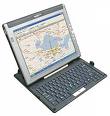
So I’ve been meaning to post about my feelings about the tablet computer for several months, and now is the time. This is my third tablet computer, the second one with this form factor. I liked that second one (an earlier model of Motion Computing’s slate tablet) so much that I bought six of them for other managers in the company.

My first was a convertible, with a keyboard always attached, that swung around to work like a tablet. It was too heavy, not practical, but it ended up useful because we left it in the conference room.

Which brings up a special tip — a tablet computer plugged into a projector, using blank pages in PowerPoint, is the same as an electronic white board. Run the meeting, keep the notes, save them, distribute them … remember when the latest and greatest in office technology was a savable white board? This is it, now.

Meanwhile, from what I read, the tablet computer hasn’t caught on well, which is one reason that I thought it might be useful to post my opinion about it. Contrarian opinions are more fun. And, finally, since lists are a popular format, here is a list of what I like about my tablet computer:

  1. As I said in the beginning of this post, it is very useful on planes, because of the tight spaces. The seat back in front of you is not going to smash your LCD. I mentioned handwriting and blog posts, and for that the handwriting is a compromise. But for working with PowerPoint, a medium in which you shouldn’t use a lot of words anyhow, it’s really good.
  2. It’s great in meetings. Maybe it’s old fashioned of me, but I don’t feel comfortable typing while people talk. And I do feel perfectly comfortable writing notes, as if it were into a spiral notebook.
  3. It’s excellent for presentations. Plug your tablet computer into the projector, and then you can write on your slides. You can take notes as people make comments, or compile lists, or highlight graphics.
  4. It’s good for off hours too. I’m an iTunes fan, and the tablet lets me hold it comfortably like a portable TV. So it works very well as a substitute media player with a pleasantly large screen.
  5. It’s great for eBooks. Now I have to admit I’ve ordered an Amazon Kindle, which relates to a post I did on another blog, but in truth while I travel with a tablet computer there is no good reason — except that I like gadgets, and sometimes I write about them — to have a Kindle.

My tablet is by Motion Computing, the LE1600. It’s two years old now. And, just in case you’re wondering, my company paid for it and also for the other six tablet computers I got for managers at Palo Alto Software.  This one lost a hard drive a few months ago and was in repair for a couple of weeks. Another one lost a drive and was scrapped, repair cost too much. And finally, just to keep us all honest, I think I like mine better than any of the other managers around who use them.

Watching the Kindle

So response to the Kindle is heating up. I ordered one and discovered they’re back ordered, not promising to deliver before Christmas. I’ve seen a thoughtful post suggesting that Amazon will regret not making it a more open system. And reviews on Amazon are only lukewarm.

The delay is okay with me, it wasn’t a gift, I just want it. I rationalize that I’ll be able to blog about it, but that’s just MBA rationalization, I ordered it because I want it. I did that in June with the iPhone, paid the $600 to get it the first day, and I don’t regret it.

But you realize of course that I will have to tell you about it when I finally get it. I’m looking forward to it. In fact, I already didn’t order a hard copy book from Amazon today, because I see it’s available on the Kindle, and I want to wait for the Kindle version.

I’ve been an ebook fan long before the Amazon Kindle. I’m proud of that. I like the idea of an ebook reader. I bought the old Rocket ebook reader five years ago (or so) and I was glad I did. Before that I bought my first PDA — maybe seven years ago — for its ebook capabilities, and I actually read several full-length novels on it before I went on to something else.

In the interest of full disclosure, that Rocket ebook was a gift for a teenage daughter with a reading addiction, at the rate of two or three books a week. It was in part a defense against "Dad, can we go to Borders?"

"Download it dear, download it."

The reception of the Rocket ebook reader was underwhelming. I thought my daughter was possibly the only user, so I wasn’t surprised when the content stopped coming, but I just did a Web search and found somebody else who owned a Rocket ebook reader … and liked it:

I owned the first Rocket Reader(NuvoMedia) in Grad school and loved it, absolutely loved it. I found it versatile (I could also sink my own documents to it, as well as free ebooks I found at Project Gutenberg. I could add notes and bookmarks). I read my first Dan Brown book for under two dollars, Angels and Demons, before he was discovered by the world.

Rocket Ebook Reader

That seems odd because apparently the Rocket was not a success. They stayed away in droves. I thought my daughter was the only user, so I was glad to see Rebecca’s post, but that doesn’t make it mainstream (sorry, Rebecca, but then you do call your blog "the eclectic musings of an oddball").

And yet, times change, technology marches on, and here comes Amazon with a new thing. The big gimmick is that you’re not tied to the computer, you can download the books from anywhere that has a cell connection.

Meanwhile, David Weinberger suggests the new Amazon Kindle may be "a textbook example of how the strengths of closed platforms can quickly turn into a weakness." 

One thing Amazon has going for it is that Kindle ebooks are cheaper than real bound paper books. Just a bit cheaper, unfortunately. They certainly aren’t taking Seth Godin’s recommendation for really disruptive marketing, which he titled You Won’t Find Me on Amazon’s New Book Reader.  He makes a good point, but actually, I think I will find him there.

Meanwhile, on the Harvard Business Online site, David Weinberger says Kindle is going to fail because it’s a closed system.

Amazon’s Kindle e-book may turn out to be a textbook. A textbook example, that is, of how the strengths of closed platforms can quickly turn into a weakness. From a product perspective, Kindle addresses every key weakness of its predecessors …

But Kindle operates in a closed universe, and that’s why it probably won’t succeed in the long term as currently constructed.

Interesting coincidence, he finishes that piece by asking "How about iTunes? Where do you see openness encroaching next?" Meanwhile, I’ve just this week switched my music buying patterns from iTunes, which annoys me by controlling how many computers I listen to purchased music on, to Amazon, which doesn’t. That’s right, Amazon is the open system vendor that switched me from iTunes. So it goes full circle.

Seth Godin on Web 2.0

Seth Godin is interviewed recently about Web 2.0 by Gerhardt on sellingpower.com.


http://video.google.com/googleplayer.swf?docId=-4379407413504809142&hl=en

Note: This post contains a flash video of the interview in question, and I have to apologize for it not showing up in some situations. I see it perfectly in Internet Explorer 7.0 but not in Firefox. The source file is Flash (SWF), and my Firefox think’s it’s set to play flash, so I don’t know what the problem is, and if you’ve been left out, I apologize.

— Tim

Blog scraping? Mayflogging? Or just plain stealing?

Like so many others I’m gloating over Virgil Griffith’s new Wikipedia scanner application unmasking the Wikipedia whitewashing of corporate, government, and PR interests. Bloggers and journalists are having a field day with it. Technorati shows 762 blog posts on it as I write this. Google shows more than 320,000 Web pages. And the wikiscanner home page has an honor role of mainstream news organizations picking up the story.

Go Virgil, well done.

Take a deep breath and well-earned pause. Then go after mayflogging. What’s mayflogging? I was hoping you’d ask. It’s what Wikipedia calls blog scraping. Copy a blog post, put it onto a temporary blog immersed in ads, and put up a flock of one-day parasite blogs to link to it and move it up in the Web searchers. Catch some Web searchers, get some clicks, make some money, and disappear.

I say we should call it mayflogging.  That’s "mayfl" for mayfly, and "ogging" for blogging, and the additional "flogging" in the middle because it sounds painful and it should be. The mayfly is an irritating bug that lives for just a day or so and spoils an occasional warm May afternoon by a lake. I’m glad they don’t bite but they do fly around your head and irritate the bejezus out of you, which of course is what these mayfloggers do. The illustration here, from Wikipedia, is a gang of mayflies covering a truck. Click on the image. It doesn’t show well here small. It’s ugly. So it’s a lot like mayfloggers with a post. 2007-08-26-mayflogging.jpg

It can get ugly very quickly. For example, the search results here to the right, from a Google blog search done today. Every one of the references you see takes a column first published at entrepreneur.com and repeats it word for word, without permission, as bait to get people to go to a temporary blog and click on some advertisements. It’s like radar jamming, dozens of listings with those search terms embedded in the copy but no content except clicks for ads, or some article stolen from some other website and repeated ad nauseam to generate click through.

Why do you care? First because this is commercial pollution, it fouls blog searches with sludge. Think of the swamp gunk fouling up those Internet tubes. It eats up infrastructure and interferes with searching. Second because they’re stealing your time. Third, if you’re posting at all, they are stealing your content.
Yes, as you’ve probably already guessed, I wrote the entrepreneur.com article they’re stealing in my example here.

Here’s how it works: You write a piece and publish it or have it published somewhere. It looks like it will attract people looking for that topic in the search engines. These blog scrapers pick it up and copy it onto blogs, surrounding it with ads.  Then they create, using software designed to make that simple, dozens of instant blogs using a free blogging tool like Google’s blogger. Those new blogs link to the target ad-soaked blog and push it up in the searchers. Then when normal people search for "sales forecast" they find the ad-soaked blog, which is using your work without permission, and, in many cases, against your interest. You probably don’t like to see your soulful post surrounded by trashy ads. And when it comes right down to it, nobody asked you, but it’s your work they’re using.

I’ve seen my work surrounded by all kinds of creepy ads. Usually its canned rehash business plans, just a useless twist on sample plans; but last week I saw my sales forecast article surrounded by ads for singles, supposedly available women in my home town. That’s a strange piece of sludge marketing, to be sure.

I’d like to object, but, like the mayfly that lives annoyingly for just a single day, these blogs are gone two days later.

Maybe Virgil can make the mayfloggers accountable. Cnet has a piece this month on how blogger Lorelle VanFossen reacts to mayflogging. They call it "please don’t steal this Web content."

Lorelle VanFossen is passionate. An author, travel writer and nature photographer, she also has a popular blog about, well, blogging. Her pet peeve is online plagiarism, which she encounters nearly every day. "It’s one of my favorite subjects," she said. "I make my living from my writing, and when people take it because they are ignorant of copyright laws–or think that because it’s on the Internet, it’s free–it makes me really mad. It’s stealing content, in my mind."

What’s to do about it? Governments obviously can’t help. Google is apparently working on it, but it’s a tough case because Google’s free blogger facility is one of the frequently used tools of the mayfloggers. And how do they distinguish between an interesting new blog and a mayflog? Should the Google blog search algorithms discount something for just-created blogs with only a couple of posts? The Techorati blog search does something like that with what it calls an authority rating for a blog, but the mayfloggers get into Technorati too.

Unmasking the mayfloggers won’t solve the problem, but it would help. I’m rooting for Virgil Griffiths, or anybody else out there with that kind of combination of know-how and initiative.

–Tim

Passion, 30 Years Later. Steve Jobs and Bill Gates Together

We talk about passion in entrepreneurship, often as the glue that holds things together. That  – passion — is not a quality we normally associate with 50-something-year-old people running companies with thousands of employees and billions of dollars in sales. Watch Steve Jobs and Bill Gates together, though, and you have to sense the extraordinary passion that manages to stay at the core, stay warm and alive, even over this very large span.

It’s particularly telling that this interview starts with clips of both men as driving and already-successful entrepreneurs in 1983, when Jobs looked like a lost Beatle and Gates like that kid in high school who got straight As and didn’t date. They light up again and again, particularly as they look ahead at new things coming, and again when they look back on what made them.

Gates, when asked about his second career as philanthropist changing the world, said "the most important work I got a chance to be involved in, no matter what I do,
is the personal computer. You know, that’s what I grew up, in my teens, my 20s,
my 30s, you know, I even knew not to get married until later because I was so
obsessed with it. That’s my life’s work."

He recognizes the importance of changing the world, but pauses, and finishes with "But the thing that I’ll, you know, if you look
inside my brain, it’s filled with software and, you know, the magic of software
and the belief in software and, you know, that’s not going to change." That, I think, is the kind of passion that builds great things. That’s also the focus that builds great things.

Steve Jobs, in the same context, says "we found what we loved to do and we were at the right place at
the right time and we’ve gotten to go to work every day with super bright people
for 30 years and do what we love doing.

"So I don’t think about legacy much. I
just think about being able to get up every day and go in and hang around these
great people and hopefully create something that other people will love as much
as we do. And if we can do that, that’s great."

Gates added that it was "the idea of being at the forefront and seeing new things and things we wanted to
do and being able to bring in different people who were fun to work with
eventually with a pretty broad set of skills and figuring out how to get those
people those broad skills to work well together has been one of the greatest
challenges." Jobs then said "People say you have to have a lot of passion for what you’re doing and it’s
totally true. And the reason is because it’s so hard that if you don’t, any
rational person would give up. It’s really hard. And you have to do it over a
sustained period of time. So if you don’t love it, if you’re not having fun
doing it, you don’t really love it, you’re going to give up."

This particular exchange about passion in just one of many fascinating exchanges in a one-hour  event yesterday (May 31) at the Wall Street Journal D5 conference. They talked about more than 30 years of building an industry, their
rivalry, alliances, and a great deal of what’s new, what’s next, and
what’s different. I started it with about 20 minutes available, and ended up watching the whole thing.

Happily, the video and transcript are available on the Wall Street Journal website. It’s moderated by Wall Street Journal columnists Walter Mossberg and Kara Swisher.

The video is broken into several parts, a practical improvement because of bandwidth considerations. If you don’t see the video immediately, scroll downwards.

— Tim