Category Archives: Social media

New Game: Social Media Snooping vs. Social Media Cleansing

The other shoe dropping: Business Insider posted This Company Will Expose All Your Most Embarrassing Online Moments a few days ago. It’s about a service company that helps employers by doing a social-media online background check on a potential employee.

It was more than two years ago that I first saw a business plan for a social media cleaning service, meaning a company that would clean up all those dumb and embarrassing things college kids posted on Facebook, when they wake up to the job market and the implications. (Aside: that one was done by Kai Davis, who is now doing marketing for Palo Alto Software).

My favorite comment in this context:

What part of the word publishing don’t you understand?

I’m traveling as I write this, waiting for my car to get new brakes while on a driving trip to California. While I was driving this morning I heard a major radio station commercial for a social media cleaning service. Sorry, I forget its name, I’d like to mention it.

So the contest is on: the social media scraping service, telling your next employer every dumb comment and picture you posted online; vs. the social media cleaning service, helping you get all of that off of the web.

Shall we take bets? Who wins?

(Image: heal the bay/Flickr CC)

OK Maybe I Communicate with Logos … But Are They Friends?

Social media seems inherently about people, to me, not companies. It’s like a conversation, sort of, but one that has publishing mixed in, so it’s an amplified, recorded conversation. Do you agree? Isn’t this what’s happening on Twitter, Facebook, and LinkedIn?

But there are companies there too. Do we engage in conversation with companies? Perhaps, but not in the same way. I’ve used social media methods to contact companies looking for solutions, or information. So I’m glad they’ve made themselves available to me for that. I’ve tweeted with hosting providers, airlines, and restaurants. It’s nice, but it’s not conversation.  The tweet here from Infusionsoft, for example … I like the company, but is this good use of social media? I’m glad they’re there when I need them, but it’s not conversation.

I engage happily with people at companies. Shashi Bellamkonda., for example, who works with Network Solutions, or Richard Duffy, with SAP. These are people. I’ve met them on Twitter, and then in one case in person and the other by phone. This is actually social, amplified by technology. It’s cool.

I don’t care to converse with the Infusionsoft logo, or the Pillsbury Doughboy or the Michelin tire creature. But I’m glad they’re there too, when I want to communicate with them about business.

How do you feel about this?

My Recommendation About Your Twitter, Facebook, and LinkedIn

A couple of weeks ago I was in a classroom full of entrepreneurial MBA students, as a guest speaker, answering their questions about me and Palo Alto Software and bplans.com, this blog, and so forth.

When they asked me how I managed my online self in social media, my response went something like this:

I don’t do social media clutter. I think of social media as publishing and I try to offer nothing that isn’t useful to a reader. When I’m on Twitter I tweet only what interests me and might interest somebody else. I highlight blog posts I wrote and posts I read that seem worthwhile. I ask questions. I sometimes share something useful about business planning, or small business. I use TweetDeck to manage my Twitter self, and I set TweetDeck up to share that with my Facebook and LinkedIn pages.

Several of the students seemed troubled. One of them asked: “So you never post anything personal? What about who you really are?”

And I realized, with that question, that maybe I was lucky. I got into social media late in life. The topics I care about are business related, and my friends are business related. I was already a published author and business owner. I wasn’t ever tempted to post the kind of personal stuff that gets younger generations in trouble. I was always aware of it as publishing, not just gossip. Most of the students, on the other hand, started on Facebook as high-school or university students. Facebook was fun first, business, if at all, only as an afterthought, later.

So here’s my advice: your social media presence is public. It’s publishing. Never clutter it up with personal trivia, much less drinking parties, embarrassing pictures, inappropriate comments, or anything your adult self might not be proud of. Use phone, sms, and instant messages for playing around with friends. Build a social media presence you’ll be proud of when your next prospective employer, boss, or client looks into it.

Oh, and by the way: you don’t have to call it personal branding. You can just call it taking care of your reputation.

5 Rules for Kindergarten Friends and Twitter

Not long ago I was driving a five-year-old grandson to kindergarten when he asked me how to make friends. That’s ironic because networking is hardly my strong suit, but he doesn’t know that. And I guess that’s what kids expect grandfathers to know, so I really wanted to help him. grandsonsI tried. It sounded like a lot of clichés to me, but then I’m not five years old.

I think it’s about Empathy. That’s too big a word for a kid, so I called it feeling what the other kids feel. You have to be a friend to have a friend; the golden rule; kindness. etc. My mother would have said “put yourself in the other kid’s place.” My mother-in-law called it “see yourself through the other kids’ eyes.”

Just a few hours later, in a group of mostly-baby-boomer types drawn together by interest in entrepreneurship and possible angel investment, Twitter came up. I like it and I said so. Somebody asked me for supposed secrets of success in Twitter.

Without actually thinking of that  moment with my grandson earlier that day, I gave them these five tips for success with Twitter. And as I did so, it struck me that it’s mostly the same thing: empathy.

  1. Offer something other people want. In Twitter specifically, nobody cares what you’re watching on television or eating for lunch. It’s publishing, not babbling. Use twitter to offer people quotes, humor, ideas, and – my favorite by far – useful links they can follow up on.
  2. When in doubt, treat others like you want them to treat you. Teasing, mocking, insulting, shouting (all caps) are not appreciated.
  3. When you don’t have anything to say, don’t say anything.
  4. When you’re angry, wait. Breathe. Think about it before you do it. Public arguments are ugly. And (when published on Twitter, at least) they live forever. Angry words are not biodegradable.
  5. Return favors. When somebody does you a favor, remember it, and do them a favor back. Thank you is nice but a favor in return is more effective. In twitter at least, too much thanking becomes clutter. Twitter involves a lot of passing other people’s tweets (posts) along, called re-tweeting, so when somebody likes what you’ve published (tweeted) there and passes it to others, find something of theirs to pass along (re-tweet).

The next time I was with my grandson, I gave him almost this same list, revised only slightly, for kindergarten use. And while I’d like to report that he took it to heart and he’s now the life of the proverbial kindergarten party… well, at least we’re both still trying.

(Image: My own photo. All rights reserved. © Timothy J. Berry)

Disturbing Look at Search Engine Innards

I was browsing the NYTimes online yesterday when I discovered Search Optimization and Its Dirty Little Secrets. I couldn’t stop reading. Author David Segal investigates the dark side of search engine optimization in a story that blends mystery and suspense while it gives good background of something that affects most everyone who owns a business.

Segal starts by setting the story:

PRETEND for a moment that you are Google’s search engine. Someone types the word “dresses” and hits enter. What will be the very first result?

And from there, introduces the mystery of JC Penney’s seemingly inexplicable search-engine success:

The company bested millions of sites — and not just in searches for dresses, bedding and area rugs. For months, it was consistently at or near the top in searches for “skinny jeans,” “home decor,” “comforter sets,” “furniture” and dozens of other words and phrases, from the blandly generic (“tablecloths”) to the strangely specific (“grommet top curtains”).

What happened? That makes for great reading — about search engine black arts, cheating the algorithms, manipulating links, fly-by-night stealth sites, and big business. And it seems like good investigative journalism as well. The Times paid a search engine expert to drill down into JC Penney’s success, and what he comes up with was surprising to me. Especially when I thought about how much is implied but not actually said.

And it includes a lot of background that’s good to know. Most businesses depend on search engines and search engine placement. And some of this is scary.

Read it: I dare you.

Social Media Business Reality Check

I took a one-hour flight over the weekend and ended up talking to a smart business owner — she has a bakery in a small town in Oregon — who doesn’t have any Web presence. bread

What’s really cool is that her business, as she described it, is doing just fine. She makes a good living, it’s in a small town she loves, she knows all of her customers, and she enjoys her days. She loves the actual work. She enjoys the baking and she enjoys the interaction in the shop.

She is online, but in her own way. She has personal email and uses it often to keep in touch with grown children and grandchildren.

So, what do you think? Does she need to start a blog? Should she be announcing daily specials on Twitter? Should she have a Facebook account? Should she be apologizing to me (sort of) as we talk on the plane because she doesn’t do any of that stuff?

I don’t think so.

Sure, I do see that the online world provides a great leveler, a wonderful opportunity for even the smallest business to share and validate expertise and build a reputation. I’ve known some and read about many businesses that do very well in online reputation and social media. Still, let’s not assume that everybody has to follow the same path. Are there additional opportunities for my bakery friend? Sure. Is she crazy to just do what she’s doing? What do you think?

(Image: DUSAN ZIDAR/Shutterstock)

3 Posts on Stuff We Know But Frequently Forget

Does this happen to you? You read something, love it, realize you sort of knew it, but this author puts it in a new context, new light, or new list, so that it’s very useful to you just to see it again? I found three of those this week in three blog posts:

  1. Donna Fenn posted The Top 10 Best Ways to Fail as an Entrepreneur on BNET. Manage partnerships poorly … hire too fast — grow too fast … delegate sales. She has some useful surprises and good reminders.
  2. For a good practical review of what makes your website work, read 6 Must-Haves for Your Small Business Website, by Lisa Barone, on Small Business Trends. She mentions intuitive navigation, sticky content, a blog … that’s another good collection of reminders.
  3. Seth Godin is amazing. He so often says so much in so few words. His post Pleasing is maybe 100 words long. If you’re in business, read it. You know what he’s saying there, but you keep forgetting.

I saw an interview with Seth Godin where he says he puts labels on things we already know. I think he’s underestimating himself with that description, but still, give me those labels. Well done. 

(Image: Evlakhov Valeriy/Shutterstock)

Twitter and Problogger to the Copyright Rescue

OK, this is cool. The web makes copyright stealing so incredibly easy, and it’s extremely annoying when it happens to you. And it happens all the time. So you have to like this example.

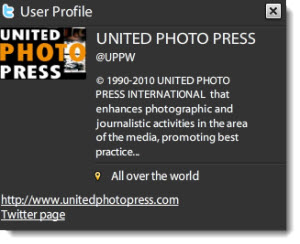
Here, to the right, is what Darren Rowse, blogger extraordinaire at problogger.net, @problogger on Twitter, decided to do about it. He posted it on twitter where his 117,809 followers can see it.

No, I don’t know the facts in this case. If it turns out I’ve become a pawn in some foul plot, unwittingly ganging up with Darren against an innocent photo business, I apologize. It sure looks like United Photo Press is linking to Darren’s work and presenting it as theirs. Right?

I’m jealous. I still remember when a competitor took a GIF my son had done, painstakingly combining all the logos of all the magazines that had reviewed our product, and posted it on their website. I would have loved to have been able to publish that on Twitter.

And while that one is old news, all the time now fly-by-night blogs pick up my stuff, often from here, and post it as their own, presumably for spam or SEO gains. That’s happening now, today, often.

In this case, though, the alleged culprit in this case, United Photo Press, isn’t flying by night. It’s been around since 1990, and one can assume it’s staying around.  So maybe this really works. I hope so. If it’s true, I hope Darren’s tweets get it to stop.

Darren, United Photo Press, can we get an update, now that the problem has been published on Twitter? Was the problem solved?

Small Business Labs on Trends for 2011

Sure, there are lots of trends pieces going around these days, but Steve King of Emergent Research is the best expert I know on researching trends and putting them into sensible pieces. His company does some really good trends research that is often published by Intuit. , so I’d like to share his Top 10 Small Business Trends for 2011, some of them with my comments.

First, four major economic trends:

1. The small business economy recovers from the great recession.

From your lips (or keyboard), Steve, to God’s ears. May you be right on this one.

2. Variable cost business models:  Small businesses will continue to focus on cost containment, bootstrapping and business flexibility in 2011.  More small businesses will shift from fixed cost to variable cost business models, adopting a pay-as-you-go approach to minimize cash requirements and increase business agility.

3. Small firms reinvest U.S. Manufacturing

That’s a surprise to me. I thought U.S. manufacturing becomes less competitive. But Steve points to the weak dollar, technology, growing world markets, and the web giving more worldwide access to smaller companies.

4. Alternative financing

He cites “merchant advances, micro lending, community lending, crowd funding, and factoring.” I bet alternatives like crowd funding take longer, though, because of securities law, fraud, and those worries.

Second, five social and social media trends:

5. Social media moves to the small business mainstream.

6. Social commerce: the amazing growth of Groupon and other social commerce sites in 2010 …

7. Small businesses friend Facebook. …. small businesses are embracing and adopting Facebook as a key part of their web presence, and in growing numbers using Facebook as their primary website.

Myself, I’d like to see more examples.  Is this proving to be good business?

8. New localism continues to flourish

9. Freelancers realize they’re small business owners

It’s about time.

Finally, one technology trend:

10.  Working in the Cloud: No trends list would be complete without mentioning mobile, cloud, local and social computing.

No surprise there.

So I give special attention to Steve’s trends posts because 1.) that’s what he does for a living, mainly; and 2.) he’s good at it.

You Are Always Being Judged. Deal With It.

I overheard (couldn’t help it; waiting in line) somebody complaining about social media metrics like the Klout score, a measurement of influence. She said: “What’s up with these people to try to judge and rank people?”

And I thought to myself:

1. You are always being judged and evaluated…

A couple of generations ago we were all judged on appearance, dress, diction, actual resume stuff, and perceived resume stuff. We went from being tracked through dumb class to smart class beginning in first grade through the whole high-school thing with grades and SAT scores, dating and coolness assumptions, athletics, accerated classes, or not. And then there was which college, which degrees, and, finally, for some of us, which grad degrees. And did we marry or not, and if so, kids or not. And then where we lived, what car we drove.

People have been sorting and selecting and evaluating and judging other people for thousands of years. There is nothing new about that.

2. At least it’s objective…

So now it’s almost 2011 and we’re all doing it as much as we ever did. I don’t deny it. I google you if I’m going to meet you, check out your blog if you have one, your website if you have one, look at the “about” page to see what you think is important about yourself, see who you think you are. Don’t you?

So what’s so bad about a ranking system for Twitter and Facebook based on some algorithms, measuring how your self-published items flow to the rest of the world?

(Disclosure: one of my daughters works with klout.com)