Category Archives: Entrepreneurship

Go Ahead: Disagree. I dare you.

This one had me from the moment I saw the title: Dare to Disagree. I clicked, watched, and I love it.

Good disagreement is central to progress. She illustrates (sometimes counterintuitively) how the best partners aren’t echo chambers — and how great research teams, relationships and businesses allow people to deeply disagree.

I’ve seen this for years in starting, growing and running a business. It’s vital. Do yourself a favor. Take 12 minutes to watch Margaret Heffernan in this TED talk. She starts with a real story, and gets into the nuts and bolts of making disagreement work for you.

http://video.ted.com/assets/player/swf/EmbedPlayer.swf

If you don’t see this video here, you can click here to link to the original on TED.com

3 Incredibly Common Credibility Killers in Business Plan Numbers

Business plans are about business decisions. When I read them — and I read hundreds of them every Spring — I’m looking for the concrete specifics, like dates and deadlines and tasks and milestones, that point towards execution. But part of that is reasonable, credible projections. And I am way too familiar, way more than I’d like to be, with these three very common mistakes. 

Credibility killer #1: unbelievable profits

Face it: startups aren’t normally profitable. Existing businesses, once they’re established, rarely make more than 10 or so percent profits on sales (that’s profits divided by sales). Some of the best businesses make 15 or 20 percent. 

Therefore, when you project 30, 40, 50 or more percent profits on sales, you’ve lost all credibility. That doesn’t make anybody think you’ve actually going to generate that kind of profitability. It does make people think you don’t know the real costs. 

Additional tip: nine times out of 10, you’ve underestimated the marketing costs. 

Credibility killer #2: ignoring sales on credit

Businesses that sell to other businesses don’t normally get paid immediately. They send invoices for products and services. They wait. Weeks or months later, they get paid. Sales accompanied by an invoice like that are called sales on credit. They count as a sale, but instead of adding to cash they add to accounts receivable, and then they get into the bank account later, when the receivables are paid off. 

If you don’t allow for sales on credit in your projections, you kill your credibility. So plan your cash to include the additional working capital it takes to support waiting to get paid.

Credibility killer #3: expenses vs. assets

We all use the word asset to refer to something good to have, like a friend, a second language, and a college degree. More to the point, we often refer to business advantages such as a product design, software code, a prototype, brand awareness and so on as assets. 

In financial terms, however, assets are specific. They are entries in a balance sheet. Assets are equal to capital plus liabilities. Cash, inventory, accounts receivable, equipment, office furniture, vehicles … those are assets. 

The most common problem with this is what happens when you pay salaries or project fees for software or web development. That’s an expense. It reduces your profits and lowers your taxes. So it’s a loss. Way too often people show those expenses as if they were buying an asset. Sorry, we hope that your programming expenses generate something good for your business; but they are expenses, not purchase of assets. 

Oh, and that land and those buildings your business owns? Those are assets, yes, but they should be on your books for what you paid for them, not what you think they’re worth. 

Summary: 

Finance and accounting have this annoying thing about them: things have to mean what the standard principles say they mean. You don’t get to redefine them back into what you think they ought to mean. 

(Image: shutterstock.com)

Big Mistake: Meaning Mismatch in Marketing

Yesterday I discovered, to my surprise, that a good friend who does licensed massage therapy said she doesn’t think of herself as an entrepreneur.  In her mind, entrepreneurs want to get outside investment, hire employees, and grow their businesses fast. People like her think of themselves as self employed, sole proprietor maybe, small business owners probably. And those professionals, the doctors, lawyers, accountants and such, they don’t think of themselves as entrepreneurs either. I think of them all as entrepreneurs.  But what if they don’t?

Business mistake: What if you want to reach that larger group, and you address them as entrepreneurs in your marketing, but they don’t think of themselves that way? So most of the people you want to reach don’t ever realize you’re talking to them?

What about you? Official stats say there are about 27 million businesses in the United States and about 21 million of them have no employees. What’s an entrepreneur to you? There are only a handful, a few thousand, that meet that stiffer definition. What matters is whether the target potential customer self identifies into the group. If a business is aiming at one group and using a word that stands for the other, that’s a big mistake.

This isn’t just semantics. It’s not about language or definitions. It’s about the fundamentals of marketing.

In human communication, the listener assigns the meanings to the words. Not the speaker. You don’t get to tell the audience what your word means. They tell themselves.

That’s why so many marketing images show an arrow hitting a target. This kind of meaning mismatch is one really powerful way to miss.

(Image: bigstockphoto.com)


Q&A: When to Quit the Day Job and Start On My Own

This Q&A post is different. Usually I highlight questions here for my answer, meaning I’m answering a question I think others are asking, for which I’m hoping my answer might be useful. In this case, however, I’m posting because of the question itself: It’s extremely common, very important, and doesn’t have any obvious single answer I can think of. 

This question came through my ask me form on timberry.com: 

I am at a crossroads in my working life. The company I am working for is going through retrenchments and no-ones job is secure. I have good experience in the industry and was aproached by a former employer who suggested that start my own business and sub contract to them. I do not have capital and because of the problems that the company I am working for have had my finicial situation is not looking good. I have always wanted my own small business and this seems a great opportunity except I am worried about the finances. My question is simply this: Do i take the risk and go on my own or find a another better paying job and sort out my finances at the risk of loosing this opportunity?

Your advice would be greatly appreciated.

My first reaction to this is not to answer out of respect for the importance of the question, and how little information I have.  Yes, this is one of the most important questions I get, and I get it a lot, although not often as well worded as this one. And in my case respecting the question means I’m afraid to answer it simply. It’s a life-changing decision and no thoughtful person should answer it from afar, with an email answer. 

My follow-on reaction is easy answers that are cliches: things like follow your gut that sound good but don’t really help. 

My best answer is you should do a business plan. Not a formal written business plan, a plan-as-you-go business plan, a simple practical plan that’s just big enough to reduce the uncertainty; that may never get printed; that may be as simple as a target market and business offering, key milestones, and projected sales, costs, expenses, and cash flow. 

The right kind of business planning is the best way to break the huge fear and doubt down into more manageable pieces. 

(Image: shutterstock.com)

The So-Called Arrogance of Gen Y Social Media Managers

Last Friday NextGen Journal published Cathryn Sloane’s Why Every Social Media Manager Should be Under 25. Her main point was:

We spent our adolescence growing up with social media. … we learned to use social media socially before professionally, rather than vice versa or simultaneously.  To many people in the generations above us, Facebook and Twitter are just the latest ways of getting messages out there to the public, that also happen to be the best.

That generated thousands of Facebook shares, hundreds of Tweets and hundreds of angry comments. NextGen founder Conner Toohill responded Saturday, and 47-year-old guest author Mark Story posted a rebuttal on Sunday. 

It reminds me of something I saw three months ago. It was a job listing for a programming job that — the listing, in print — specified that applicants should be no older than 30. I found that shockingly stupid because it’s first of all illegal (age discrimination) and secondly, well, stupid. Discrimination is stupid. 

However, there is a huge difference between explicit discrimination is a job listing and Cathryn Sloane’s published opinion. She’s not hiring. She’s just making a point. And she’s arguing for the underdog in the situation too. So if she had just toned it down a bit, perhaps suggesting that younger people shouldn’t be ruled out for their youth, or that age and experience are different qualifiers in the context of social media, I might actually agree with her. 

What I believe, firmly, is that the 25-year-old should not be excluded from leadership because she isn’t old enough. And, furthermore, that the 40-year-old shouldn’t be excluded because she’s too old. Do you agree? With both statements? 

I really like three points that Connor Toohill makes in his A Response to Cathryn Sloane’s Article on Saturday.

First, he’s not apologizing for publishing Cathryn’s post. And he shouldn’t: 

In a time when 1 in 2 recent college graduates are unemployed or underemployed, those sentiments are understandable. You may disagree — some members of our Editorial staff happen to disagree. But we don’t consider it a mistake to showcase Cathryn’s honest opinion, informed by her own experience as a recent graduate and shared by many other young Americans. We consider it as part of our mission.

Second, he objects to the nastiness in some of the responses: 

Secondly, for those who disagree with Cathryn’s premise: we respect your opinions. Critics have already penned a number of compelling responses, and the comment section contains dozens of interesting rebuttals.  What’s unfortunate, though, is the amount of vitriol and hate contained as well. We’re referring to personal insults, direct badgering of Cathryn via her social media accounts, and allegations that this one opinion will preclude her from full employment. As one social media professional Tweeted yesterday, ‘I agree with some criticisms of Cathryn Sloane’s @nextgenjournal article, but it’s starting to look like adults cyber-bullying a kid.’ Criticism and disagreement are absolutely legitimate and encouraged, but savage attacks are out of line.

Third, he objects to the idea that opinions gain importance with age: 

One final point to address: many comments, Tweets and criticisms seemed to convey the idea that a given person’s opinions are worthless absent years of direct work experience. They referred to not just Cathryn, but our entire generation as arrogant, entitled, naïve and ignorant. They reflected back on their own days of ‘thinking they knew everything,’ and proclaimed that maybe, one day, Cathryn and other young people will finally see the light. … The implicit premise of those criticisms is ageist in its own way: they condemn the opinions and ideas of all young people as ‘not worth listening to.’ In the process, they utterly and completely ignore the many advantages that young people bring into any given situation: an energy and idealism, a sense of innovation and willingness to try new things, and a broader focus, among others.”

Mark Story in his rebuttal, makes another valid point. Addressing Cathryn, he writes: 

You confused familiarity with using social media tools like Facebook and Twitter with the ability to turn that into offering actionable, solid communications advice for internal or external clients.  There is a BIG difference between posting Facebook Timeline updates and telling General Motors what to do with their own social media presence in the midst of a crisis.

Hmmm … I’m sticking with what I posted here six months ago in age vs. experience not always obvious.  

At least with my generation, the baby boomers, we were all just one big vague hippy-long-hair-freedom stereotype and we didn’t mind it. But with Gen Y, all this stuff about entitlement and selfishness, jeez, what a drag. … She’s 25 now, classic Gen Y, and might seem impatient with managers who don’t understand Facebook and Twitter. She’s been working with Facebook from the very beginning, and adapted Twitter in 2007. She’s taken social media as instinct, commonplace, something obvious. But the world around her thinks she’s demanding too much too soon. Does that make sense?

Young people, Gen Y, and, for that matter, you 40-somethings too: Go for it. Fight the stereotypes. Demand change. Full speed ahead. 

12 Ways Best Blogging Practices Aren’t

I like Blogger Brad Shorr‘s list of 12 Most Horrible Pieces of Blogging Advice. It’s a good list, well worth reading, good food for thought. More important, in my opinion, is that it’s also an eloquent reminder of the essential case-by-case rule that applies not only to business blogging but also to all of small business, beyond blogging.

Here’s Brad’s list of 12 pieces of bad advice:

  1. Keep posts under 300 words
  2. Stick to a rigid publishing schedule
  3. Blogs are an SEO shortcut
  4. Bloggers need to be edgy
  5. Images aren’t important
  6. Blogs should be monetized
  7. All it takes to succeed is quality content
  8. Cultivate reciprocal links
  9. You must use a custom design
  10. Blogging has been replaced by social media
  11. Corporate blog content can be outsourced
  12. It’s all about subscribers.

In most of these cases, Brad takes a commonly accepted best practice or general rule and points out the exceptions. He sums up most of this with his very first item, for which he explains:

Beware of absolutes. This advice stems from the generalization that all blog readers are in a hurry. However, if your blog’s purpose is to provide information or analysis, and you’re good at it, people will be willing to read five times that word count.

In other cases, advice that used to be good advice has gone stale. For his #8, on reciprocal links, he explains:

This is an outdated SEO tactic that can now do more harm than good if you have links coming in from bad sources. For audience building only, reciprocal linking is OK, but only when you are selective in terms of the relevance and quality of your link partners.

And that, aside from blogging specifics, is the real nugget in this particular post. Attractive as advice and guidelines are, out here in the real world everything is case by case. The only rule is that there are no rules. Best practices only work when applied carefully with a lot of respect for the specifics of context and a lot of flexibility to use not as directed.

I’m sure that applies for small business too, not just blogging. And maybe for life in general too? What do you think?

Which is Worse: Making a Mistake or Losing an Opportunity?

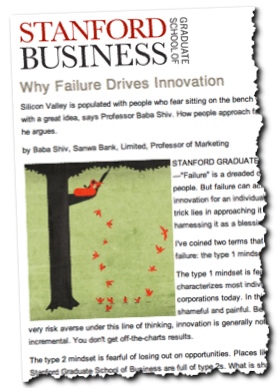
What a great thought: how people approach failure is a key to success. That comes straight from Why Failure Drives Innovation, an article by Baba Shiv, Professor of Marketing, published in the Stanford Graduate School of Business news page. Consider this:

“Failure” is a dreaded concept for most business people. But failure can actually be a huge engine of innovation for an individual or an organization. The trick lies in approaching it with the right attitude and harnessing it as a blessing, not a curse.

In his article, Prof. Shiv pits fear of making mistakes against fear of losing opportunities. 

He says most individuals, managers and corporations live with fear of making mistakes:

In this mindset, to fail is shameful and painful. Because the brain becomes very risk averse under this line of thinking, innovation is generally nothing more than incremental. You don’t get off-the-charts results.

The entrepreneur, however, is more worries about losing out on opportunities: 

Places like Silicon Valley are full of type 2s. What is shameful to these people is sitting on the sidelines while someone else runs away with a great idea. Failure is not bad; it can actually be exciting. From so-called “failures” emerge those valuable gold nuggets — the “aha!” moments of insight that guide you toward your next innovation.

I like that a lot. I’ve written often that one of the most important traits for entrepreneurs is being able to live with mistakes. This makes perfect sense to me.  

Backroom Backbiting Will Bite You Back

There’s a coffee shop in the Portland (OR) airport with the tagline “good coffee … no backtalk.” It’s hard to see in my picture here, but there it is. 

What I make of this is a reminder about a fundamental business practice that way too many business owners forget. You can’t, simply can’t, let your employees get together and amuse each other by telling stories of how annoying the customers are. 

Seems obvious. But it happens all the time. Criticizing somebody else is the best ice breaker between strangers. When you sit beside a stranger in a plane, does conversation start with how wonderful air travel is? Or does it start with how bad the airline, how late the flight, how small the seats? We criticize. It’s who we are. 

But don’t let it happen behind your scenes, backstage, in your business. Don’t let your employees do it. 

I have no data to prove it, but I’d bet that the the annoyed and self-righteous tone of the petty bureaucrat and counter minder starts behind the scenes, with people sharing stupid questions and annoying traits of the customers. 

Don’t let that happen to your business. 

(Image courtesy of Shelley’s Coffee Notes)

Really Great Ideas Seem Obvious

Amazing fact (to me at least): the first wheels on suitcases appeared in the 1970s. My wife and I, both baby boomers, have asked ourselves: how is it possible that we all dealt with suitcases without wheels all the way through the 50s and 60s? What was wrong with all of us?

And sliced bread first appeared in 1928. I’m not talking about cumulative technological advances here, like computers and cell phones and ATMs. 

Still, isn’t that the way with a lot of the really great ideas? They seem obvious. But only after you see them. 

Can you help me with this? Can you remind me of some other great-but-obvious ideas? 

A Sign of the Entrepreneurial Times. B-School Startups

According to Vital Signs – WSJ.com:

The number of students from Stanford University’s Graduate School of Business who have chosen to start their own businesses within four months of graduating has grown to 16% among the 385-member class of 2011—more than a fivefold increase since 1990, according to the university.

Only 3% of the 1990 class founded their own businesses shortly after graduating, says the school. …

That doesn’t surprise me. It’s convergence. The big companies are struggling. Big consulting isn’t as glamorous anymore. The Stanford GSB curriculum has embraced entrepreneurship. Big winners — Bill Gates, Mark Zuckerberg, Steve Jobs, Phil Knight — are household names. The Stanford business school hosts a parade of insightful entrepreneurs filling guest spots. Take a look at — for example — the Stanford eCorner or the Stanford Business School channel on YouTube. You’ll see what I mean. 

Not that Stanford is special in this regard. Entrepreneurship has taken over business schools up and down the prestige ladder. Harvard, Wharton, Northwestern, same thing. I point out Stanford because those are the emails I get, and the groups I join. And I’m glad the GSB has changed and adapted since I was there, 30 years ago, and most of us wanted to be management consultants.