Category Archives: Business Financing

If You Can’t Get Funding, It’s You, Not Them

You can’t get your new business funded? Damn, that’s disappointing. But does it prove that the world is unfair? All those other people get funded and you don’t? Or that the world is stupid?

I don’t think so. I think what it proves is that you don’t have the deal right. Investors don’t want it. Advisers don’t think you’re ready. Fix it or forget it.

Investors don’t buy into your business out of fairness, respect for your idea, or because they know you and like you; they invest in your business because they believe the money they spend buying a piece of it today has a fair chance of becoming a lot more money later. Investment is about business, plain and simple. And it’s their money. They have every right to say no. They are not a public service.

Yesterday I posted A Seasoned Angel Investor Highlights These 4 Factors here. Factor number one is previous startup experience. And yes, there is a catch 22 problem:no experience means no funding, but without funding, how do you get the experience?

It’s a trick question. If you don’t have any previous startup experience, don’t blame the world, get some. Work with a startup. Get partners who have experience. Maybe scale down the plan. Bootstrap it.

If your plan can’t get funded, don’t blame everybody else. Change the plan.

A Seasoned Angel Investor Highlights These 4 Factors

This was interesting. The speaker, Wade Brooks, is executive director of the Willamette University MBA Angel Investment fund. A couple of nights ago as he shared notes and research with members of the Willamette Angel Conference. blocksThese are the top four things Wade and his group looks for in the companies his organization is considering for investment:

1. Entrepreneurial expertise

They want people who have been there, team leaders who have been through the experience of a startup. Wade says there’s no getting the kind of experience they need without going through it.

2. Affordable loss

Affordable loss is about planning, expense control and careful management.  “A little bit of money goes a long way,” he says, when a company is careful with it. If there were no loss, they wouldn’t need angel investment at all; but a big loss means trouble.

3. Early “yes” answers

Ideally, that means people are saying “yes” to sales, and signing contracts. That doesn’t always happen, but there can be yes answers to major allies, distribution channels, beta users, and so on. The best validator is early sales.

4. Milestones met

Wade talked about “a history of performance.” That’s a matter of setting goals and meeting them. He said the company that consistently exceeds its milestones is very rare, but very good to have. Sometimes his group will redo the projections on their own, come up with substitute numbers, and then, even if the substitute numbers are smaller, they still credit the company for making those lesser numbers, if they do.

Wade and his group work with Dr. Rob Wiltbank, who has one of if not the largest database in the world on return on angel investment. The program at Willamette University is impressive — MBA students, with the help of a lot of advice, guidance, and mentoring, are actively involved in making angel investment decisions. The group participates in several of the angel investment groups operating in Oregon, and makes multiple investments every year.

Case Study: Vizme, Adaptation, and Living with Facebook

I’ve been watching vizme.com since I first saw the demo about a year ago. It struck me as immediate coolness. Imagine being able to mix up a combination of online video and pictures that play when clicked, representing a topic, theme, idea, or brand; and putting that onto your blog or Facebook page as something like an icon (it’s actually bigger than an icon, but circular, as shown here) that plays when clicked.

To give you an idea, I went over to vizme.com and picked up a token for sharing. If you click the image here, a vizme token, it should take you to some person’s creative work patching together SuperBowl commercials from YouTube. In this case, it’s a lot like a YouTube playlist, but it’s a dark background and a much more direct, less cluttered, interface. I could share it on Facebook, Twitter, or, like here, on a website. And it’s free.

I’m interested in Vizme for several reasons: It’s in Eugene, OR, so it’s local to me. It entered the Willamette Angel Conference investment contest last year, and I’m a member there, so I got to watch the pitch. It didn’t win, but it did get my vote on the first ballot. I like Dan Mayhew, one of the three founders. I think it’s a cool idea, well implemented.

vizme logoPerhaps most important, though, is the principle of adaptation. While I’ve been watching, the vizme founders have gone up and down in sophistication of the interface as they went through early users and had to make changes. They’ve had to adapt to changes in the Facebook interface that (entirely by accident, without any bad intentions on Facebook’s part) changed the way the tokens work. And they’ve been scrambling for angel investment, testimonials, advisors, and interface adaptations to fit the changing face of social media. And their revenue model has been revised and adapted several times.

And, as a great example of what happens in the startup world, life goes on. Facebook changes, vizme adapts. Users work with it, suggest changes, and vizme adapts. Those changes affect the revenue model, and vizme adapts.

For a second opinion on that, you might read Will Vizme Revolutionize The Way We Share Content? over at FastGush.

Why Market Numbers Are Like Patents: Good, But Not To Be Believed

I was enjoying Chris Dixon’s Size markets using narratives, not numbers when I realized his point is a lot like a point I like to make about patents:

good to have, but not to believe in

On sizing new markets, with startups looking for investors, Chris says:

The only way to understand and predict large new markets is through narratives. Some popular current narratives include: people are spending more and more time online and somehow brand advertisers will find a way to effectively influence them; social link sharing is becoming an increasingly significant source of website traffic and somehow will be monetized; mobile devices are becoming powerful enough to replace laptops for most tasks and will unleash a flood of new applications and business models.

That makes good sense to me. He adds:

For early-stage companies, you should never rely on quantitative analysis to estimate market size. Venture-style startups are bets on broad, secular trends. Good VCs understand this. Bad VCs don’t.

I’m with Chris on this (although I like to call them stories, instead of narratives; just a matter of style). Markets are future developments that haven’t happened yet, and stories picture the developments better than data.

But even as I write that I realize that as a frequent reader of business plans, for judging and investment purpose, I also like the numbers. I want to see how many buyers now, or how many people who meet those criteria, how much money now, a certain amount of numbers to give me a sense of size.

Which takes me back to the patents reference: I realize the best is having them but not believing them. I want entrepreneurs to realize their numbers are more background than data. Show me what it could be, but don’t think it proves anything. And with patents, well, here’s what I wrote about that last March, in  10 requests from your business plan reader:

Show me your patents if you have them but if you do, show me something about how defensible they are (if at all) and make sure your projections include legal expenses to defend them.

Does that make sense? Is there a parallel there? Both are good to have, but not to believe in? I wonder how much of business planning, entrepreneurship, and startups fit into that same basic category.

(image: Sergej Khakimullin/Shutterstock)

True Story: Dollars vs. Eyeballs in Business Valuation

It was a warm late-spring day in 1999. I sat in my office with a venture capitalist, my lawyer, and my son. The sun beamed in the patio outside my office. We talked about Palo Alto Software and its web subsidiary bplans.com. At one point the VC said:

You wouldn’t be an attractive investment for VCs. You’re too profitable.

I chuckled. I thought it was a joke. We’d grown sales in four years from less than $1 million to more than $5 million annual sales. We had to be profitable because we had no outside money.

He said:

That’s no joke. It’s like the Oklahoma gold rush, a land grab, and the assumption is that if you’re profitable, you’ve stopped too soon. You should be spending more to build traffic.

Those were strange times.

(Image: iDesign/Shutterstock)

Charting the Lesson of Wikipedia’s Jimmy Appeal

Yesterday I posted here David McCandless’ fascinating 18-minute talk on data visualization, in which he puts up charts and graphs as a window into patterns and relationships in numbers.

Watching that talk led me to discover his Information is Beautiful blog, which is a great source of ideas and insights.

For example, the chart shown here, from that blog, titled The Science Behind Wikipedia’s Jimmy Appeal:

business chart

That’s just one recent example. Fascinating stuff.

Top 10 Business Plan Mistakes #8: Making Financing the Goal

Top 10 Logo

(Note: this is the third of a 10-part series listing my revised top 10 business planning mistakes. The list goes from 10, the least important, to 1, the most important.)

It’s just too damn bad that so many entrepreneurs assume to start a business you do a plan, get financed, and then you start. As if the goal of the plan is getting financed; and as if the getting financed is the win, regardless of financed how and by whom and on what terms.

And that’s a big mistake. You should choose investors as carefully as you choose a spouse.

Contrary to the myth, winning the investment isn’t always a win. Getting investment from the wrong people isn’t a win. It’s a recipe for disaster. Marrying your company with incompatible investors can turn a dream into a nightmare. And yet so often when you talk to entrepreneurs they seem to think that just getting that investment is the same as winning the race. Find somebody to say yes and you’ve succeeded.

Not all good businesses make good investments for outsiders. Investors need exits in 3-5 years, while lots of good businesses aim for forever, not just 3-5 years. And entrepreneurs often want independence, while investors usually feel like bosses. They are owners. Some of the best businesses are bootstrapped, meaning they don’t get outside investment. They use their own funds, or early sales, and they grow more slowly but without requiring other people’s money. And some successful businesses are financed by loans, which increases the risk, but doesn’t dilute ownership.

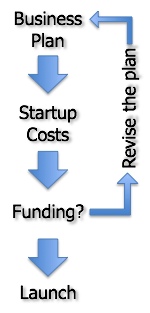
I say let the nature of the business, and the goals of the entrepreneur,  determine the financial strategy regarding investment. Some businesses simply can’t sprout without healthy amounts of outside investment. Others have no good reason to even think of investment. And most are in between, with investment a matter of what the owners ultimately want. And there is what I’ve called the Startup Sweet Spot, the natural right level of financing for the startup, based on what it actually needs to develop right, which may or may not require outside funding. As in the diagram here to the right, the plan estimates the ideal startup costs level, and if funding for that isn’t available, then you revise the plan.

The correct goal of the planning process is to help the entrepreneurs determine what their startup really requires, and to help them look at options for growth, so that they can decide whether or not they even have something that will interest investors. And, if they do, then also of course whether or not they want investment. Then, if the entrepreneurs decide they want or need investors, then the planning helps communicate the business to the investors, and that becomes a starting point to deciding whether or not the founders and the investors are compatible.

Top 10 Business Plan Mistakes #9: Pitching Without Planning

(Note: this is the second of a 10-part series listing my revised top 10 business planning mistakes. The list goes from 10, the least important, to 1, the most important.)

I’m guessing that the idea of doing a pitch – meaning a slide deck driving a presentation, about 20 minutes’ worth maximum – instead of a business plan is popular mainly because of a huge misunderstanding. People mistakenly think of a business plan as a big honking document, difficult to do, unwieldy, and off putting. So they want to do anything they can to avoid it. Then in walks somebody who ought to know better saying no, you don’t need to do the plan, just do a pitch.

A pitch without a plan to base it on is like a movie without a screenplay. It makes no sense. The pitch is summarizing the plan.

Whether or not you show a plan document to anybody, whether that somebody sees the pitch and not the plan, the plan is your most recent take on what’s supposed to happen, and both the pitch and the document are outputs of the plan. A pitch slide deck summarizes a plan. It doesn’t stand alone.

In the angel investment group I’m a member of, we read summaries first, then watch the pitches that survived the first cut. But nobody gets serious interest without having a business plan, and a pitch without a plan shows up like a sore thumb. As soon as people start asking questions, the pitch alone doesn’t answer them.

The plan itself isn’t a document, or a slide deck, or a memo; it’s what’s going to happen, and why. It’s a combination of strategy and specific steps to implement strategy. It makes the connections between the different functions and relationships in the business. And usually it lives on a computer.

Those documents, the pitch presentations, and the summary memos, even the elevator speech? Those are all just output of the plan.

When Selling is the Hardest Part of Consulting Biz

Looking back on my consultant years, I know that one reason I focused so hard on repeat business was I wasn’t good at sales. Doing the work, yes; finding new clients, no.

alignmentI was reminded of that yesterday reading Perception is not reality. Author Mike McLaughlin, co-author of Guerilla Marketing for Consultants, tells a good story that a lot of us (me for sure) will recognize.

It felt like the presentation went badly:

The audience of twenty client managers glared at me with icy indifference. I tried to appear at ease, but the voice in my head had already convinced me that my presentation was a disaster of Titanic proportions.

I certainly empathized as I read it. He continues:

On the long drive home, I mentally dissected every part of the presentation, retracing my missteps. I came up with a list of things I’d do differently next time. I would do anything, I vowed, to avoid another stinker like that one.

And then, the next day:

A call came the next day from my client. Fortunately, she couldn’t see my nervous fidgeting as I listened to her: “Our managers have evaluated your presentation. We’ve decided that we want you to come back and give that same presentation to each of our operating divisions, beginning next week.” What? My dread dissolved instantly–into utter confusion. “Of course, I’d be glad to do the presentation again,” I managed to choke out.

At that moment, I realized how little I actually knew about reading people.

His point is well taken:

You can easily misread people by observing behavior. I’ve seen some, for example, who project a false sense of confidence when they’re frightened; others express inner anxiety as eerie calmness. As with the audience during my presentation, outward behavior often belies inner feelings. As a consultant, ignore this reality at your peril.

Still, though, I don’t buy that altogether. I say it’s not as much a failure to read people as a natural result of the selling situation for what I call “the rest of us” who don’t naturally sell well. I never got the idea of sales as an exciting challenge, or a fun competition, or fooling people or somehow getting them to do what they didn’t want to do. To me it was always off-putting, like a job interview, or oral exam.

I think the mentality is related to why so many normal people look in the mirror and see themselves as fatter or thinner or in some way or another less attractive than they actually are. It’s natural. But it’s not fun.

And Mike McLaughlin goes on, in his post, to offer some pretty good advice on how to go on with the selling and go on with the business. Whether it’s a natural self consciousness, which I’m suggesting, or a failure to read people, as he says, he offers some good tips on how to get over it.

For example, ask questions. “Do you think this is taking on too much?” “Are you worried about what might go wrong?” “Does this seem to be the right scope?” “Do you feel like the deliverables are realistic enough, or comprehensive enough?” “What do you think is a workable schedule for all of this?” Ask specifics. Ask questions that invite real answers. Don’t just trust your instincts; find out for sure.

(Image: Mashe/Shutterstock)

Our Angel Group Chooses to Invest in Healthy Natural Organic Intimacy Products

I fear you’d have to know the quirky nature of Eugene, Oregon, my home town, to understand how well the choice of our local angel investor group matches the area. Some people call Eugene “Berkeley North.” We have to have way more health foods stores, organic foods, and natural products per capita than any national average; and more Birkenstock, and more gray ponytails behind bald heads.

Good Clean LoveSo it’s not a complete surprise that the winner of the Willamette Angel Conference angel investment was Good Clean Love, offering all-natural intimacy products in a market that is dominated by petrochemical-based products. This is what people in this town call “Eugenian,” a natural product produced by a company built on values.

This company reminds me of Coconut Bliss, another local success story, which went from founding to successful exit in less than five years, built around the values of natural and organic and healthy. I posted the Coconut Bliss story on my other blog just a few weeks ago.

Good Clean Love won over an impressive field of startups. As one of the investors, I can tell you that the deliberations were very tough because we did in fact have several very strong companies to consider. If you’re curious, take a look at the conference recap here.

The choice may surprise you if you look at those other companies. But for me, the lesson here is being different, building around a story, credibility, and staying local. This is a good story of local investors believing in local companies.  And developing the local area without sacrificing investment potential.

(And that brings up an interesting conflict of interest point, since I’m one of the angel investors, that means I now have an investor interest in Good Clean Love. Just so you know.)