Category Archives: Advice

Will Success Spoil Ted.com?

I’ve watched dozens of TED talks online and never seen a bad one.
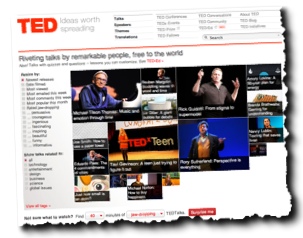
TED stands for Technology, Education, and Design. It started in 1984. Since 1990 it was located in a conference center outside of Monterrey CA. Since 2001 it’s been curated mainly by Chris Anderson.

Most TED conferences were amazing. I’ve never been, but what I’ve seen is a collection of excellent presentations about compelling ideas and information delivered by the best and the brightest in the world. If you’ve been reading this blog you’ve seen TED talks off and on. Since I first discovered the online TED talks at TED.com I’ve been back to that well regularly. And what I’ve found has been consistent highest quality of thought, communication, and, specifically, presentations.

For more than a dozen of my favorites, from previous posts on this blog, use this link.

So far, so good. Can anybody blame TED for wanting to branch out and expand? Not me. TED is now branching out to TEDx talks that are way less exclusive. Look around for TEDx on the web and you’ll see the TEDx talks popping up everywhere. Here’s what TED says about TEDx:

Created in the spirit of TED’s mission, “ideas worth spreading,” the TEDx program is designed to give communities, organizations and individuals the opportunity to stimulate dialogue through TED-like experiences at the local level. TEDx events are fully planned and coordinated independently, on a community-by-community basis.

In theory that’s great, but what if the end result is that TED talk no longer means guarantee of high quality? I hope the TED tradition continues. But here’s the concern I have:  Does that mean dilution of quality? A lower bar? More people presenting to more people on more subjects in many more locations?

TED says that 231 TEDx conferences were held last month.

And meanwhile, just to make that a bit more real, this morning I clicked a TEDx link in my email to end up with this disappointing result:

Is This Mad Men Then or Silicon Valley Now?

A lot has happened during my lifetime to give women more and better choices. What you see in the TV drama Mad Men about how hard the business world was for women, back then, is what I remember from those times. So there has been progress.

But damn, let’s not confuse progress towards equality with equality.

Read “Silicon Valley’s Brogrammer Problem” on Mother Jones. It’s good Journalism, not muckraking. You’ll be amazed that this is happening now, and in Silicon Valley. Calendar girls, frat-boy bragging, and general stupidity. But it is. Take my word for it, I know it does.

What? Not in some fictional way back when, but in 2012? Who’s going to believe that?

I am.

I don’t like it. This is bad for all. My suggestions:

  1. Acknowledge that it’s still true.
  2. Speak out against it.
  3. Don’t let it happen in the environments you influence.

What do you think?

7 Bad Habits That Aren’t, plus a Great Title That Is

Here’s a great title: The 7 Bad Habits of Insanely Productive People. That was on copyblogger last week, posted by Sonia Simone, one of the nicest plays on contradiction and irony I’ve seen a while. There’s some real truth here, but hidden in paradox, and a lot of humor too. Who wants bad habits? You have to read the post to see. 

For example, in her intro, musing on productivity advice …

And the truth is, I’ve gotten a lot out of productivity advice. If it weren’t for David Allen and Tony Schwartz, my life would consist of eating cupcakes and checking Netflix to see if there’s a new Phineas & Ferb out.

And all those bad habits? How does this sound:

  1. Being thin-skinned
  2. Flakiness
  3. Selfishness
  4. Greed
  5. Distractibility
  6. Self doubt
  7. Arrogance

Not so attractive at all, right? Except that Simone uses each of these to get your attention. Then she tears them back down.

For example, thin-skinned … 

Most of the successful people I know are sensitive and perceptive. And yes, when they get criticized, they feel like shit. Do they let trolls and whiners stop them from doing something great? No. But it’s not because they don’t feel the insults … it’s because their passion for what they do is stronger than the discomfort.

And on flakiness …

The truth is, if you’re building something epic, you’re going to be juggling a lot of pieces. They don’t always go together neatly. Sometimes they don’t go together at all. If you’re stretching yourself, you’ll drop the ball sometimes. Try to figure out the circumstances in which you should never let yourself drop the ball, Make sure the “A” tasks get done.
Do your best, and say sorry when you screw up. But don’t stop just because things get messy. 

So you see how that goes, right? Selfishness has to do with drawing lines and setting priorities, greed is motivating, and distractibility is creativity. I like this quote:

Creativity is the residue of time wasted.
~Albert Einstein

And this one too, under self doubt:

Jim Collins showed nicely in his book Great by Choice that one marker of a business leader who succeeds over time is what Collins calls “productive paranoia.”

And finally, concluding my post on Sonia’s post, a final thought from bad habit #7, arrogance:

for your project to become truly epic — to help an epic number of people — you’re going to have to get out there and talk it up. Which will make some people uncomfortable. 

That’s just a quick summary. Read the post. 

Oh No! Microbreaks Are Productive, Real Breaks Aren’t

What, no coffee break? This feels vaguely like the idea that so-called grazing all day is better than three good meals and nothing else. Clearly, I’m way too old-fashioned. I just discovered that traditional coffee breaks do nothing for productivity. 

And I do mean traditional. The idea brought me quickly to this old number, from a musical that debuted in 1961, which was made into a 1967 movie, and is now a hit revival. This is a piece of history. It’s from decades before Starbucks. What happened to coffee at your desk? Before we discuss micro breaks let’s consider what we’re losing: (The YouTube number here is from How to Succeed in Business Without Really Trying. Or you can click this link to see it on YouTube.)

The microbreak idea is from Boost Your Productivity with Microbreaks, and HBR Ideacast from earlier this month. Portland State professor Charlotte Fritz studied the problem of productivity and breaks. It turns out that what works for me — the quick walk, the change of pace, a non-business phone call — doesn’t actually work that well. 

Microbreaks are a term that me and some colleagues came up with to describe all the little things that we do during somewhat unofficial breaks during the workday. … going to the water cooler, chatting with a colleague, checking in on your family … we were looking at these microbreaks, thinking about them in terms of recovery at work. So, the little things that keep us energized throughout the workday that aren’t bigger breaks. 

And what they discovered was not what you’d expect (or at least not what I expected):

….the work-related tasks, and specifically tasks that were associated either with learning something new, realizing the meaningful pieces about your work, or connecting positively with others at work, those were the ones that seemed to be related to feeling energized at work.

Not that anybody actually takes old-fashioned coffee breaks. Do you? Don’t we all grab the coffee (or tea, or Pepsi (yech)) quickly and sip it in the morning while we deal with email, blog posts, Twitter, and the business morning routine? So I think Starbucks is safe. 

And the study doesn’t say productivity depends on working all day every day without stopping. There is this comforting note: 

this was the first study that ever looked at it that way, so we need to be a little bit cautious with our interpretation. But with regard to those microbreaks, yes, going for a walk and so on, going outside for fresh air, that wasn’t related to energy at work. However, I would say, maybe it’s because we were just specifically looking at shorter breaks, microbreaks. However, during a lunch break, I would still encourage people to go for a walk, go outside, and get some sun in.

And this one too:

we do know by now that vacations are good for us. So, definitely again for well-being and health, helps reduce burnout and so on. We do find that they’re good for us. But we also find that the effects fade out relatively quickly. So, within two or three weeks after we come back from vacation, all the positive effects have pretty much faded out. What that suggests is that, rather than taking one long break per year, it would be good to take vacations, maybe a week, like five to six days long or something, or even maybe just long weekends several times per year to recharge.

Amen to that. 

Q&A: What To Do With Those Web App Ideas

This is question I received over the weekend via my Ask Me page at timberry.com:

I have 3 great app ideas that I think many people will benefit from. I am only 18 and I am absolutely clueless on how I am going to turn my ideas in to a reality…. Any sort of advice will be truly appreciated.

I should start by saying that this is definitely not my expertise.  On the other hand, like you, I see what’s happening in mobile apps, it’s clearly a huge opportunity. So I did some investigating. I do know people in the apps business, I’ve talked to several, done some research, so here is my quick-and-dirty summary.

programming_mobile_apps.jpg

Good news or bad: If you’re going to pay somebody else to do an app, it’s going to cost at least about $75,000. I say at least because it’s often much more. To keep costs down you must be good at managing developers, probably from remote locations; and you have to have good design.

Good news possibly: some of the best apps are do-it-yourself apps by smart people who learned programming and just did it. Do a good web search. There are lots of learn-programming facilities available on the web, for amazingly low prices. Do you have the persistence to stick with it, learn it, and get good at it? Few do. I’d venture to say the ratio of people who start this path to people who finish it is about the same as the ratio of people who start a novel to people who finish one. But it’s there. Start with udemy.com.

And here’s a tip: Go take a look at 99designs.com. Take a look at what they do to bring international developers into a project one by one. Look at some of their examples for design projects, then some for development/coding/web projects. (disclosure: I’m a happy customer, I have no business relationship except I’ve paid them money).


I Love These 5 Use-Everywhere Apps

What makes good software? For me, the use-everywhere factor is a big deal. I work with a desktop using Windows 7, a Mac at home and a Macbook for travel, mobile phone and a tablet computer. The more my gadgets spread, the more I appreciate the apps that let me get to my workspace wherever I am. Kindle Reader

  1. Dropbox. Now the files I’m working on, like drafts of documents and slide shows, show up as part of the file system I browse on my Windows desktop and all of my Macintoshes, and are available to me on my iPad and — not that I want to use them on my mobile phone — on my phone too. Its system software manages to work into natural file browsing too, as least on a desktop in Windows or Mac. Nowadays I routinely save documents to DropBox so I can pick them up wherever I left off, from wherever I am. I’m embarrassed to say that I don’t pay for my Dropbox, because they are leaving money on the table. I would pay if they made me. As it is, if I don’t use a whole computer’s worth of storage space, it’s free.
  2. Evernote. Every bit as powerful and as useful as Dropbox, which is saying a lot. I can input a note using a keyboard, a microphone, or a screen shot or website. I can get back to my notes from any computer, laptop, iPad or iPhone I use, and I think I could get it on Android as well, probably on Windows Mobile too. Type a note on the computer you’re at, and access it later when you need it. Fabulous software, and this too is free. And I’d pay for it if they made me.
  3. Kindle reader. I have the Kindle software on every device I have. I’m never caught waiting for something without immediate access to the latest book I’m reading, unless I don’t have my phone. Kindle automatically synchronizes to the last page I was reading on whatever device I was reading last. And it’s on phones, laptops, tablets, and desktops. And it’s free … although obviously I have to buy the books. Lately Kindle has also become a document manager too, so that — to cite one example — when I’m reading business plans I can load them to my Kindle and get the documents anywhere I am.
  4. Roboform. I complained three years ago when I switched to Mac at home and couldn’t get Roboform on my Macs. Now I can, and also on my iPad, and on every phone too. Roboform helps me keep track of logins and passwords, and — God help me — I sure hope it’s safe. Roboform is not free, but some of their browser add-ons are, and it’s worth a lot more than the equivalent of a good lunch, which is what they charge. I think I’m glad they charge me, and I hope they invest that in keeping up with security. They do have updates as often as any software I deal with.
  5. Things. Things, by Cultured Code, gets honorable mention here, for the new beta version that synchronizes my to-do list on iCloud so that I can access it, work with it, and massage it from my phone, iPad, laptop, or desktop Mac. That’s not the production version yet, and it doesn’t extend to Windows. But I do like it a whole lot. Things costs $49.95 and it’s worth every penny to me.

Disclosure: Last week I posted here that I didn’t post this one because there’s so much sleazy spammy tactics going on, paying bloggers for plugs, that I worried you’d think I’m doing that. I’m not. Nobody’s paying me a penny to recommend these five apps, and the ones that aren’t free — Roboform and Things — I purchased.

This is just great software. And I felt like sharing.

(Image: a screen shot from the Amazon Kindle download page.)

Slow and Steady Decline of Trust

This trend really bothers me. Even after the FCC rules on blogging and disclosure, I still get regular offers like this one that was in my email this morning. It was a nicely worded email, with some flattery, but here’s the meat:dollars

I’d love to put together a high-quality article written specifically for the site. There is absolutely no charge for this and no strings attached;  the only thing I would ask in return is that I’m able to include two do follow links to the sites of my choosing within the article – nothing shady or unethical, just one of the professional businesses I freelance for …

What do you think? Is this bad business ethics? Working links into editorial content, for money? Wouldn’t the FCC rules require disclosure? (By the way, that grammar errr

I think it’s sad how pervasive these practices are. This morning I was about to write a post about some software I like, but I stopped, worried that you’d think I’m on the take.

I wonder how much of this is going on, all the time, without disclosure.

For the record, I do get frequent emails offering me guest posts for this blog. In 1,500 posts I’ve had two guest posts that I remember. Occasionally I pass one of those emails on to the marketing team at Palo Alto Software, where some have resulted in good posts on Up and Running. But I consider this blog mine. On the days that I don’t post, I don’t look for a guest post.

(Image: bigstockphoto.com)


Facebook Needs at Least One Woman on Its Board

(Note: I posted this earlier today on the Huffington Post. I’m reposting it here because this is my main blog, and I believe what I wrote, so I want it here too.)

Why would a startup as important as Facebook, run by somebody as young as Mark Zuckerberg, whose users are more than 50 percent women, go into all-important public stock offering with a board of directors composed of seven men?

For no good reason.

Not that these seven don’t make a great group. It includes Peter Thiel, Donald Graham, James Breyer, Mark Zuckerberg, Marc Andreessen, Reed Hastings, and Erskine Bowles. So that’s the founder, several world-class successful entrepreneurs, the CEO of the Washington Post, a venture capitalist, and a former university president who was also co-chair of President Obama’s Commision on Fiscal Responsibility and Reform. That’s an excellent group of men.

Still, qualified as they may all be, seven men and no women? After all, the purpose of a board of directors, Wikipedia says is to govern the organization, establish broad policies, review the CEO, and answer to stakeholders for the organization’s performance. That purpose isn’t better served with at least one woman in the seven-member board? I don’t believe that. Do you?

There is research indicating that including women on a board of directors is better business. For background on that, read Why Your Next Board Member Should be a Woman on TechCrunch, or The ‘Terrible Truth’ About Women on Corporate Boards on Forbes.com, just to cite two of many. And, if you like irony, listen to Cheryl Sandberg, Chief Financial Officer of Facebook, in this Ted talk from 16 months ago, worried about under representation of women in the upper ranks of business. She cites a statistic I’ve seen elsewhere, that over the last six years, women have held a static 15-16 percent of c-level corporate jobs and spots on boards of directors.

Frankly, nobody can say there aren’t qualified women available. Search the web. That’s just dumb.

So why?

I was contacted by the group behind the Face It Campaign, at http://www.faceitcampaign.com. I went to their website, saw the video on YouTube (embedded here), and signed up. They’re not asking for money, just support for what should be obvious.

If change is going to happen, it takes place one step at a time. This seems like a good time to take this step.

(Note: if for any reason the embedded video doesn’t show up here, it’s on YouTube at www.youtube.com/watch?feature=player_embedded&v=8DMdSPeBuvU)

Double Your Productivity with Real Focus

According to the emails and comments, Tony Schwartz’ post The Magic of Doing One Thing at a Time on the Harvard Business Review is getting a lot of attention this morning. He says: vision

Tell the truth: Do you answer email during conference calls (and sometimes even during calls with one other person)? Do you bring your laptop to meetings and then pretend you’re taking notes while you surf the net? Do you eat lunch at your desk? Do you make calls while you’re driving, and even send the occasional text, even though you know you shouldn’t?

I recognize that behavior. That’s often me. Tony follows with:

The biggest cost — assuming you don’t crash — is to your productivity. In part, that’s a simple consequence of splitting your attention, so that you’re partially engaged in multiple activities but rarely fully engaged in any one. In part, it’s because when you switch away from a primary task to do something else, you’re increasing the time it takes to finish that task by an average of 25 per cent.

That reminds me of the “good-ol’ days” in the 1980s when I was writing books and doing consulting. I would lock myself in with a project. I’d focus and get two and sometimes three hours straight concentrated productivity on one thing. All I had to do, back then, was take the damn phone wire out of the phone. I’ve always been a procrastinator, but this concentrated focus was my remedy. Wait until deadline, then dive in. Full force.

Today it takes putting the computer to sleep too.And — much  it also takes a lot of discipline. I confess. I don’t think I’ve managed to focus that well for years.

(Image: bigstockphoto.com)

What Business For You? Look in the Mirror. Two Good Posts.

I’ve always said that what business is right for you depends not on the market, or what’s hot, but on who you are. So look in the mirror. Today I stumbled on two excellent blog posts that put this in good perspective.

Balance_at_sunset_bigstock_3393994.jpg

First, What Kind of Startup is Right for You, a post by Nellie Akalp on Mashable today. Nellie goes right to the heart of an often misunderstood core concept of small business, which is that the best business for you depends almost entirely on who your are, what you want, and what you do.

The best business is always a matter of context. You look in the mirror and figure out who you are, then you apply that to business. Here’s just a quick piece, two paragraphs:

Create a list of skills that covers what you’re good at and areas where you’re a subject matter expert. Then list out the things you like to do. Compare these two lists and see if any patterns emerge, or point to any business type that aligns both your strengths and passions.

Imagine yourself at a cocktail party, Tweetup or other networking event, and you’re asked that inevitable question: “So, what do you do?” Think about how you’ll respond with each potential business option. Are you proud and excited to describe your new business? Or a little embarrassed and looking to steer the conversation elsewhere?

This is really good advice. She has five points in the post, all of them worth reading.

The second one today is a really nice post called How to Fit Freelancing Into the Rest of Your Life, on freelance folder, written by Laura Spencer. It’s another reminder that what’s best for each individual you depends on your specific needs and nature.

For example, one of her points is “Know Yourself:”

What enables you to do your best work? Do you need quiet, or do you thrive in the midst of chaos? Are you your most creative first thing in the morning, or are you best late at night? What inspires you? Some freelancers are inspired by music, others by art or nature. Does clutter bother you, or can you work just about anywhere? Once you understand what enables you to do your best work, you can make sure that your work environment fits the bill.

Two very good posts. Conclusion: generalizations are dangerous. Every startup entrepreneur, ever solopreneur and freelancer, is a different case.

(image: bigstockphoto.com)