Category Archives: Writing

Celebrities Save Which Endangered Species?

Much like global climate and habitat change threatens giant pandas and black rhinos, global socio-economic and technological change threatens writers. Print media outlets are slowly dying, literacy is gradually declining, and the book business is shrinking. Animals are threatened by global warming, and writers by global dumbing.

So I guess I’m glad to see that now celebrities are pitching in to help save writers. Maybe.

I saw this in Ghosts and the corporate gurus posted by the Financial Times. Here’s a quote:

The rise of the ghost, says Madeleine Morel, a New York literary agent who represents ghostwriters only, has been largely driven by celebrity culture and the publishing industry’s transition from a literary endeavour to a nakedly commercial business. “Most non-fiction agents,” she says, “have been forced into the position of seeking authors who have a ‘platform’. This means either household names or people such as motivational speakers who bring the market to the book. The problem is that most of these authors aren’t writers. Books aren’t books any more. They’re products and this has been very good news for ghostwriters.”

There’s interesting irony here: celebrity culture is blamed for the demotion from literary endeavor to nakedly commercial business. And celebrities, hiring ghostwriters, are keeping a few rare specimens of this endangered species alive.

This makes me wonder: some endangered species thrive in captivity; they breed and multiply and eventually go back into the wild. Do you think that’s true for writers?

(Image: Nickolay Khoroshkov/Shutterstock)
The Best of the Best Lists

Of all the “best of” blog posts I’ve seen this month, Bob Sutton’s Work Matters: The Best of 2009 posts is the best.

No coincidence, I suppose, that he writes very well and has a great blog, teaches at Stanford, and is author of several important books. But there are other great blogs around.

What I really like about Bob’s best list is that he goes month by month, specifies one particular post for each month, and — really nice touch — he also comments on the comments.

So his list is a great read. Bob writes about work matters, the whole no A**hole thread, and smart business.

Missing the Spanish Phrase “Ni Modo”

I miss the phrase “ni modo.” It’s a wonderful Mexico City idiom meaning “oh well, this is not good, but it can’t be changed either, so we might as well accept it and deal with it.” They say few languages are as concise as English, and Spanish usually isn’t. But ni modo takes an English sentence to translate.

This is left over from my nine years living in Mexico City, many years ago.

Repeat after me: ni modo. Pronounce it as if it were neemodo. When you’re stuck in traffic, ni modo. When you really need to work but your Internet connection is down, ni modo. When you said the wrong thing and you’d love to take it back, ni modo.

I’m not sure whether this is just Mexico City slang or if it also applies in other Spanish-speaking cultures like the rest of Latin America or Spain. I learned my Spanish during those years living in Mexico City. Idioms like these are hard to gauge. Sometimes they’re very local, sometimes not.

What I do know is that it’s a wonderful mix of language, philosophy, life style, and karma. When things go wrong, ni modo.

Why Men With Pens is Written by a Woman. And Why That Matters.

Honestly, except for the name itself, I’ve never cared or wondered whether the author of Men With Pens was man or woman. It’s a good blog for writers. I did assume man, of course, because of the name of the blog, and the byline. This isn’t something I think about.

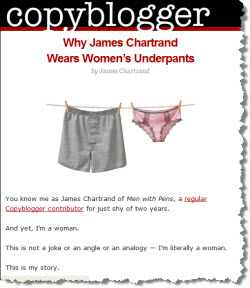
But I was shocked to read Why James Chartrand Wears Women’s Underpants as a post in CopyBlogger yesterday. It turns out that James Chartrand, author of the Men With Pens blog, @menwithpens on Twitter, is a woman, not a man.

Why do I care? I don’t care that she’s a woman and not a man. It makes no difference to the value of the content.  But I do care about the story she (James Chartrand) tells, and why she uses a man’s name.

Taking a man’s name opened up a new world. It helped me earn double and triple the income of my true name, with the same work and service.

No hassles. Higher acceptance. And gratifying respect for my talents and round-the-clock work ethic.

Business opportunities fell into my lap. People asked for my advice, and they thanked me for it, too.

Did I quit promoting my own name? Hell yeah.

I do believe that the difference between genders is the most interesting thing in creation. But I don’t believe in gender differences in jobs or opportunity and particularly not in writing. My favorite bloggers are about half and half, men and women. I just want the posts to be useful, interesting, amusing, and good. I’m as likely to read Pamela Slim or Anita Campbell as I am to read Seth Godin or John Jantsch. I like to think the world has come a long way since I was born in 1948. That the chauvinism we took for granted without even thinking about it in the 1950s and 1960s has given way to a better, more equal world.

Maybe so; but “more equal” isn’t the same as “equal.” Damn. Ask James Chartrand about that.

Everybody should read Why James Chartrand Wears Women’s Underpants. And everybody who cares about writing and blogging should subscribe to her blog – not because of her gender, or her surprising revelation about gender disguised, but, rather, because it’s got a lot of good content.

Why Worry About Spelling? Who Cares!

I’ve complained before, on this blog, about some common misspellings that get to me like fingernails on a chalkboard.

Yesterday Megan tipped me off to 11 Gorgeously Ironic Misspellings In Protest Signs on 11Points.com, by Sam Greenspan. Misspelling is bad, yes, but it’s got to be worse, or at the very least more ironic, when people butcher the language while complaining about language.  The post includes pictures showing the following exact quotes taken from protest signs defending the English language:

  • Get a brain, morans
  • Respect Are Country, Speak English
  • This is America and our only lanaguage is English

You tell me: is that a great argument for basic spelling? It reminds me of Harvard math professor Tom Lehrer’s song Be Prepared, that included the following line:

Be prepared to hold your liquor pretty well
Don’t write naughty words on walls that you can’t spell

Useful sentiment. And, along the same lines, if you’re going to brandish your politics for all to see, in your yard … well, do you think this illustration is purposeful parody?

Finally, back to the xenophobic politics of the English-only crowd, just one last picture:

The photos shown here are just two of the 11 on the original post. Definitely worth a look: 11 Gorgeously Ironic Misspellings In Protest Signs on 11Points.com.


(Photo credit: both of those photos are taken directly from the post on 11Points.com, 11 Gorgeously Ironic Misspellings In Protest Signs)

Lots of Words in Italics Meaning I’m Jus’ Sayin’

Accents, real speech, figures of speech, colorful speech. Expressions. The way we use language fascinates me. I wonder if technology changes it?

I have questions:

  • Why is groovy so hideously and embarrassingly obsolete, but cool is still cool? Am I the only one who still likes Paul Simon’s song, Feelin’ Groovy?
  • Why does just sayin work so well, especially in Twitter, to smooth out rough edges, frame thoughts, and soften things? It’s almost like a Photoshop effect to make a photograph look like a painting. I don’t get it. I mean, I’m just sayin.
  • And why does is it just me seem to flow so well, almost like just sayin, as a statement softener?
  • How do you pronounce LOL? Can you use it outside of instant messaging and/or Twitter? Is it okay in normal conversation? And what about WTF and OMG, both acronyms using single-syllable letters instead of single-syllable words. I think I know the answer to that one. Not that there is a single right answer. BTW, I liked it when my daughter was studying in Madrid, and came up with QTF. Although I hate the F part of that.

And also, some simple observations, about language in my lifetime, and how it’s been changing.

  • I love the way Spanish has grown and prospered inside our modern American English. Starting with simple expressions like nada and the whole enchilada, there’s Spanish all over the place now, and I, for one, love it. I think it’s a living example of the kind of natural change that brought French into English a few centuries ago, and that gave us, gradually, the English we speak instead of the English they spoke in Shakespeare’s time. I like to see that living change. And I like it that it’s happened before. Deja vu. And here’s a test of popular culture: can you say deja vu without adding the Yogi Berra addition, all over again? Nobody seems to use the naked deja vu expression anymore. It’s verboten.
  • I hate the expression that something sucks, meaning that it’s bad. Do you know where that expression has been? And if you don’t, I warn you, don’t ask anybody who was a boy in the 1950s or 1960s. And then there are those related expressions, like bite me, or it bites the big one. Not good. It’s weird, to me, that these are now commonplace, and accepted by picky censors, like on network TV.
  • And, speaking of what’s acceptable on network television these days, I kind of like what Jon Stuart and Stephen Colbert have done with the beeped-out expression. Have you noticed how well they both use that? This stuff can be overused, but still, language and expression prevails.
  • And all the cleaned expressions, like bleeping and fricken, [Ed. Note: and the popular (among sci-fi fans) frak from the Battlestar Gallactica TV series].
  • Is it possible that all of the silliness related to code works and acceptable and nonacceptable has contributed to the twisting and distortions?
  • Which reminds me, the overuse of certain words becomes just silly. I listen to people on a bus unable to say a simple sentence without adding fuckin after every three words. What’s up with that? Doesn’t it get in the way? I think an actual conversation with all that extra burden would be exhausting. Do they even hear it?
  • I suspect that the worst language anywhere in this country, in terms of supposedly swearing and foul words and such, is found on the elementary school playgrounds, particularly where the fourth-sixth grade boys are playing?

I’m just sayin.

But Can We Trust the Trust Agents?

I was just getting back to the office yesterday, a Monday morning after a week away — 4 days of business, and 3 relaxing and invigorating days in Yosemite, which is really away — when Dan Levine (@schoolmarketer on Twitter) suggested I read The social media country club on Mark Shaeffer’s businessgrow blog.

Yes, I’m a sucker for contrary points of view. Get a group going, approach consensus, and I want to read the one who’s out in left field. If everybody else is right and this one’s all wrong, so what, I can work that out. But then how often is left field the right place to be?

Mark starts out objecting to rave reviews of Trust Agents, the book by Chris Brogan and Julien Smith. It’s subtitle is “Using the Web to Build Influence, Improve Reputation, and Earn Trust.” I haven’t read it, but I’ve read a lot of favorable comments. Mark, however, says those favorable comments are the result of group think and myth making:

The “thought leaders” of social media marketing are a country club fearful of saying anything negative or controversial about another club member. The real commerce of social media is trading favors and a negative comment breaks the favor chain.

He paints a picture a lot like the fable of the emperor’s new clothes. You can see with this quote, under the general heading of credibility, that at the very least he’s making his position clear:

Take a close look at the credentials (if you can find any) of nearly any leading social media marketing “expert.”  How many have ever had a real sales job or have been actually accountable for delivering new value in a marketplace by creating, testing and distributing a product on a meaningful scale?   Very few.  Yet these are our marketing “gurus?”  In a communication channel already dominated by porn-peddling, get-rich-quick nimrods, it simply doesn’t help our collective credibility to have our most visible advocates spouting incredibly naive statements about marketing fundamentals they know little about.

I don’t know that I agree; it seems too harsh to me. I don’t think expertise is measured only by job history, or sales history, or middle management in a big company history, which seems to be laying just under the surface of the blogger bashing. And I wish Mark had said which statements in the book are naive. But it’s certainly a very contrarian point of view. And worth considering. So I’m sharing it here.

(Photo credit: STILLFX/Shutterstock)

Maybe Writing Isn’t So Obsolete After All

Just a few years ago I was mourning the loss of the printed word in our media-hungry and web-hungry society. Even people I really respect, although most of them much younger than I, were starting to show cavalier disregard for the English language. I’d grimace while reading something that mistook then for than, or they’re for their, or misspelled lots of simple words. The response would be rolled eyes, like…

Maria Skaldina/Shutterstock

why do you care? You can read it. You can see what it says.

It makes me feel like the archetypical grumpy old man.

Meanwhile, television news has taken over from print news. Newspapers are dying. And books?  Doomed. I picked this up in a 2007 New Yorker piece called Twilight of Books:

In 1982, 56.9 per cent of Americans had read a work of creative literature in the previous twelve months. The proportion fell to fifty-four per cent in 1992, and to 46.7 per cent in 2002. Last month, the N.E.A. released a follow-up report, “To Read or Not to Read,” which showed correlations between the decline of reading and social phenomena as diverse as income disparity, exercise, and voting. In his introduction, the N.E.A. chairman, Dana Gioia, wrote, “Poor reading skills correlate heavily with lack of employment, lower wages, and fewer opportunities for advancement.”

But then — about 2007 for me, late, I know, compared to the web literate elites — I caught on to blogs. And discovered where writing had gone to; and where people cared about writing. Writing and reading are alive and well, it turns out, but they’ve migrated to some extent. The Huffington Post, the world’s leading blog, gets something upwards of 20 million unique visitors per month.  Blog after blog is about writing: writing well, writing better. I just looked: more than 10,000 hits on Google for the search term “writing blog headlines.” And I keep stumbling on blogs that are exhilaratingly well written. Look at Ann Handley’s Annarchy, for example (for a good sample, read Refugee at Home). Or Penelope Trunk’s Brazen Careerist (sample this post for good writing, but you should know first that, like a lot of good writing, it’s dark.). And I read business and entrepreneurship blogs that are not just good content, but extremely well written. Seth Godin delivers a short beautifully written post almost every day.

Lately there’s twitter, limiting the writing to 140 characters, putting a whole new twist on writing. There’s so many examples of good writing in 140 characters that it’s like searching for needles in a pile of needles. Do this twitter search for haiku to see what I mean. And then I just browsed the tweets of the people above, and came up with this one, by Penelope Trunk. I didn’t have to search for a good one, this was simply her latest as I wrote this post:

I forget to tell the waiter to hold the bacon bits. Then I go wild: I decide a Jewish woman who dates a pig farmer can take a taste of pork.

That’s good writing. And there’s so much of it out there. I’m feeling way better about the future or writing after all.

(Photo credit: Maria Skaldina/Shutterstock)

Want to Write Well? Cut Mercilessly

Back in my distant past I had to learn to live with editing. I was in my twenties. It made me mad. Why change my stuff? But it also made my stuff better.

“Berry, you write like a God-damned literature major.” (Norberto Schwarzman)

So said the overnight editor at UPI back in 1972.  He did me a great favor. “Write for the reader,” he would say, way more often than I would have liked. 

By the late 70s I was writing for a Business Week editor (Hugh Menzies) who consistently cut the shreds out of my writing, and, dammit, every time he did he made it better. I sent my stories to him for about four years. And I learned that cutting was good.

I’ve been writing professionally for 30-some years now, and I’ve never written anything that wasn’t better after cutting. So I’ve come to love cutting.

If you want to read some really good advice about this, read Editing for Tighter Copy: How to Write with a Knife on Copyblogger yesterday. And if you want to write better, print it and paste it on your wall.

Does Twitter Matter? Can It Possibly Last?

Yes, I think it does matter. And no, although it won’t last, not like it is now, it is the beginning of something that will last, but will be changing a lot. I could say the same about personal computing, the Web, and blogging.

Twitter is all the rage because it hit fertile ground. People like it, people use it, and because what it does catches us. The key to it is something related to publishing and broadcasting. It’s why I like writing this blog, why you like writing your blog, and why both of us read each other’s.

It’s related to instincts deeply embedded in our human nature.

Image by Carla16 on Flickr

The first of these is expression. When nothing else was possible, people drew on cave walls. That was about expression. So is telling stories, reciting  poems, and singing songs. It’s in our nature. We crave expression.

The second is curiosity. We want to see the pictures, hear the stories, know what’s up, and what’s going on.

And then, beyond these two basic instincts, there’s how much we like gathering, and shows, entertainment, and keeping up with each other.

All of which happens on Twitter. It’s not email, it’s not blogging, it’s publishing in 140-character pieces. Do it well and you have more people reading what you publish. Do it poorly and you have nobody reading what you publish. Make it interesting, informative, or funny and it’s good to do and people will follow. Use it to sell stuff or whine or share trivial life details and people will stop following. Use it to push sales talk at people and they will stop following.

Which–the click to follow or not–is the clincher, in my opinion, that makes Twitter more significant. I’ve seen some very interesting musings on Twitter’s future, such as Jeff Sexton’s piece asking is Twitter is digging its own ditch?  He says some of the Web’s bright and shiny new things (he mentions Digg and Technorati) burst on the scene, become popular, and then got manipulated, declined. The classic pattern is email with spam now killing it. He asks whether that might happen to Twitter.

And I think not. Because of both sides of the coin: the instinctive allure of posting like this, and reading the good posts, which is one side; and the ability to click and unfollow people, which is the other.

So please, follow me on Twitter: click here.