Category Archives: Weblogs

Are You a Good Manager? How Can You Tell?

What makes a good manager? Is it something you’re born with, or something you learn? Is there management instinct? I don’t know for sure. I’ve been in business for more than 30 years now, and I still don’t know.

A few years ago I was trapped on a plane with nothing to read but The One-Minute Manager, by Kenneth Blanchard and Spencer Johnson. It was written in 1982, and still sells very well today, according to Amazon.com ranking, even 26 years later. It’s in the top 2,000 books.

It was a short plane trip, and an easy book to read. It seemed about like this:

Make expectations specific. Tell people what’s expected. Follow up. Track results. Tell people afterwards how they did.

Several things struck me about that:

  1. Completely obvious, but
  2. still very valuable.
  3. Some things that seem completely obvious, once said (or written) still needed to be said (or written).
  4. Authors deserve special credit for keeping a simple book short. This one was easy to read in a one-hour flight.

I’ve never been much of a manager myself. That’s no big deal, of course; lots of people aren’t managers. In my case, though, people expected me to be, because I’ve had a lifetime of successful entrepreneurship. But entrepreneurship and management are different things.
I don’t think I’m alone. I’ve just been browsing the Amazon.com site. Small and simple books like that one sell lots of copies to lots of people. Who Moved My Cheese?, another that fits that description, sells phenomenally well. It’s in the top 300 at Amazon.com

What makes a good manager? Is it confidence, relative certainty, good communications skills, comfort with authority? I just read How to Be a Great Boss on a blog ironically named “Dumb Little Man.” And it’s a good list, too, but not surprising. Standard stuff: listen, communicate, say “Thank You.” And this one: bring food and arrange treats. What is this, kids’ soccer?

Thinking about it, I want to ask the experts some questions back: what makes a good manager?

  1. Is it getting things done?
  2. Getting other people to get things done?
  3. Is it doing the company’s bidding?
  4. Being well liked?
  5. Advancing your own career?
  6. Inspiring people, or leading them?
  7. Coordinating a team?
  8. Is a good manager able to do the work instead?
  9. Do you have to know how to code to manage programmers?

And some really fundamental questions: is a good manager liked, hated, respected, feared, or all or none of these? Is it possible to lead people to higher productivity and the greater good of the business while being disliked? Is it possible to do that while being universally liked? Does a good manager have friends, allies, enemies, bosses, underlings, followers, or minions?

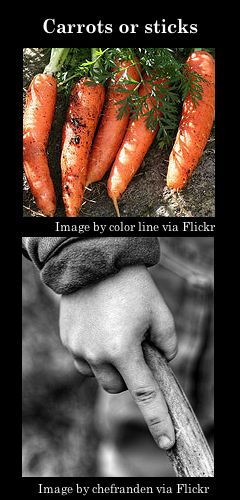
Is it about carrots and sticks, or both?

Can You Do It: Business Pitch in 140 Characters

Brevity is good. Brevity for business pitches is good too. The idea of pitching a new business in a single 140-character tweet (pardon the expression) is intriguing to me. Do you think you could do that?

Celebrity entrepreneur Richard Branson is pitching a Twitter pitch contest as part of a startup training program he’s involved in.

That idea’s intriguing, but not completely new. I thought I’d heard of something like that before so I Googled it and discovered that none other than my friend and world-renowned blogger Anita Campbell of Small Business Trends (@smallbiztrends on Twitter) won a Twitter business plan contest last year, with this 140-character business plan:

Monetize answering research questions for readers on a section of my website – ad supported – listing fees featured research

And the runners-up were pretty good too, in my opinion:

  • zackgonzales @hoovers pink eraser scentd cologne in pink parallelogram bottle, distro thru urban outfitters, archie mcphee, and scholastic book fairs
  • AndyBeard @hoovers Business plan by tweet? Sim Startup (All formats – I am sure I could get Activision to publish)

I think every business owner, operator, and manager should be able to boil the core of a business down into 140 characters. Can you? Can you do that for your business?

Here are some of my favorite businesses, in 140 characters (and, to keep it honest and because I included that “hard sell” jab above, I’m skipping Palo Alto Software and/or our products). All of these are less than 140 characters. Most of them leave 20 or more characters for retweeting:

  • Trunk Club: good-looking men’s clothing with personal online service for men who need clothes but hate shopping.
  • Cafe Yumm: Really healthy really tasty fast food with slow food values in Oregon. Franchisor too.
  • Mini-Cooper-S: bite-sized transportation for one or two with a kicker: unbelievably fun to drive.
  • Klymit: simple knob insulation adjustment in high-tech sports clothing.
  • Zapproved: Add-on magic to untangle email threads making group decision making faster, easier and more accountable.
  • Java Juice: easily transportable high-quality great-tasting condensed coffee for coffee lovers who travel or backpack. Just add hot water.
  • In Context Solutions: amazing 3-D retail modeling revolutionizing consumer in-store on-shelf research in an online virtual model.

And that, doing it for these seven companies I happen to like, was fun and easy. What would your 140-character pitch look like? Could you tell your company from your competitors, with that limit on the text?

(Image by Boris Veldhuijzen van Zanten via Flickr)

Facebook Disaster: Don’t Bother Coming In Tomorrow

I’ve had a run-in on this before, including this one on the Huffington Post that got a lot of comments …  but still, look at this delightful post from thenextweb.com:

Author Zee, editor in chief at thenextweb.com, titled it: “Note to self: Don’t ‘friend’ your boss and then bitch about the job.”

After all, what part of the word “publishing” don’t you understand? Or maybe I should point out the word “media” in the phrase social media? Nobody violated anybody’s privacy here. You don’t get to publish it and then claim it was private. It didn’t take a hacker to find it. No snooping was needed. Just, perhaps, a lapse of common sense and self-preservation instinct.

All I’m Sayin’ is Give Y a Chance

I’m not buying all the generalizations about generation Y, also called millennials, echo boomers, and the trophy generation. They’re getting through college and into the work force. I’ve seen the book The Dumbest Generation. I’ve seen the ads for special corporate trainings on how to deal with them. And I don’t like it.

Generation generalizations can be amusing. It’s a good parlor game. But does anybody seriously believe that there’s really a generation that is over-entitled, over-coddled, lazy, demanding, and so forth?

I don’t.

And why does it always seem like it’s gen-X that’s doing most of the complaining about gen-Y?

Could it be as simple as the fact that the people just out of college and into the workforce are using previously nonexistent technology to voice the same kind of sentiments that 20-somethings have had forever? So we have phenomena like the 10 best gen-Y blogs, and a Wikipedia entry, and all of that?

Isn’t everybody impatient and demanding when they’re 20-some years old? I was. I just didn’t have anywhere to say so. Remember the 1960s? What, we weren’t demanding? I certainly hope we were. And you 30-somethings and 40-somethings, you don’t remember what you said about your first job?

Generation Y is supposedly more entrepreneurial. Is that a function of the people, the age group, or the changing world we live in?

I like Brian Moran, who’s a real expert in small business, but earlier this week I caught his post Fixing Generation Y-ner. Brian jumps onto the bandwagon started at NBC, pasting a stupid law suit onto an entire generation. One recent college grad sues the school because she doesn’t have a job. Do we really think that’s a symbol of a generation? I don’t. And he jumps on the trophy story, which has the whole generation suffering from too many trophies for all, without distinction between winning and losing. I was there for some of that. I coached soccer for kids in that generation. They know the difference. The trophies fooled nobody.

I taught my start-your-business class this again year, as I have for many years, and watched how hard a bunch of graduating seniors worked to get employed in this worst-of-all-years employment situation. They didn’t look entitled to me. And I watched my own two millennial daughters get into the job world, and neither one of them seemed all that demanding or all that entitled. True, that’s not much data, but still, not very much of this gen-Y stuff is based on data.

I say give them a job, give them a break, and so what if they want meaningful work. I did too. And so did you.

Does Twitter Matter? Can It Possibly Last?

Yes, I think it does matter. And no, although it won’t last, not like it is now, it is the beginning of something that will last, but will be changing a lot. I could say the same about personal computing, the Web, and blogging.

Twitter is all the rage because it hit fertile ground. People like it, people use it, and because what it does catches us. The key to it is something related to publishing and broadcasting. It’s why I like writing this blog, why you like writing your blog, and why both of us read each other’s.

It’s related to instincts deeply embedded in our human nature.

Image by Carla16 on Flickr

The first of these is expression. When nothing else was possible, people drew on cave walls. That was about expression. So is telling stories, reciting  poems, and singing songs. It’s in our nature. We crave expression.

The second is curiosity. We want to see the pictures, hear the stories, know what’s up, and what’s going on.

And then, beyond these two basic instincts, there’s how much we like gathering, and shows, entertainment, and keeping up with each other.

All of which happens on Twitter. It’s not email, it’s not blogging, it’s publishing in 140-character pieces. Do it well and you have more people reading what you publish. Do it poorly and you have nobody reading what you publish. Make it interesting, informative, or funny and it’s good to do and people will follow. Use it to sell stuff or whine or share trivial life details and people will stop following. Use it to push sales talk at people and they will stop following.

Which–the click to follow or not–is the clincher, in my opinion, that makes Twitter more significant. I’ve seen some very interesting musings on Twitter’s future, such as Jeff Sexton’s piece asking is Twitter is digging its own ditch?  He says some of the Web’s bright and shiny new things (he mentions Digg and Technorati) burst on the scene, become popular, and then got manipulated, declined. The classic pattern is email with spam now killing it. He asks whether that might happen to Twitter.

And I think not. Because of both sides of the coin: the instinctive allure of posting like this, and reading the good posts, which is one side; and the ability to click and unfollow people, which is the other.

So please, follow me on Twitter: click here.

10 Really Bad, 11 Really Creative Designs

That’s right: it’s a doggy washing machine, not a faked photo, at least according to the write-up at http://www.davison.com in a hilarious collection called dangerously dumb designs. (Editor’s note: That page has been removed from the Davision Creators’ site, subsequent to the publishing of this  post.)

from www.davison.com

The description says:

Yeah, that’s right, a dog washing machine. Traumatic and automatic. Dumb, dumb, dumb. I would strongly suggest trimming your dog’s nails before placing your loved one in this machine (or taking it out) to avoid becoming both dumb and dangerous.

And that’s not all. It’s a fun collection of 10 of these.

And a lot of other interesting pages, too. I discovered this site thanks to Guy Kawasaki on Twitter. He pointed out 11 Creative Advertising Designs, which is also really good. Here’s one of the highlights from that one (and do you get that it’s a Harley-Davidson ad?):

And, once I was there, I couldn’t resist the dangerously dumb post as well. I don’t know Davison Designs, but hey, great stuff. Pleasant surprises on the Web.

(Photo credits: I found them both on the http://www.davison.com site, and I’m hoping with the link back, they won’t mind. The doggy washer started with craziestgadgets.com, and I’ve linked back to there from the photo. And the Harley-Davidson ad started with http://www.thecoolhunter.net, and I’ve linked back to that site for that one. Both are ads, so I apologize in advance for not getting permission.)

About Dumb Obvious Blog Comments

Is this funny, or just annoying? It’s an alleged comment to one of my posts on this blog. And get this: the same comment also appeared, word for word, on another post on my Up and Running blog on entrepreneur.com. Two different posts, but the identical comment, as follows:

Great post, I agree. I think a great addition that might help others would be learning how to outsource. It’s really helped my business. I found a free outsourcing mini coarse and I learned a lot from it. It’s amazing what you can do when you can hire someone for $4 per hour to help you run your business.

And it has a URL, that I haven’t included, because I don’t want to promote it. A link that people are supposed to click to take part in the “amazing” gains of hiring someone for $4 per hour to be you. And I didn’t approve the comment, so don’t look for it, you won’t find it.

  • Re: “Great post, I agree.” Oh come on, how dumb do you think I and normal readers are? How obvious is that?
  • Re: “free outsourcing mini coarse.” I guess it doesn’t include spelling.
  • Re: hiring someone for $4 per hour to run your business. Yeah, you just put this comment on a post about how social media requires authenticity, which is hard to leverage. And on another post about overused words in advertising. I can see how that’s working for you.

Still, that’s a poorly executed waste of time commenting on blog strategy, which, I sincerely hope, will never work for you.

I Don’t Have to Show You No Stinkin Labels

Labels, and labels. Two days ago I complained here about self-proclaimed “experts” and “gurus.” And today I realize that I do the same thing myself, calling myself an entrepreneur. I ran into this interesting thought:

I must admit that when I hear the word (which inundates conversation and — more interestingly– the personal summaries of seemingly everyone over the age of twenty on my two favorite social networks), a little voice in my head channels Inigo Montoya in The Princess Bride, and I say to myself in a nerdy accent to the entrepreneur in cyberspace, “You keep using that word. I do not think it means what you think it means.”

Gulp. She — Colleen Dilenschneider, in The Mind-Numbing Evolution of the Term “Entrepreneur” — has a point. She goes on:

The title of entrepreneur– especially when said in description of oneself– is losing its meaning to me and I wonder how long it will be until the word has virtually no meaning at all.  Perhaps my scope is skewed, and this is an issue among all social network users, regardless of generation.  When I read entrepreneur in a person’s description, I think, “I need to learn more.”

Well said. And while Colleen links all the entrepreneurship to Gen Y traits …

by izzie whizzie on Flickr

With the rapid onset of social media, does the word entrepreneur mean less because we are all entrepreneurs? Is generation Y an entire generation of entrepreneurs? We certainly seem to be.

… I think it’s more than that. It’s most of our entire solopreneur-enamored, pushed entrepreneurs, baby boomer recession-survival Western world.

We love labels. Experts, gurus, entrepreneurs, nonconformists, bloggers, professionals, rock-star programmers, middle managers, and out-of-the-box thinkers all of us. We like working with labels and slogans because, as with the 30-second news byte, it makes life easier. We all need our labels. Sometimes it seems like the beginning of a board game, choosing your token to play monopoly.

And if everybody has the same label, the game doesn’t work.

(photo credit: izzie_whizzie on Flickr)

Accent and Grammar Bigotry

I heard a comedian the other day, on the radio, making fun of how the rest of the country looks down on a Southern accent. It was a funny routine. I wish I could quote from it, but I was driving, it was on the radio, so I can’t.

I dealt with a man once, PhD in Chemistry from Princeton, who called me out on that. He got me on the phone one day and challenged me to pay attention to his words instead of his accents. He said something like “everybody I talk to in California acts like I’m stupid, and nobody listens.” I’m impressed by degrees, though, so I listened. Only because he challenged me. And I was glad I did. He was a very smart guy, with a real talent for software. He spoke with a thick Louisiana accent. Our business never went anywhere, but for other reasons. And he taught me that I too could be a bigot. I didn’t like that lesson, but I learned.

I was reminded of that the other day with Seth Godin’s am I the only one distracted by apostrophes and weird “quoting”? He explains how grammar mistakes with apostrophes and quotes distract him. Me too. It clouds his judgment. Mine too. He says:

When I get a manuscript or see a sign that misuses its and it’s and quotes, I immediately assume that the person who created it is stupid.

And then he apologizes:

I understand that this is a mistake on my part. They’re not necessarily totally stupid, they’re just stupid about apostrophes. It’s a moral failing on my part to conflate the two, but I bet I’m not the only one.

I’m sorry. I go with Seth’s first instinct. Call me elitist. But I get distracted by mistakes on basic grammar such as confusing its and it’s. Use apostrophes for plural nouns having nothing to do with possessives distracts me too. Like spinach showing in the smiling teeth.

The difference, I think, is that accents are much harder to unlearn and aren’t fundamentally correct or incorrect. Grammar is relatively easy to learn, and there is such a thing as correct and incorrect. I think making assumptions for Southern accents is dumb, but making assumptions for bad grammar, is less dumb.

Despite the apology, Seth ends up pretty much in the same place he started on grammar:

What else are your customers judging you on?

It’s not just about being a grammar stickler. The fact is, we’re constantly looking for clues and telling ourselves stories based on limited information. It shouldn’t matter, but it does.

I completely agree. I don’t want to be bigoted against certain accents, which is dumb. But I’m not going to give up on grammar.

Journalism, TechCrunch, Stolen Information

This — the TechCrunch publishes stolen information flap last week — is why I worry about the gradual disappearance of Journalism as newspapers and traditional advertising disappear.

You may or may not have read about it. Somebody stole documents from Twitter’s computer and sent them to TechCrunch. They stole more than 300 memos, presentations, projections, and lots of private work about the business.

And TechCrunch, one of the premier blogs in the world, on just about everybody’s list of top blogs, decided to publish it. Not because the world needs it, not to defend anybody against anything, just for the fun of it. There’s no public good involved, not that I can see.

This is not Daniel Ellsberg and the New York Times with the Pentagon Papers, this is just business voyeurism. Publishing other people’s private stuff.

Why? Simply because they can. And I object. TechCrunch should know better.

I like the idea of professional journalism, with standards. Like what Wikipedia suggests, or, even better, the Code of Ethics of the Professional Society of Journalists. I know that a lot of journalists trashed ethics long before blogs came along. Still, at least there was a general understanding of right and wrong.

It seems to me inevitable that newspapers as we’ve known them, printed on paper, are going extinct. Blogs can replace a lot of what newspapers have been doing. So who says that ethics don’t matter in blogs? Not me. You don’t have to appear in print to be a journalist; but you do have to have a code of conduct. I hope.