Category Archives: Web/Tech

Maybe Writing Isn’t So Obsolete After All

Just a few years ago I was mourning the loss of the printed word in our media-hungry and web-hungry society. Even people I really respect, although most of them much younger than I, were starting to show cavalier disregard for the English language. I’d grimace while reading something that mistook then for than, or they’re for their, or misspelled lots of simple words. The response would be rolled eyes, like…

Maria Skaldina/Shutterstock

why do you care? You can read it. You can see what it says.

It makes me feel like the archetypical grumpy old man.

Meanwhile, television news has taken over from print news. Newspapers are dying. And books?  Doomed. I picked this up in a 2007 New Yorker piece called Twilight of Books:

In 1982, 56.9 per cent of Americans had read a work of creative literature in the previous twelve months. The proportion fell to fifty-four per cent in 1992, and to 46.7 per cent in 2002. Last month, the N.E.A. released a follow-up report, “To Read or Not to Read,” which showed correlations between the decline of reading and social phenomena as diverse as income disparity, exercise, and voting. In his introduction, the N.E.A. chairman, Dana Gioia, wrote, “Poor reading skills correlate heavily with lack of employment, lower wages, and fewer opportunities for advancement.”

But then — about 2007 for me, late, I know, compared to the web literate elites — I caught on to blogs. And discovered where writing had gone to; and where people cared about writing. Writing and reading are alive and well, it turns out, but they’ve migrated to some extent. The Huffington Post, the world’s leading blog, gets something upwards of 20 million unique visitors per month.  Blog after blog is about writing: writing well, writing better. I just looked: more than 10,000 hits on Google for the search term “writing blog headlines.” And I keep stumbling on blogs that are exhilaratingly well written. Look at Ann Handley’s Annarchy, for example (for a good sample, read Refugee at Home). Or Penelope Trunk’s Brazen Careerist (sample this post for good writing, but you should know first that, like a lot of good writing, it’s dark.). And I read business and entrepreneurship blogs that are not just good content, but extremely well written. Seth Godin delivers a short beautifully written post almost every day.

Lately there’s twitter, limiting the writing to 140 characters, putting a whole new twist on writing. There’s so many examples of good writing in 140 characters that it’s like searching for needles in a pile of needles. Do this twitter search for haiku to see what I mean. And then I just browsed the tweets of the people above, and came up with this one, by Penelope Trunk. I didn’t have to search for a good one, this was simply her latest as I wrote this post:

I forget to tell the waiter to hold the bacon bits. Then I go wild: I decide a Jewish woman who dates a pig farmer can take a taste of pork.

That’s good writing. And there’s so much of it out there. I’m feeling way better about the future or writing after all.

(Photo credit: Maria Skaldina/Shutterstock)

Twitter As Big Brother and Sports Celebrity as Intoxication

This post isn’t about the football star who punched an opponent; it’s about sportsmanship in general, sports business as oxymoron, twitter, YouTube, millions of dollars, and the impact of the ultimate big brother.

The ultimate big brother in this story is a lot like George Orwell’s 1984 Big Brother, but without the malice. He’s just as threatening. But he’s accidental. Twitter et al. We can’t stop it or change it, and I don’t think we even want to. But I’m just in awe of how much the events surrounding this particular punch in the face reflect the huge changes I’ve seen in sports, media, technology, and our whole world in my lifetime.

Last Thursday night, after a game had ended, a college football star punched another player in the face. He’d had an extremely bad night; his team was humiliated and he played badly. He’d been quoted all over the sports media criticizing the other team. And the player he punched had been taunting him. None of that gets him off the hook. His punch was ugly. It was violence, not sport. And sports losses happen a lot, even humiliating losses, without people punching each other. But this post is about him or his punch; it’s about the speed of the information, the distortion of sports morphed with money morphed with very young people being rich and famous. Let me explain.

I watched that game on television Thursday night. After it was over, I turned off the television and moved to my computer to check the world out.

To my shock, that game was all over twitter. The web was following behind, short of breath, but twitter was already all over it. The impact of the punch had risen in twitter to a number one position in buzz meters, and continued so fast – it outpaced even Michael Jackson for a while – that a twitter search couldn’t keep up. I’d search the term, pause maybe 10 seconds to look at results, and twitter search was already telling me I had another 150 tweets to view with a refresh.

Until then I didn’t know about the punch. Within a minute or two, though, I’d even seen it on video. Somebody posted it on YouTube (it’s off now, because of copyright issues with ESPN).

No way to be sure, but I wonder whether or not that kind of thing was happening a few years ago with very few people knowing about it. What if the television cameras would have been turned off when it happened and the sports photographers would have been on their way back to the office to process their photos. If I found out about it at all, it would have been on a slow-moving rumor mill days or weeks afterward. I might never know about it. Would that be a good thing? I’m not sure. Was it as likely to happen years ago? I doubt it. Not as easily. The mix of sport and money has become steadily more money and less sport. And the fame and wealth showered on the stars has been steadily growing.

But this is 2009. So millions of people knew about it. 

As I write this, that football star is off the team. Until the punch he’d been a pro prospect with a pretty good chance to get a pro contract worth millions of dollars next summer. Today, he might still be able to get on a pro team anyhow, maybe, if he’s lucky, and works hard. And it won’t be for millions of dollars. His prospects are vastly reduced. And I’m not saying he got a bad deal or that we should all just look the wrong way. He’s not a victim. It was an ugly, violent punch in the face.  But did his fortunes ever turn around quickly.

  1. Our culture has lost the idea of sportsmanship and replaced it with obsession on winning. At all levels of sport. I let my season tickets drop this year for a number of reasons, but one thing I won’t miss was the spectacle of a whole stadium booing the opposing team when they take the field. That happens everywhere these days, and every time I find myself in a crowd that boos the opposing team, I’m embarrassed. I don’t mind so much the booing of a specific play or a coach’s decision or a bad call by the referees, although that’s also bad sportsmanship; but booing the visiting team just for showing up? That’s plain ugly. What’s even worse is the fact that this behavior has polluted kid sports too, meaning that parents watching their subteen children can be every big as ugly as a stadium full or raging professional sports spectators. Or more so.
  2. Sports business is oxymoronic, but it’s everywhere. For the players its win to get onto the high school team and again to get onto the college team and then again to get onto the pro team and then again to get larger contracts. And then become a coach and win some more or get fired in disgrace. I’ve seen high school coaches make decisions that hurt their kids while motivated, as plain as day, mainly by wanting to win so they could get into college coaching, which would then lead them to pro coaching.
  3. Fame and wealth and celebrity are very powerful intoxicants that our society pumps into some very young people, with very bad results.
  4. The advance of media is unstoppable. I’m not complaining about twitter — I love twitter. But I am saying that the combination of Internet and media and our society’s obsession with celebrity has some tough side effects.

(Photo credits: the first is a still shot from the YouTube posting of Apple Computer’s famous 1984 Macintosh SuperBowl commercial. You can click the picture to go to the video. The second picture is an image by ene from shutterstock.com)

Want to Write Well? Cut Mercilessly

Back in my distant past I had to learn to live with editing. I was in my twenties. It made me mad. Why change my stuff? But it also made my stuff better.

“Berry, you write like a God-damned literature major.” (Norberto Schwarzman)

So said the overnight editor at UPI back in 1972.  He did me a great favor. “Write for the reader,” he would say, way more often than I would have liked. 

By the late 70s I was writing for a Business Week editor (Hugh Menzies) who consistently cut the shreds out of my writing, and, dammit, every time he did he made it better. I sent my stories to him for about four years. And I learned that cutting was good.

I’ve been writing professionally for 30-some years now, and I’ve never written anything that wasn’t better after cutting. So I’ve come to love cutting.

If you want to read some really good advice about this, read Editing for Tighter Copy: How to Write with a Knife on Copyblogger yesterday. And if you want to write better, print it and paste it on your wall.

Are You a Good Manager? How Can You Tell?

What makes a good manager? Is it something you’re born with, or something you learn? Is there management instinct? I don’t know for sure. I’ve been in business for more than 30 years now, and I still don’t know.

A few years ago I was trapped on a plane with nothing to read but The One-Minute Manager, by Kenneth Blanchard and Spencer Johnson. It was written in 1982, and still sells very well today, according to Amazon.com ranking, even 26 years later. It’s in the top 2,000 books.

It was a short plane trip, and an easy book to read. It seemed about like this:

Make expectations specific. Tell people what’s expected. Follow up. Track results. Tell people afterwards how they did.

Several things struck me about that:

  1. Completely obvious, but
  2. still very valuable.
  3. Some things that seem completely obvious, once said (or written) still needed to be said (or written).
  4. Authors deserve special credit for keeping a simple book short. This one was easy to read in a one-hour flight.

I’ve never been much of a manager myself. That’s no big deal, of course; lots of people aren’t managers. In my case, though, people expected me to be, because I’ve had a lifetime of successful entrepreneurship. But entrepreneurship and management are different things.

I don’t think I’m alone. I’ve just been browsing the Amazon.com site. Small and simple books like that one sell lots of copies to lots of people. Who Moved My Cheese?, another that fits that description, sells phenomenally well. It’s in the top 300 at Amazon.com

What makes a good manager? Is it confidence, relative certainty, good communications skills, comfort with authority? I just read How to Be a Great Boss on a blog ironically named “Dumb Little Man.” And it’s a good list, too, but not surprising. Standard stuff: listen, communicate, say “Thank You.” And this one: bring food and arrange treats. What is this, kids’ soccer?

Thinking about it, I want to ask the experts some questions back: what makes a good manager?

  1. Is it getting things done?
  2. Getting other people to get things done?
  3. Is it doing the company’s bidding?
  4. Being well liked?
  5. Advancing your own career?
  6. Inspiring people, or leading them?
  7. Coordinating a team?
  8. Is a good manager able to do the work instead?
  9. Do you have to know how to code to manage programmers?

And some really fundamental questions: is a good manager liked, hated, respected, feared, or all or none of these? Is it possible to lead people to higher productivity and the greater good of the business while being disliked? Is it possible to do that while being universally liked? Does a good manager have friends, allies, enemies, bosses, underlings, followers, or minions?

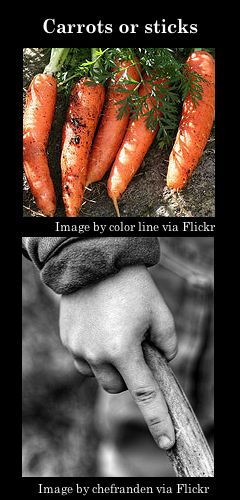
Is it about carrots and sticks, or both?

Can You Do It: Business Pitch in 140 Characters

Brevity is good. Brevity for business pitches is good too. The idea of pitching a new business in a single 140-character tweet (pardon the expression) is intriguing to me. Do you think you could do that?

Celebrity entrepreneur Richard Branson is pitching a Twitter pitch contest as part of a startup training program he’s involved in.

That idea’s intriguing, but not completely new. I thought I’d heard of something like that before so I Googled it and discovered that none other than my friend and world-renowned blogger Anita Campbell of Small Business Trends (@smallbiztrends on Twitter) won a Twitter business plan contest last year, with this 140-character business plan:

Monetize answering research questions for readers on a section of my website – ad supported – listing fees featured research

And the runners-up were pretty good too, in my opinion:

  • zackgonzales @hoovers pink eraser scentd cologne in pink parallelogram bottle, distro thru urban outfitters, archie mcphee, and scholastic book fairs
  • AndyBeard @hoovers Business plan by tweet? Sim Startup (All formats – I am sure I could get Activision to publish)

I think every business owner, operator, and manager should be able to boil the core of a business down into 140 characters. Can you? Can you do that for your business?

Here are some of my favorite businesses, in 140 characters (and, to keep it honest and because I included that “hard sell” jab above, I’m skipping Palo Alto Software and/or our products). All of these are less than 140 characters. Most of them leave 20 or more characters for retweeting:

  • Trunk Club: good-looking men’s clothing with personal online service for men who need clothes but hate shopping.
  • Cafe Yumm: Really healthy really tasty fast food with slow food values in Oregon. Franchisor too.
  • Mini-Cooper-S: bite-sized transportation for one or two with a kicker: unbelievably fun to drive.
  • Klymit: simple knob insulation adjustment in high-tech sports clothing.
  • Zapproved: Add-on magic to untangle email threads making group decision making faster, easier and more accountable.
  • Java Juice: easily transportable high-quality great-tasting condensed coffee for coffee lovers who travel or backpack. Just add hot water.
  • In Context Solutions: amazing 3-D retail modeling revolutionizing consumer in-store on-shelf research in an online virtual model.

And that, doing it for these seven companies I happen to like, was fun and easy. What would your 140-character pitch look like? Could you tell your company from your competitors, with that limit on the text?

(Image by Boris Veldhuijzen van Zanten via Flickr)

New World, New Leaders, New Institution

Singularity University, brainchild of Ray Kuzweil and other industry leaders (Nobel physicist George Smoot, for example, and Tom Byers of the Stanford Technology Ventures Program, Google leaders Vint Cerf and Chris DiBona, SIM City creator Will Wright; quite an impressive list), is up and running now at the NASA-Ames research center in Moffett Field, CA, tucked away between Mountain View and Sunnyvale, just west of the huge obsolete blimp hangars that have been there for at least 50 years. It’s an amazing venture. From it’s website:

“Singularity University derives its name from Dr. Ray Kurzweil’s book “The Singularity is Near.” The term “Singularity” has been used to refer to a future time of rapid and accelerating development of various sciences and technologies including biotechnology, nanotechnology, artificial intelligence, robotics and genetics. One goal of Singularity University is to [expand / teach / show] how these rapid developments occur today, sometimes so common that we do not see them for what they are, as when a graphics card is faster than any supercomputer of just a decade ago.”

A first lucky group of a few dozen students is there now, taking part in a 9-week program. In the near future they’ll be offering some 10-day programs for middle managers, and 3-day programs for executives. Here’s Ray Kurzweil introducing it earlier this year, as a TED talk:

http://video.ted.com/assets/player/swf/EmbedPlayer.swf

If for any reason you don’t see the video here, you can click this link to go to the source at ted.com.

I heard about this a couple of weeks ago from David Rose, founder of angelsoft.net, who is also, it turns out, leading the finance and entrepreneurship track. I’ve been meaning to post about it since. What an opportunity!

Facebook Disaster: Don’t Bother Coming In Tomorrow

I’ve had a run-in on this before, including this one on the Huffington Post that got a lot of comments …  but still, look at this delightful post from thenextweb.com:

Author Zee, editor in chief at thenextweb.com, titled it: “Note to self: Don’t ‘friend’ your boss and then bitch about the job.”

After all, what part of the word “publishing” don’t you understand? Or maybe I should point out the word “media” in the phrase social media? Nobody violated anybody’s privacy here. You don’t get to publish it and then claim it was private. It didn’t take a hacker to find it. No snooping was needed. Just, perhaps, a lapse of common sense and self-preservation instinct.

2 Pictures, 200 Words, Lots of Ideas.

Pictures, words, ideas. If one picture equals 1,000 words, how many ideas does it generate? Is there a transitive property there? I had time over the weekend to pick up two unrelated pictures. Each covers something entirely different. Both are full of ideas.

The first, a chart by Seth Godin:

From Seth Godins Blog
From Seth Godin

This is one of those things that must have been hard to come up with, but makes sense when you look at it. A map of communication. On the horizontal axis of the chart, from book on one end to a conversation at the other. With a book, the writer writes it at one point in time and the reader reads it at an entirely different time. With the telephone and coaching, both parties of the communication, sender and receiver, are involved at the same time. On the chart’s vertical axis, how much bandwidth is involved, from mail and graffiti at the low extreme, to movies and coaching at the high extreme.

The Second, from Buzz Networker:

from bizzia.com
From bizzia.com, buzzworker

This one is fascinating to me. As always with this kind of research, accuracy depends on how they sampled, but even if it could be off by a bit, it still gives a big picture of the main social networking sites (which is what I assume the acronym SNS stands for) usage by age. I have no conclusions to draw, but maybe you do.

All I’m Sayin’ is Give Y a Chance

I’m not buying all the generalizations about generation Y, also called millennials, echo boomers, and the trophy generation. They’re getting through college and into the work force. I’ve seen the book The Dumbest Generation. I’ve seen the ads for special corporate trainings on how to deal with them. And I don’t like it.

Generation generalizations can be amusing. It’s a good parlor game. But does anybody seriously believe that there’s really a generation that is over-entitled, over-coddled, lazy, demanding, and so forth?

I don’t.

And why does it always seem like it’s gen-X that’s doing most of the complaining about gen-Y?

Could it be as simple as the fact that the people just out of college and into the workforce are using previously nonexistent technology to voice the same kind of sentiments that 20-somethings have had forever? So we have phenomena like the 10 best gen-Y blogs, and a Wikipedia entry, and all of that?

Isn’t everybody impatient and demanding when they’re 20-some years old? I was. I just didn’t have anywhere to say so. Remember the 1960s? What, we weren’t demanding? I certainly hope we were. And you 30-somethings and 40-somethings, you don’t remember what you said about your first job?

Generation Y is supposedly more entrepreneurial. Is that a function of the people, the age group, or the changing world we live in?

I like Brian Moran, who’s a real expert in small business, but earlier this week I caught his post Fixing Generation Y-ner. Brian jumps onto the bandwagon started at NBC, pasting a stupid law suit onto an entire generation. One recent college grad sues the school because she doesn’t have a job. Do we really think that’s a symbol of a generation? I don’t. And he jumps on the trophy story, which has the whole generation suffering from too many trophies for all, without distinction between winning and losing. I was there for some of that. I coached soccer for kids in that generation. They know the difference. The trophies fooled nobody.

I taught my start-your-business class this again year, as I have for many years, and watched how hard a bunch of graduating seniors worked to get employed in this worst-of-all-years employment situation. They didn’t look entitled to me. And I watched my own two millennial daughters get into the job world, and neither one of them seemed all that demanding or all that entitled. True, that’s not much data, but still, not very much of this gen-Y stuff is based on data.

I say give them a job, give them a break, and so what if they want meaningful work. I did too. And so did you.

Does Twitter Matter? Can It Possibly Last?

Yes, I think it does matter. And no, although it won’t last, not like it is now, it is the beginning of something that will last, but will be changing a lot. I could say the same about personal computing, the Web, and blogging.

Twitter is all the rage because it hit fertile ground. People like it, people use it, and because what it does catches us. The key to it is something related to publishing and broadcasting. It’s why I like writing this blog, why you like writing your blog, and why both of us read each other’s.

It’s related to instincts deeply embedded in our human nature.

Image by Carla16 on Flickr

The first of these is expression. When nothing else was possible, people drew on cave walls. That was about expression. So is telling stories, reciting  poems, and singing songs. It’s in our nature. We crave expression.

The second is curiosity. We want to see the pictures, hear the stories, know what’s up, and what’s going on.

And then, beyond these two basic instincts, there’s how much we like gathering, and shows, entertainment, and keeping up with each other.

All of which happens on Twitter. It’s not email, it’s not blogging, it’s publishing in 140-character pieces. Do it well and you have more people reading what you publish. Do it poorly and you have nobody reading what you publish. Make it interesting, informative, or funny and it’s good to do and people will follow. Use it to sell stuff or whine or share trivial life details and people will stop following. Use it to push sales talk at people and they will stop following.

Which–the click to follow or not–is the clincher, in my opinion, that makes Twitter more significant. I’ve seen some very interesting musings on Twitter’s future, such as Jeff Sexton’s piece asking is Twitter is digging its own ditch?  He says some of the Web’s bright and shiny new things (he mentions Digg and Technorati) burst on the scene, become popular, and then got manipulated, declined. The classic pattern is email with spam now killing it. He asks whether that might happen to Twitter.

And I think not. Because of both sides of the coin: the instinctive allure of posting like this, and reading the good posts, which is one side; and the ability to click and unfollow people, which is the other.

So please, follow me on Twitter: click here.