Category Archives: Starting a Business

Q&A: How Do I Finance My Company Without Losing Control?

Question:

I need $250,000 to get my business started, but from what I see on the web, I’m going to have to give away the business, practically, to get that money from investors. And I don’t want to borrow the money because it’s a startup and I can’t be sure I’ll succeed.

cash ball and chain

My answer:

  1. You may be worrying about the wrong thing entirely because investors want know part of you or your business. Don’t even try to get angel investors unless you can convince them that there’s a reasonable chance that the money they give you today will give them ownership in a company that they’ll be able to sell to somebody else for 5, 10, or more times that amount of money in 3-5 years. “Reasonable chance” is just that, a decent shot at it, we know you can’t be certain. But can you convince people that it’s worth spending money on your business for their chance of return?   Ask yourself: do you have what investors want? If you don’t, then don’t waste time on this.
  2. Investors write checks. They expect something back in return. If they they write checks for your business instead of to buy a fancy car or second home, that’s because they expect to own something for a while and make money on it when they sell it. Don’t complain about giving them ownership.
  3. Real investors want control for good reasons. Good investors end up as partners. Don’t give up control if you don’t have to, but depending on how good your business looks, and how much startup experience you have, sharing control might be the only way to go. Or the best way. 
  4. I’ve written it many times, although this isn’t mine originally: choose an investor like you would choose a spouse. Find somebody compatible, who can offer help and advice, and ad to your team.
  5. If you manage to convince friends and family to invest in your business and give them a bad deal, you’re going to have to live with that problem for a long time.
  6. 10 good reasons not to seek investors for your startup.
  7. You don’t want to borrow the money because there’s too much risk? But it’s your startup, right? Why should anybody else take the risk you don’t want to take. Banks aren’t supposed to take risks either; it’s against the banking laws.
  8. Not that you should borrow the money, even if you can because you have house equity or something to pledge as collateral. Weigh your own risks and returns.
  9. If you want peace of mind, scale that business plan back to a size you can manage with your own resources. It’s possible for some businesses.
  10. Look for alternative financing like early prepaid sales, or share of future revenues, etc. Read 5 non-traditional ways to get startup money.

(Image: cash chained, bigstockphoto.com.)

Isn’t it Creepy to Walk Into a Startup with Fancy Offices?

Funded or not, ambitious or not, I just don’t see the sense of startups having fancy offices. In the old days, as a consultant to startups and investors both, I hated walking into an interview with a startup when it was a nice office, beautiful windows, carpets, and lots of space. In the middle days, building my own company, I didn’t want to be spending on appearances when there was never enough for product development and marketing for growth. And nowadays, as an angel investor, I don’t want a company that has nice offices. 

There are exceptions: some kinds of businesses need fancy offices as part of their strategy; accountant, lawyers, and some high-end consultants. Those are rare special cases. I was a successful and expensive consultant for years, out on my own, without a fancy office. I never met a client who wouldn’t work with me because my office space wasn’t nice enough. I did have at least one who selected me because (among other factors, obviously) he didn’t want to pay high-end-consulting overhead. 

Another exception I always make is powerful tools. As consultant, entrepreneur, or investor, I don’t respect a company that has people working on slow computers, outdated software, or slow network bandwidth. That’s a dumb way to save money. 

I just read 7 Frugal Startup Tips from Millionaire Entrepreneurs on Entrepreneur.com. It includes some great tips, like avoiding expensive office furniture, reusing supplies, being careful about space, and so forth. That reminded me. 

A bootstrapped company doesn’t overspend because it can’t. By definition. It doesn’t have other people’s money. But a funded startup should spent the money on the product and the marketing. Not the offices. 

I don’t respect obvious overspending. It doesn’t mean smart founders or smart investors. The best example are those absurdly expensive SuperBowl ads in 1999 and 2000. But a fancy office is right up there. 

(image: bigstockphoto.com)

What is the most important thing to have when you are just starting your company?

Entrepreneur.com asked What is the most important thing to have when you are just starting your company?  on LinkedIn and here are the results:

While I really like the answer business plan — I’m a business planner — I don’t completely agree. If I weren’t biased down to my bones, I’d answer “something else” and clarify that what you really need, more than anything else, is customers. You can have money, idea, business plan, and the guts to go for it and still fail miserably if nobody wants to buy what you’re selling.

However, realistically, not all startups have the luxury of early customers. While ideally you find some early customers, or promises, or prepaid sales, sometimes you need to create something first (such as a product, website, app,etc.) before people can buy it. And in those cases, the business plan is the next best thing because — if it’s done well — it focuses on real indications, real information, and reasonable estimates of believable sales prospects.  So that makes business plan is a good compromise.

And business plan alone isn’t enough; it has to be a realistic, practical, concrete business plan that you can execute on.

The guts to go for it isn’t enough. It’s what we call a necessary but not sufficient condition. You’re nowhere without it, but you might be even worse than nowhere with it. Courage without customers, for example, is a terrible combination.

Enhanced by Zemanta

Please Give Me A Step by Step Startup Map, Personalized, and Free Too!

There was a comment posted on this blog last week. It’s well-written and touches the heart. It also plays some chords I get to often, worth calling out in a blog post. It starts…

I’m a 40-something woman and I want to start my own business. I have a visionary mind and I’m very analytical (almost to a fault…). I have been working in [mid-level clerical jobs] for over 7 years now and I’m hitting a dead-end in the industry. Not to mention, I’m tired of the cube life. I have worked even booths at home-shows and fairs for virtually nothing and less. I have half a clue as to how to operate, but I have no idea how to get started.

… so of course I’d like to help. And then she adds…

Because of the down-turn in the economy and the job market, I have been working as a temp for the last 2 years and our home is way under water. As a result, I have no money – we live literally from week to week.

… which makes want even more to help. But then I get to this:

… the research I’ve done so far has revealed that I know nothing. I just discovered that if I get a food cart, it has to go through an approval application review at $130 hr w/ a minimum of 2 hours. None of the books I’ve read have mentioned this expenditure.

She goes on:

If it sounds like I’m asking for some hand-holding, well, yes I am. I want to do this so badly, but fear has always been my own self-defeating nemesis. All of that to ask you: Do you have a map? Any direction you can provide would be GREATLY appreciated! I don’t want to think I’ve covered the bases only to find out – oh, sorry, you screwed up. You now owe us big money. I can’t afford that. Anyway, I’m hoping you can offer something…

Do I have a map? Well, yes, sort of. Although, to be be honest, when she doesn’t have $260 for an approval, it’s hard to imagine any way she can actually build a real working business. That level of spending for approvals and licenses and such is really hard to avoid.  Isn’t the food cart itself going to take spending? And complaining about those books that didn’t mention it makes me nervous about giving advice. I’m thinking they probably waved a hand or two at licenses and approvals, because most people assume there will be some fees along the way. My own book 3 Weeks to Startup makes only general references to this kind of detail. It’s hard (probably impossible) to generalize with a book, to make it useful, and also include specifics to the level of detail of approvals required for a food cart in some specific location.

Still, I do have suggestions:

  1. Chris Guillebeau’s book The $100 Startup. It’s brilliant. And so well-written, in such delightful detail, that it actually makes the $100 number seem believable, although I still take it as more symbolic than specific. Chris is a gifted writer and he’s actually done what he’s recommending. And besides, a book with a chapter titled “Hustling: The Gentle Art of Self Promotion” that’s subtitled ‘Advertising is like sex: only losers pay for it’ deserves to succeed. Warning: it will cost you $15 or so.
  2. I’m disappointed getting a request for a map as a comment on a website that tries, and oh so hard, to be a map. You’re reading this at www.bplans.com. Her comment was on this blog, on www.bplans.com. I’m obviously biased but I still think this is the best place in the world for free start-you-business information. And I’d like to think that map is right here.
  3. Sabrina Parsons (@mommyceo) and I wrote the book 3 Weeks to Startup, published by Entrepreneur Press, in 2008. I like it a lot. It’s not nearly as much fun as Chris’ book, but it has a lot of good information. Unfortunately, it does, like the books you complain about, talk about licenses and permits without giving specific numbers. Warning: it will cost your $15 or so.
  4. Find your local SCORE chapter with the search at SCORE.org. Make an appointment and talk to one of the SCORE counselors.
  5. Do some Google searches for obvious search teams like “cheap startup” or “startup no money” and see what you get, but go very carefully with this one, because those waters are seething with sharks looking to take your money.

And a final thought: lots of people want the personalized step-by-step map, but building a business isn’t like that. Nobody but you can wade through the thousands of pages and flood of information available, sift and sort what works for you, and recreate a specific personalized guide. Everybody’s map is different. Thousands, maybe millions, of us have tried, in books and websites. But what you need is sorting and sifting and digesting it all, and then recreating a special customized personalized message for you, and that would take days, maybe weeks, of somebody else’s time. You have to do it yourself.

Q&A: When to Quit the Day Job and Start On My Own

This Q&A post is different. Usually I highlight questions here for my answer, meaning I’m answering a question I think others are asking, for which I’m hoping my answer might be useful. In this case, however, I’m posting because of the question itself: It’s extremely common, very important, and doesn’t have any obvious single answer I can think of. 

This question came through my ask me form on timberry.com: 

I am at a crossroads in my working life. The company I am working for is going through retrenchments and no-ones job is secure. I have good experience in the industry and was aproached by a former employer who suggested that start my own business and sub contract to them. I do not have capital and because of the problems that the company I am working for have had my finicial situation is not looking good. I have always wanted my own small business and this seems a great opportunity except I am worried about the finances. My question is simply this: Do i take the risk and go on my own or find a another better paying job and sort out my finances at the risk of loosing this opportunity?

Your advice would be greatly appreciated.

My first reaction to this is not to answer out of respect for the importance of the question, and how little information I have.  Yes, this is one of the most important questions I get, and I get it a lot, although not often as well worded as this one. And in my case respecting the question means I’m afraid to answer it simply. It’s a life-changing decision and no thoughtful person should answer it from afar, with an email answer. 

My follow-on reaction is easy answers that are cliches: things like follow your gut that sound good but don’t really help. 

My best answer is you should do a business plan. Not a formal written business plan, a plan-as-you-go business plan, a simple practical plan that’s just big enough to reduce the uncertainty; that may never get printed; that may be as simple as a target market and business offering, key milestones, and projected sales, costs, expenses, and cash flow. 

The right kind of business planning is the best way to break the huge fear and doubt down into more manageable pieces. 

(Image: shutterstock.com)

5 Signs of Startup Success, 5 Signs of Startup Failure.

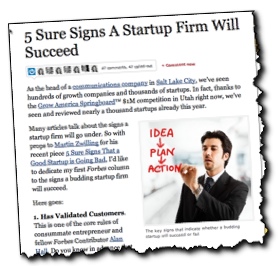
Excellent: Cheryl Conner starts her 5 Sure Signs A Startup Firm Will Succeed list on Forbes.com with this one: 

1. Has Validated Customers. This is one of the core rules … Do you know in advance that you have customers who are willing to pay the price you are asking for the product or service you have? … A successful startup scales its growth on the basis of proven, steady and paying customers (especially where residual/subscription income is involved). Steady acquisition is also a very good sign, as opposed to high and low fits and starts.

This reminds me of the “you had me at hello” scene in the Jerry MacGuire movie. That’s all I need to read on. This person is working from the real world. 

But the list holds up as it continues … Cheryl cites 2.) strategic perspective, 5.) good communications, 4.) transparency, and — another favorite of mine — 3.) what she calls “cash conservative:” 

There’s never been a better time to start a business in many respects, but there’s perhaps never been a more challenging time to obtain early stage credit or funding. Lean operations are the name of the game, and the ability to stretch and conserve early stage funds, even if greater funds are available, is a significant sign that points to future success. 

While I like this, and she’s quote right, I do wish she hadn’t framed it around the funding. Funded startups are the rare exception. For the vast majority of startups, reality is starker than this. It’s about not spending money you don’t have. Period. 

I also liked her tip of the hat to Martin Zwillig‘s other side of the coin, 5 sure signs that a startup is going bad. The two make great companion pieces. 

Tipping Point Trumps First Mover Advantage

Two interesting milestones: a note last week that Ebook Sales Surpass Hardcover in the U.S. coupled with the fact that digital music overtook physical media for the first time in 2011, something I expected since 1998. In both cases what surprises me is not that it happened, but how long it took. And what interests me is who makes the money on timing these trends. Because it sure wasn’t the first mover. 

I posted about this in Who Makes the Money on An Inevitable Shoe Dropping earlier this week on the gust.com blog. I was an early adopter in both these markets. I bought the Rocket eBook Reader in 1999. I bought the Diamond Rio mp3 player in 1998. Both products were first movers, innovative leaders, but they were brought out well before the right time. Both were discontinued years ago. And, I think but can’t prove, both were business failures. 

What does this tell about first-mover advantage? The ebook reader finally took off roughly 10 years later when Amazon.com and Apple converged on it with hardware and content. The mp3 player took off just a couple of years after the Diamond Rio. 

What happened? The tipping point happened. And the first-mover advantage didn’t. Why not? What do you think? 

Don’t Give Away Ownership As If it Were Just Credit. Please.

Please, entrepreneurs, this is important. Please don’t give away ownership in your startup, ever, except to partners who offer permanent help and value to the business, and will be there forever. That’s team members working the business, investors, or strategic partners with long-term commitments you can’t live without. Separate ownership, which is critical, and should never be given away easily; from credit and kind words, which are easy to give away.  

I’ve seen this so many times. People give percentages away to their lawyers, their graphic artists, their friends, and their relatives, but for no good reason. Then what happens is if the business makes it a year or two into actual business, suddenly those once-naive founders realize they are doing business with partners, who own part of their company, who don’t work, don’t care, criticize, and drag the decision-making processes. Pay the fees. Don’t save starting costs by giving the business away. 

Giving a piece of your new business isn’t liking buying a round of drinks at a table, but sometimes people treat that as if it were. But the truth is that you only have 100 percentage points to give away. The best ownership structure is 100 percent you. If however you need resources, key people and investment, then you need those percentage points to trade them for absolutely critical long-term relationships, or money. Not to make your cousin happy. Not to save on attorney fees. 

I recently dealt with an entrepreneur who was grateful for a ton of help, including written content, received from a good friend. He was trying to figure out how much of the company to give that friend as a reward. But the friend wasn’t going to be involved in the future, had taken another job, and wasn’t even asking. 

Don’t give her a piece of your business, I said. Pay her fairly. And if you can’t afford to pay her now, write up a bonus or a percent of sales that you’ll give later if you make the sales. Everybody wins. And you own your whole company. You don’t give away a piece of it in gratitude for somebody who won’t be a permanent part of it. He took my advice and gave her money now and a promise of money later, but not ownership. Both sides of that were delighted with that arrangement. 

What brings this to mind is this question I received over the weekend in my ask-me form on my timberry.com website: 

I’m 19. I have been avidly working through ideas for an amazing product. I’ve gone through lots and I eventually stumbled upon one that my mom loves so much that she wants to be a part of my business. Great news, but my issue now is that I’m willing to list my mom as a founder and now she wants me to add my stepfather as a founder as well. I feel like people are fishing for credit and titles that they have not yet earned. I’m not willing to appease anyone for the sake of it. How can I build a successful business alongside my family? 

Kid, you’ve got this one right and your mom and stepdad have it wrong. Read the post here. Family or not, ownership in your business is about actual contributions to your business. You say you’re “willing to list” your mom as a founder. But this isn’t like the acknowledgements at the beginning of a book; this is ownership in the business. List, sure; stocks and shares, no. 

Titles and credits are nice but ownership should be reserved for people who are going to actively contribute either money or long-term help. List them as advisors and give them credit on your website but give them ownership in proportion to the work, contribution, or money. This is business.  

(Image: bigstockphoto.com)

Give People Value and You Should Succeed

Russ Capper of the BusinessMakers show interviewed me three weeks ago for a 20-minute segment on that show. In this snippet be focus in on one two-minute piece of that that he calls “the BusinessMakers Classic Minute.

It comes down to two points:

  • First, the myth of persistence. Persistence doesn’t make a business succeed. It’s what’s left over after all the other causes of failure have been scraped off. 
  • Second, the most important single factor is value. Give customers value. 

If you don’t see the video here, you can click this link to see it on YouTube. 

7 Questions to Ask Before Doing Business With Your Spouse

I often say “choose an investor like you would choose a spouse.” Sometimes I say “choose a partner like you would choose a spouse.” But what if you already have the spouse, and you’re looking to start a business together? What do you choose? 

Before you start, it’s a yes or no question, I think. Do we start a business together or not? 

I recently received an email from Dennis Seaman and Quincy Yu who are married to each other and, presumably, to their business, which they is SeaYu Enterprises, whose main product is Clean+Green Pet Stain and Odor Remover. They call that “copreneurs” and “marriedpreneurs.” They’ve been doing it for 10 years now, they said in their email. And they’re obviously happy with the results. 

They offered me this list of seven questions to ask before starting a business as a couple: 

#1 Do your skill sets compliment each other – or compete with each other?
#2 Do you have similar professional AND personal goals?
#3 Is your relationship equipped to handle the stress of running a business together?
#4 Do you know the “work” version of your spouse?
#5 Are you both equally passionate about the business?
#6 If planning to work from home, can you set aside a separate office space?
#7 Do you trust and respect each others’ skills?

Those are powerful questions. But from my point of view, having had 30+ years in business with my wife, and 10+ years watching two of my grown-up children doing business with their spouses, that the right (or wrong) answers may not be as obvious as you think. Take question #5 there, for example, or question #2: Do you think a yes answer is required? I don’t.  And with question #3, I’m afraid that until you’re right up to your neck in the business you have no idea what the stress level will be, or whether or not you can handle it. 

But I will say this: This is definitely a good list of questions to answer. And do it out loud, please, and then discuss it. It’s never going to be this simple after you start.