Category Archives: Marketing

A True-Story Reminder About Pricing In Consulting

True story: back in my business planning consulting days, 1983-1994, Apple computer was by far my best client. I worked for the Latin America group, then Apple Pacific, then Apple Japan, and a bit for Apple USA and Apple Europe. I facilitated a lot of business plans, and did market research and some country plans, single-issue plans, and so on. I also worked with other clients, of course; but I depended on Apple.

money trapI priced my consulting by the engagement. The client would describe the job, I’d write a proposal, set a pricing and billing schedule, and then stick with it.

There was one person, among several dozens I worked for, who had a pattern of scope creep: meaning that after we’d agree on what was to be done for how much money, as I delivered the work in stages, he’d consistently want more than what had been agreed. It was always “But what about this” and “have you followed up on that?”

And it’s hard, as you know if you’re in this kind of expert business, to tell the client too often that what he or she is asking for is beyond the scope of the project. Sure, you have to sometimes, but it’s never easy.

So here’s my nugget about pricing: after I worked with that person and had that happen once, I was concerned with the problem. The second time he asked for a job, I wrote the proposal much more carefully, trying to block out scope creep; but it happened anyhow. The third time he asked, I calculated what I would normally charge, and tripled it.

That pricing idea worked. I didn’t want to have an enemy embedded among my favorite clients. So he didn’t accept that proposal, and I didn’t do any more work with him after that. But we remained on good terms at meetings, and he didn’t lobby against me when my name came up.

The worst I heard he said about me, second hand, was “how can you guys work with him so much? He’s really expensive.” And that was fine with me.
For Better Market Research Get Real Clicks not Fake Answers

For real information, watching what people do is way better than asking them what they think, what they did, or, the worst case, what they intend to do. That’s why I like this new click-based and search-based research so much.  Don’t go with what people say; go with what they do.

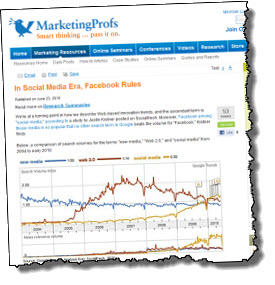
A great recent example is Marketing Profs’ In Social Media Era, Facebook Rules. The data is fascinating; but the methodology, and the tool used, is even more so. Screen Shot

This particular post, for example, uses Google Trends to illustrate the comparative rise and fall of the common phrases. You can see at the bottom of this post how the trends chart shows the rise and fall of the three terms “new media, web 2.0, social media.” You can look at the chart here – taken from that post, which, in turn, highlights research done by Justin Kistner posted on socialfresh. He’s saying that social media is the new third wave of the Web, and he uses the Google trends search and news charts to illustrate. I hope you can see it on the chart below. In Web searches, on the top, “new media” gradually fades from 2004 to now. “Web 2.0” goes up fast in 2005 and 2006, but peaks, and then falls. “Social media” goes up gradually, but seems to be accelerating. In Web news reports, on the bottom, social media is taking over.

Line charts

That’s done with Google Trends. Try it. Go to the Google Trends Web tool and start typing in search terms to see what the whole online world has been looking for, and finding, for the last few years. Try it with the terms “hamburger, sushi” and then with “Twitter, blogs” and you’ll see what I mean. I like what I see for “accountability,” which I think is increasing in importance these days.

This is a great tool for thinking, and planning. Educate those guesses.

Business Plan, Marketing Plan, or Both?

“if I have a marketing plan, do I need (or want) a business plan too?” Good question. And so is its opposite question too, “if I have a business plan, do I also need (or want) a marketing plan?”

As for a lot of these planning questions, you’re going to get different answers from different people. There’s no consensus on this.  But here’s my answer:

  1. Marketing is critical to business, and every business plan has a lot of marketing plan in it. There’s no need to keep the marketing separate from the rest of the planning. The marketing plan is an extremely important part of the business plan. No need to do it separately.
  2. That is, however, unless you are one of those people who are responsible for marketing, but not for the whole company. You don’t manage cash or financial strategy or ownership of the business. Then your job is marketing and related functions like sales and customer service and branding and social media and SEO, and so forth. You ask for the resource, and somebody else reviews, prioritizes, and gives you that resource or a reason why not. You probably have to manage expenses and show how they relate to sales and the health of the company. You probably have to show how those expenses make good business sense. You should probably be doing marketing planning, not the whole business planning; just your subset.

So to me, at least, the marketing planning is different from the business planning because it’s a subset. It doesn’t deal with financial health or financial strategy. It should have projections for sales, cost of sales, and sales and marketing expenses. It doesn’t project overall cash flow or the projected balance sheet. It probably deals with personnel, but just the related personnel, not the whole company personnel or larger personnel strategies.

Somebody just asked me that in email.

How to Make Personal Posts Into Good Business Blogging

This is good advice for any father, any day: Top Ten Father and Daughter things to do, by John Espley on an Accent Inns blog;  but I’m posting about it for its blogging and business implications more than just its content. If you’re a parent, of either gender, and whether you have daughters or sons or both, it’s good advice. And whether or not you’re a parent, it’s an interesting example of business blogging.

Here’s why:

1.  Focus is better than general.

Blog screen shotHaving been a father for 38 years now, and a son for 62, I feel like I know this territory pretty well. I’m father of four daughters and one son. The advice John gives on Father’s Day, focused on father’s and daughters, is as valid for fathers and sons, or mothers and daughters, or mothers and sons. Okay, there’s some male gender stereotyping, perhaps, in camping and fishing; but it’s still valid on a larger more generalized scale. By focusing on fathers and daughters, and doing it on Father’s Day, John makes it more powerful, not less.

2. You can’t fake real. You have to be authentic.

I’ve never read John Espley but as I read his post today I totally believe he’s the father of a young daughter. He couldn’t fake it.  That makes his focus in point #1 stronger. He adds real details. His father-daughter suggestions are all things he’s done with his little girl. It’s obvious. And maybe this is why focus works — if he talked about father-son or parent-child, it wouldn’t be as specific, and the details wouldn’t feel as real as they do.

3. Attack the expected. Blow stereotypes apart. Surprise people.

It’s sad that camping and fishing are stereotyped as father-son activities, but it’s also true. So when John leads with camping in father-daughter mode, he goes off track. It’s unexpected. Dog bites man is boring, so this is man bites dog. That’s always more interesting. Screw stereotypes. That makes better reading.

4. Authentically personal stuff can be good for the business

John is business development manager of Accent Inns. Notice that his post isn’t about Accent Inns or the lodging business or travel in British Columbia; and it starts out recommending camping, not staying in an Accent Inn. However, I think it still fits, somehow, with John’s business position. Here I am blogging about Accent Inns, because of his post. I’ll look at them first the next time I’m headed for BC, because I like that post. And camping and fishing gets people out and about, and could involve a stay at the inn as part of the program. I think this is a good example of how personally authentic is also business friendly.

Frankly, I struggle with this a lot. Blogging is a big part of my job, but nobody pressures me to post about the company or the product. Occasionally I do because I can’t resist. But my blog is about me and what I think, stories I want to tell, advice I want to give, mistakes I made that you should avoid, and so on.

Lately I’m watching this same struggle again (and funny how this goes back to the father-daughter theme this post started with) as I watch my daughter Megan blogging as marketing manager for Klout, which measures online influence. She just did a great post on Mashable on Twitter strategies, without specifically mentioning Klout. But metrics are critical to strategy and Klout is the best in the business on Twitter metrics. Should she have mentioned Klout specifically? I doubt it. Does she lose credibility if she does? I think so. No matter how well you do it, if you’re pitching a product people sense it and it diminishes the realism and authenticity.

(ps: thanks to Ross Dunn for putting that post on Twitter. I wouldn’t have seen it otherwise.)

Damned Commercial Crap Threatens Social Media

The stupid comments that are just thinly-veiled ads, disguised as blog comments … the twitter traffic that’s just “buy me buy me” … like the spam that threatens to drown email altogether, it’s not just annoying. It’s destructive. It’s a damned shame.

Yesterday the comment here below was submitted …

comment

… as an addition to my post Revising the Root Canal Theory of Business Planning here, on this blog, last August. As you knew instantly (you being a human, who actually reads), that post is entirely about business planning, not at all about teeth or dentistry. The root canal is a metaphor.

While I love your comments on my blog – I encourage them, respond to them, thank you for them – I hate the increasingly common attempts to circumvent the so-called social media conversation with hidden agendas. Stupid fake comments. And that includes all those stupid generic-fake-praise comments plastered all over blogs for obvious self-serving SEO purposes. Scripts and bots, set loose, in this case crawling around the Web looking for “root canal” in posts, placing the commercial crap there. Pollution on purpose.

As far as I can tell, almost all blogs that allow comments have to be moderated these days because of all this commercial crap, essentially fake comments, advertisements masquerading as conversation. No wonder some of the highest-traffic blogs, like Seth Godin’s blog, don’t allow comments. This is what I was referring to earlier this month when I posted the problem with crowd sourcing is crowds.

Selfish, mean people have almost killed email with their sociopathic behavior. Now they’re after blogging and Twitter. A curse on all of their houses. Dammit.

3 Marketing Truths I Wish I’d Known Sooner

I posted 3 Marketing Truths I Wish I’d Known Sooner on Amex OPEN Forum earlier this week. I hope you have a chance to read it there; it’s been getting a lot of play. Amex OPEN ForumThe alleged truths are 1.) Great marketing beats great product; 2.) Real people beat real money; and 3.) Consistency beats brilliance.  I’ll leave the explanations there, not repeat them here.

Just between you and me, it was awkward for a while because I’d started it as a list of five but eventually cut it down to three. Then I got rushed and sent it in without changing the title, so it promised five truths and included only three. Gulp. That’s embarrassing.

A couple of people asked about that on Twitter. I told them truth #4 is that marketers exaggerate their numbers and truth #5 would have been that marketers can’t count, if it weren’t for the fact that marketers can’t count.

Anyhow, it’s back to 3 in the title there, and I hope you read it and like it.

The Marketing Power of Negative

Two strangers sitting next to each other on a commercial airplane: if one chooses to say something to the other, the most likely comment, by far, is going to be something negative about the airline. They’re always late, the seats are too small, something like that. It’s human nature. We break the ice by criticizing someone else because that unites us.

Blog posts, presentations, workshops and the like do much better organizing around mistakes and myths or failure than anything else. My posts on business plan mistakes, or startup mistakes, do much better than lists of tips. My workshops and presentations organized around top 10 mistakes to avoid do better than keys to success.

People talk way more about what’s wrong with something than what’s right with something.

I’ve seen research indicating that angry customers tell 17 people, on average, about what made them so mad. Happy customers tell three. Word of mouth is much more likely to be about what’s wrong than what’s right.

Does your marketing know that? How powerful is the negative? How does that impact your business? Your social media strategy? Your marketing message? Your customer service?

(Image: Copestello/Shutterstock)

Build A Referral Engine Right

The Referral EngineI love this paragraph:

There are three ingredients necessary for a rewarding and successful business experience: You must enjoy what you do and feel a sense of purpose; you must be good at what you do; and you must be able to convince other people to pay you for what you do.

That’s from John Jantsch’s new book, The Referral Engine, which is out on the market and available today. John is the world-famous author of Duct Tape Marketing, perhaps the world’s best thinker on marketing in the real world, in a practical, down-to-earth (hence the duct tape image) way.

If you’re running your own business, trying to grow, it’s hard to imagine a better way to spend $15 or so and a few hours than on this book. We all take referrals for granted; it’s second nature. We assume that if we do a good job then referrals will happen. How many times have you heard and accepted the phrase “word of mouth” as the most powerful tool in marketing?

What John does in this book is take you through a process that makes referrals a key driver of your business. He starts with defining what referrals really are (aside from the common assumptions) and how they work. He links that to the high-end strategies that drive real business growth. From there, he goes into the actual nuts-and-bolts systems that create what he calls referral engines.

I know you’re busy. It won’t take your time and money, it will save your time and money. So read this book.

10 Good Market Motivators (and 3 Not So Good)

A smart person I trust told me that lists of 5 or 10 points do better in readership than lists of any other number. Strange, I suppose, but I can work with it. So I’ve taken 13 Ways to Instantly Motivate Your Target Market by Alex Mathers of  Red Lemon Club, and cut it down to 10.

WizardryTruth is, though, 9 3/4 is the real number. Because I like the connection of that number with wizardry (ref. the illustration here) and I’m not sure about one of my 10. I’m not all that pragmatic: Cutting three of them wasn’t hard. I just plain didn’t like these three:

1. Create the impression of scarcity
2. Build a sense of obligation
5. Evoke desired emotions

They remind me of classic old-style advertising, before the world changed. Sell ’em the sizzle and all that. And another reference here to wizardry. Alex explains them well though, so click this link if you’re interested.

And the remaining 10 points are listed here in Alex’s original order.

3. Express yourself

This is the new world of social media in business, which I really like, because it allows us to have relationships with people in companies, rather than just with companies. For example, the way Shashi Bellamkonda (@shashib) presents himself as a person, while still representing Network Solutions, on Twitter. As Angela LoSasso (@AngelaAtHP) does for Hewlett-Packard, or Stephanie Greenwood (@stephgreenkc) does for Sprint. And of course my special favorite, Megan Berry (@MeganBerry) of Mobclix (my daughter).

4. Limit options

I’ve dealt with the problem of too many choices a lot. I agree with Alex on what he says here:

By cutting down on the choices you offer to people, whether this be all the products you want to sell them, or in the various services you might offer, you will reduce the issue of ‘decision paralysis’, which restricts one’s ability to make a decision at all. By minimizing choice, options become clearer and easier.

6. Tell stories

Yes, absolutely. I would have made this number one on my list. Alex says it well, but the best on this is All Marketers Are Liars, the classic book by Seth Godin. And the title, by the way, is ironic: he talks about authentic stories, not lies.

7. Get people to make a small step

Alex talks about the psychology of small commitments:

So, if you provide the ability to leave comments or feedback on your site, for example, this can lead to people taking further action in committing to you if the opportunity is there.

8. Activate the brain’s survival instinct

Honestly I would have left this one out too, for the same reasons I left out 1, 2, and 5, if not for the goal of having a list of 10. It makes me uncomfortable. Try this on:

Three things are linked closely to the this survival trigger: sex, food and danger. Consider incorporating these themes and images relating to them into the headlines you write, your articles, images you include on your blog and in the work you create to grab attention and motivate people to act.

See, for me, I’m not happy with headlines about sex, food, or danger, followed by a marketing message. That’s ugly.

9. Present quick results

Instant Business Plan Pro download, for example, or super fast shipping.

10. List key things first

People like simple lists and step-by-step explanations.

11. Demonstrate ‘Social Validity’

Here he’s talking about reviews, ratings, comments, and testimonials.

12. Use the word ‘you’

Of course. That’s not just marketing, that’s all writing and communications. Job letters. Apologies. Whatever.

13. Be professional

Yes. Honest, good production values, fair, things like that. Tell the truth.

One Way Not to Market Your Expertise

Is this you? Are you trying to sell yourself as a consultant by sending general messages to people (or companies) you don’t know? Promising to solve whatever problems they have?

TrashI don’t dislike this person. I just feel sorry for the enormous waste of time and effort spent in the wrong direction.

This morning I received a second email from a guy who wants to sell me management consulting. His message is hardly convincing me of his competence. He’s never met me or anybody else at my company of 45 employees. And he’s addressing the wrong person because I’m not CEO anymore. And he’s promising to solve whatever problems I happen to have. Quote:

My services are flexible, ranging from advisory services to senior management and targeted special projects, as well as interim C-level management.

I’m sorry because he’s obviously in a tough spot. Despite this very unconvincing trolling marketing effort, he’s got what looks like a good resume and it’s a well-written email. I like this phrase:

I don’t write theoretical reports–I provide hands-on, practical assistance to help companies achieve the next level.

Then I think of the effort I assume is involved in finding me and my company. How many others are getting the same offer? How many people are opening that email, let alone reading it? And I think our website makes it obvious that I’m not even the right person to send this to.

This has to be an enormous waste of time. I’ve been close to consulting one way or another since 1974, and I was a full-time management consultant for 11 years. In all that time, I’ve never heard of a consulting engagement that started with a blanket offer like this. Companies seek consultants out to solve problems. As a consultant, you have to have a focused expertise and concentrate on being found by people who have the problem you solve, but after they perceive the problem.

I wonder if a medical doctor has ever been successful offering undefined medical services to people he or she doesn’t know.

It does remind me of the snake oil cliche, a medicine that will cure whatever ails you. These are tough times. I hopes he lands a job. Fast.

(Image: Blazej Lyjak/Shutterstock)