Tag Archives: Twitter

Twitter and Problogger to the Copyright Rescue

OK, this is cool. The web makes copyright stealing so incredibly easy, and it’s extremely annoying when it happens to you. And it happens all the time. So you have to like this example.

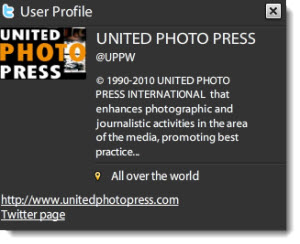
Here, to the right, is what Darren Rowse, blogger extraordinaire at problogger.net, @problogger on Twitter, decided to do about it. He posted it on twitter where his 117,809 followers can see it.

No, I don’t know the facts in this case. If it turns out I’ve become a pawn in some foul plot, unwittingly ganging up with Darren against an innocent photo business, I apologize. It sure looks like United Photo Press is linking to Darren’s work and presenting it as theirs. Right?

I’m jealous. I still remember when a competitor took a GIF my son had done, painstakingly combining all the logos of all the magazines that had reviewed our product, and posted it on their website. I would have loved to have been able to publish that on Twitter.

And while that one is old news, all the time now fly-by-night blogs pick up my stuff, often from here, and post it as their own, presumably for spam or SEO gains. That’s happening now, today, often.

In this case, though, the alleged culprit in this case, United Photo Press, isn’t flying by night. It’s been around since 1990, and one can assume it’s staying around.  So maybe this really works. I hope so. If it’s true, I hope Darren’s tweets get it to stop.

Darren, United Photo Press, can we get an update, now that the problem has been published on Twitter? Was the problem solved?

Twitter is the Brush, Not the Painting

On one hand, twitter offers a positive change in business landscape, a brave new world of business possibilities, and you’re crazy to ignore it. On the other, it’s just a distraction, a shiny new thing, that gets in the way of the real business.

Can both hands be right? Yes.

The one hand: I spend hours every day now watching, playing, posting, and reading twitter.  That’s gotten me mentions in Business Week and The New York Times. I find myself speaking up for social media on public forums, spouting phrases like “changing business landscape” and “you’re crazy to ignore it” and “great new low-cost road to market” or “marketing tool.” Twitter is essential to my blogging. Its a window to what’s going on and who’s doing and saying what.  It’s great for my business.

The other hand: You can use it to send useless text clutter to nobody. You can use it to pretend you’re working when you’re just watching the world go by in cute sayings, headlines, and interesting pictures. It can be a total waste of business time.

The synthesis: Twitter is the brush, not the painting. It’s a tool for a new kind of self publishing with a different kind of reach. Talk of business benefits of Twitter are like talk of business benefits of the telephone, or of conversation, or of advertising. It’s all in how you use it. Who or what are you trying to be in Twitter, and what does that have to do with your identity, your message, your business, your self.

Tools enhance power. What matters is not the tool, but what you do with it.

(Image: enhanced from a photo by Victures/Shutterstock)

What To Pay That Business Plan Consultant, Part 1

I was asked this question on Twitter yesterday and I can’t resist answering it here: “What should I pay a consultant to develop a business plan for my company?”

Start, please, by reading about my worst ever consulting engagement. That’s an old story now, about how one startup team misunderstood the place of the plan and the consultant, but it’s as true now as it ever was.

The moral of that story, which I really hope comes out loud and clear, is:

Never think of a business plan as a use-once document. It’s not a hurdle you get over. To make your company work you’ll need planning, not plan, and it’s best used like a steering wheel to manage your business.

That worst-ever engagement was my first in business plan consulting. I made my living as a business plan consultant, mostly (there’s almost always a mix of engagements when you’re on your own as a consultant) from 1983 through 1994. I learned fairly quickly that the best business plan consulting was done looking over the clients’ shoulder, making suggestions, asking good questions, facilitating, contributing to the clients’ planning process. Not writing a plan.

So my first answer to this question is this: don’t pay a consultant to develop a business plan. Do it yourself. And don’t think of it as a fancy polished document printed at Kinko’s and coil bound to be presented to investors once and then forgotten. Make your business plan short and practical and just big enough to cover for yourself your strategy, review schedule, milestones, tasks and responsibilities, and basic numbers including sales, costs, expenses, and cash flow. The plan is what’s going to happen. Do it organically, keep it on a computer, and expect it to change.

Think of that document as output of the real plan. Its just a snapshot of what the plan was on that particular day. You’ll be changing it regularly for as long as your business still exists. And in many cases it’s not even a document, but rather a pitch presentation – which doesn’t mean you don’t plan, but rather, that you customize the output to match the requirements of the moment.

You want a consultant? Do you have the budget? Get somebody who’s been through the startup process, raised money successfully, knows what works and doesn’t, and is willing to work with you providing that kind of expertise. That’s what’s usually missing. Not just writing a plan.

I have more on this for tomorrow.

3 Tech Benefits and 1 Threat for Guru Businesses

By guru business I mean the expert business, and particularly the one-person expert business. I mean consultant, coach, adviser, researcher, business hired gun, life coach, trainer, and so on.  I mean a person who makes a living by selling (real or imagined) expertise, experience, and knowledge.

magnifying glassI was a business planning consultant for most of the 1980s and early 1990s, working almost always alone, just myself, no company. So that’s an example of an expert business. And I’ve been thinking lately about how much social media has changed that business model for the better. In this case – but with one notable exception – change is good.

Benefit 1: Marketing your expertise is way easier

There is a new way of marketing that is so much better than the old way. Call it the Web, social media, blogs, Twitter, or the combination; it means way more reach, automatically, if you do it right.

Consider the comparison, now vs. then: I lit out on my own as a business planning and market research expert in 1983. I had my credentials, of course, including academic degrees and a fancy title with a brand-name consulting company, plus some published works. But how did I make myself known? Word of mouth from clients who’d worked with me as an employee, yes. But from there it was a struggle to get my articles into magazines, my self onto the podium at the big trade shows (such as Comdex), and to finish a couple of published books on my main subject matter.

Today, in comparison, successful experts build their business by a combination of useful blog posts, active mini-blogging on Twitter, ebooks, and work with Facebook and LinkedIn. Do you see the pattern there? The gatekeepers are gone.

Where it used to be important to validate your expertise by getting through the gatekeepers in corporate branding and publishing, nowadays can’t you validate your expertise by making good sense on your blog? Believe me, that’s so much easier than the old way of publishing, speaking, and giving seminars.

Benefit 2: Acceptance is based on expertise more than setting

I posted this related thought on this blog Tuesday, about how clients can get better value from a one-person business with no overhead. Who does the work? The client is much more likely today, compared to 20 years ago, to accept and even approve of the fact that you’re on your own. Not having a company around you is no longer cause to wonder what’s wrong with you.

Benefit 3: With gatekeepers devalued, it’s the work that matters

And then there’s this last thought, which I hope is true: today we judge experts by their work, meaning their writing and speaking (and tweeting), much more than we used to. Today an expert’s work is more immediately available, and with less distortion through gatekeeper filters, than ever before. Isn’t it?

How do you evaluate a guru ahead of time? Usually the about page and the content of the blog. There’s less interference there. Back when I started, it took getting through magazine editors to get published, or event managers to get a podium, or joining or creating a company.

Do you frown on an ebook because it wasn’t published by a name-brand publisher? Do you mistrust a blog because it isn’t in a major business publication? Not so much. Am I right?

And the warning?

The bad news is the other side of the good news: It’s the work that matters. Today you have to either do good work or settle for clients you can fool. It was easier back then to hide mediocre work with a company around you, or an editor of a magazine to rewrite it. Today, if you claim to be an expert, you’d better create some content to back that up. Transparency is cool when it’s a bright and beautiful looking glass that highlights and spotlights you. It’s not so nice when it’s a magnifying glass that’s going to burn you like an ant in the backyard on a hot summer day.

(Image: Freshpaint/Shutterstock)

Twitter Didn’t Invent Hilarious One-Liners

I just read The Rise of Comedy on Twitter on Mashable. The tweets they reproduce there make me jealous. I love Twitter, but I’m not funny on Twitter, or at least not on purpose. But then I’m not particularly funny off Twitter either. And then there’s also Top 7 Hilarious Fake Tweets on Huffington Post a week or so back.

Mashable asks:

But is Twitter humor different from “traditional” humor? And what happens when the television, publishing, and performance industries are set aside in favor of direct “social” comedy? We spoke with some hilarious tweeters to get their take on these trends, and on what it means to get a laugh in the digital age.

The post generates some interesting opinions from several comedians. My favorite is where they don’t like that Twitter has no gatekeepers. Winners who’ve passed gates like gatekeepers.

Is there a different style of humor for Twitter? Hey, I think the so-called one liner has been there forever. 140 characters ought to be plenty for funny. Does it take another style? Consider the following:

I’d kill for a Nobel Peace Prize.
Bills travel through the mail at twice the speed of checks.
Borrow money from pessimists-they don’t expect it back.
Half the people you know are below average.
99 percent of lawyers give the rest a bad name.
42.7 percent of all statistics are made up on the spot.

None of those are from Twitter, but all would be great as tweets. They are all from comedian Steven Wright, from long before Twitter started. They’re on a website collection called Steven Wright quotes.

And how about these, that come (without attribution, I’m afraid) from a site called Famous One Liners:

Some drink at the fountain of knowledge. Others just gargle.
Some people are only alive because it is illegal to shoot them.
Success always occurs in private and failure in full view.
Suicidal twin kills sister by mistake!
Support bacteria, they’re the only culture some people have.
The Bermuda Triangle got tired of warm weather. It moved to Finland. Now Santa Claus is missing.
The colder the x-ray table, the more of your body is required on it.

Twitter’s a great place for funny one liners. But come on, they were there long before Twitter.

5 Steps for Dealing with Social Media Malice

Let’s say you’re involved in social media for your business and you’re the victim of a social-media attack. Somebody you don’t really know singles War Gamesyou out because he’s mad at your company, or had a bad day, or whatever; and launches an attack out of the blue, mentions you and the company you work for, and claims you treated him badly. Ouch.

So you’re just doing your job, doing your best, dealing with a lot of people at once, and suddenly somebody targets you. They are messing with your business reputation. It happens a lot. People whose job involves dealing with a lot of people do become the target of personal anger that’s really directed at the company, the situation, or life itself (sometimes it’s one of those bad day things, a last straw situation) and it ends up feeling really rotten, like having an enemy for no good reason.

So let’s say that has happened. You’ve been blindsided by one of these attacks. What do you do now?

1. Stop, breathe, think.

Remind yourself that the meanness usually shows. Assume you’re dealing with an idiot. At least the smart people who encounter one of these attacks will see through it. They’ll click links to see where it started. They’ll see the malice if they look.

2.  Don’t take it personally.

I know this is hard. We talk about thick skin, but jeesh! People can be really mean sometimes. Why do they take their anger out on you? Remember that if part of your job is dealing with a lot of people, then these things come with the territory. You have to have thick skin about it because if it spoils your day then that’s bad for your health on the long term and it makes you unhappy. The idiot had the power to make you stop and think about a response. That’s all. Don’t give him the power to ruin your day, or even your hour. He ruined your moment. That’s all.

3. Decide whether or not to respond.

Sometimes the most eloquent response is silence. Be careful, though, because more often than not, silence gives the wrong impression. And it might even be bad for your health too.

Remind yourself that you can’t argue in social media. Like it or not, what you put in Twitter or Facebook is publishing, and it lives forever. Angry words are not biodegradable.  Like in the movie War Games, the only winning move is not to play (by the way, you can click the picture up above for the Youtube video, or just scroll down).

4.  Settle your anger and hurt first, then respond professionally.

If you should respond, take your time, be careful, clear your head first, and give a single response you can live with forever. Don’t argue, apologize. If an apology makes sense – don’t take it personally, this is business, you didn’t mean to offend, you didn’t realize, it was accidental, part of your job – make it a clear, clean apology that covers the whole issue. Make it one you can live with, without further comment, forever. Make it a response that shows the world that this was one-sided only.

Don’t get mad, get even. Expose the idiot by staying professional and not engaging.

5. Then forget about it. Let it go. Get on with your day.

If you like this job, and you like dealing with people, then of course this hurt your feelings, but you have to get over it or it continues to hurt your feelings. The idiot spoiled your moment, and that’s his fault; but if you brood over it or stay angry or hurt, then that’s your fault. Because what happens now is in your control. You can minimize the damage, or not.

And for extra credit…

Even though it’s been more than a year now since I wrote my 18-point Twitter Etiquette Primer, I believe all of it as much or more now. I did have “don’t argue with people in Twitter,” but I didn’t have “don’t use Twitter as a weapon, a threat for blackmail, or for venting.”

Have you seen that bumper sticker that says “mean people suck?” What do you think of people who blindside other people by broadcasting personal complaints on social media? Pie in the face might be funny when the Three Stooges do it in black and white film, but mud in the face in social media isn’t. It’s meanness multiplied by social media influence.

Now here’s that video:

For Better Market Research Get Real Clicks not Fake Answers

For real information, watching what people do is way better than asking them what they think, what they did, or, the worst case, what they intend to do. That’s why I like this new click-based and search-based research so much.  Don’t go with what people say; go with what they do.

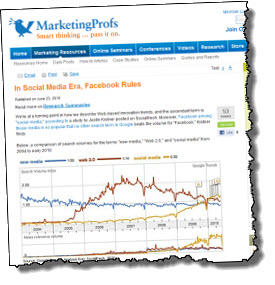
A great recent example is Marketing Profs’ In Social Media Era, Facebook Rules. The data is fascinating; but the methodology, and the tool used, is even more so. Screen Shot

This particular post, for example, uses Google Trends to illustrate the comparative rise and fall of the common phrases. You can see at the bottom of this post how the trends chart shows the rise and fall of the three terms “new media, web 2.0, social media.” You can look at the chart here – taken from that post, which, in turn, highlights research done by Justin Kistner posted on socialfresh. He’s saying that social media is the new third wave of the Web, and he uses the Google trends search and news charts to illustrate. I hope you can see it on the chart below. In Web searches, on the top, “new media” gradually fades from 2004 to now. “Web 2.0” goes up fast in 2005 and 2006, but peaks, and then falls. “Social media” goes up gradually, but seems to be accelerating. In Web news reports, on the bottom, social media is taking over.

Line charts

That’s done with Google Trends. Try it. Go to the Google Trends Web tool and start typing in search terms to see what the whole online world has been looking for, and finding, for the last few years. Try it with the terms “hamburger, sushi” and then with “Twitter, blogs” and you’ll see what I mean. I like what I see for “accountability,” which I think is increasing in importance these days.

This is a great tool for thinking, and planning. Educate those guesses.

On Fred Wilson’s 10 Ways to Start a Business

Hooray for Fred Wilson, a VC (Union Ventures) with a blog named A VC, for this brilliant 20-minute talk called 10 Ways to Be Your Own Boss, posted on his blog as online video. Fred calmly and carefully blows apart the way-too-common assumption that starting a business is about finding investors. He does this with a simple list of examples, each of which is a happy healthy business, most of which started and grew without outside investment.

He begins this talk with a couple of absolutely great quotes. The first, from a comment on Fred’s blog:

“Entrepreneurship exists in the tiny space between madness and genius; and its journey requires a few cross border violations across both madness and genius to get to the final destination.”

The second, from a tweet, shown here on the right, highlighting addiction to a monthly salary.

What I really love is the point he makes with the list. All 10 of these start-your-business instances seems perfectly understandable.

  1. The one-man show. He uses Matt Druge of the Drudge Report as an example.
  2. The two-man show with a partner.
  3. The husband and wife team. You already have a partnership. Assuming your marriage works, you already have a partnership that works. Designer and programmer, marketer and programmer. I know this one very well. Palo Alto Software started like that.
  4. The small office boutique. Fred says Union Ventures is one of those; six people. Small and happy.
  5. A federation of small businesses. He mentions Allen & Co., a New York investment bank. A lot of independents sharing a name and overhead. This works for professional services, like architects, attorneys, consultants.
  6. Projects: films, books, recordings … be an entrepreneur going from project to project to project. A good model for people with unique skills, if they can get work whenever they want.
  7. A cool website, as a small business, He mentions The Hype Machine at hypem.com, which started as a one-person website, remains small, but also profitable. It works as a one-person business, with some freelance resources, managed via laptop from places around the world.
  8. The small team bootstrapped startup. He shows redstamp.com, virtual cards that can be physical cards. This is a small-group quintessential startup, moving fast, flexible, having fun.
  9. The eventually-got-funded startup that started out as a few people working for free. Get it going, get it funded, then make it right.
  10. The startup that was spun out from another company. Twitter is an example. It was a piece of a business that got split apart.

That’s just 10, he says, and he limited his list to 10 only because he had only 20 minutes. He implied he could have gone a lot longer.

The point, made very powerfully in a delightfully cumulative way, is that only two of these 10 raised outside investment money. And one of those two got well on its way first, with people working for free, believing that the future would repay them.

One small detail that bugs me here is the “be your own boss” description of starting a business. I decided to put that into the 140-character tweet format as I was writing this. Here it is:

Damned Commercial Crap Threatens Social Media

The stupid comments that are just thinly-veiled ads, disguised as blog comments … the twitter traffic that’s just “buy me buy me” … like the spam that threatens to drown email altogether, it’s not just annoying. It’s destructive. It’s a damned shame.

Yesterday the comment here below was submitted …

comment

… as an addition to my post Revising the Root Canal Theory of Business Planning here, on this blog, last August. As you knew instantly (you being a human, who actually reads), that post is entirely about business planning, not at all about teeth or dentistry. The root canal is a metaphor.

While I love your comments on my blog – I encourage them, respond to them, thank you for them – I hate the increasingly common attempts to circumvent the so-called social media conversation with hidden agendas. Stupid fake comments. And that includes all those stupid generic-fake-praise comments plastered all over blogs for obvious self-serving SEO purposes. Scripts and bots, set loose, in this case crawling around the Web looking for “root canal” in posts, placing the commercial crap there. Pollution on purpose.

As far as I can tell, almost all blogs that allow comments have to be moderated these days because of all this commercial crap, essentially fake comments, advertisements masquerading as conversation. No wonder some of the highest-traffic blogs, like Seth Godin’s blog, don’t allow comments. This is what I was referring to earlier this month when I posted the problem with crowd sourcing is crowds.

Selfish, mean people have almost killed email with their sociopathic behavior. Now they’re after blogging and Twitter. A curse on all of their houses. Dammit.

Can You Have a Business Identity on Twitter?

Imagine a conversation, maybe a group of people standing around talking at a cocktail party or networking event. One of them wears a logo suit, like one of those mascot costumes, that hides the face and presents the person as the logo character only. Maybe it’s something like Ronald McDonald, or Tony the Tiger, the Pillsbury Doughboy, or that Michelin tire character.

Zappos on TwitterWhat sort of conversation is that going to be? If the other people gathered around are people, representing themselves, how comfortable would they be with the logo character?

Let’s assume that all of the others are spouting points of view, equivalent to content. I’m there talking about business planning and small business, you’re there talking about your favorite topics, and we probably share opinions and suggestions about other topics that come up. So we’re aware of our business selves and our various sets of expertise; but we’re still people. And the logo characters aren’t. Or so it seems.

So I’m watching how this works.

I use the Zappos example in the illustration here because that’s an interesting compromise. We see the person behind the curtain, he or she even introduces themselves. That’s sort of like the person in the conversation wearing a company shirt, or name tag. I get it. I’m assuming we follow them, temporarily, if we have a customer service issue.

I see people identified with companies. Scott Monty of Ford, for example. Tim O’Reilly of O’Reilly Publishing. That seems to work well for them, and it works for me too. They’re the person, not the company. I follow them if I like what they’re saying.

I see companies that tweet as companies, announcing deals, sales, products, seminars, and so on, as companies. The moving taco stand tweeting its location. Those tweets don’t seem to come from people. I’d follow them if I had a customer reason to.

I still think the business side of Twitter works best for those individual experts who are there as people, but, when topics come up, people with experience and expertise and opinions. I’d like some, but jeez, I’d need to list hundreds of names. It’s the people tweeting that makes Twitter interesting, not the companies. For the people doing expert business as themselves, Twitter is a very powerful business-related conversational platform. That’s cool. But it’s still conversation that really works.