Category Archives: True Stories

Can Stories be True When They’re False?

So it turns out that Jenny whiteboard quitting was a hoax. The Jet Blue guy with the chute exit and the beer wasn’t. I posted about both of them here Wednesday. Jenny Whiteboard CorrectedYou can read in that post that I suspected Jenny was fiction. I said so then, and I hedged my bets.

The two brothers who run thechive.com contrived the Jenny whiteboard story, hired an actress, scripted it, shot it, and put it on their site as a real thing. TechCrunch has all the details, with more on the actress and the brothers.

The Jet Blue guy, meanwhile, has been charged with a couple of felonies.

The coincidence of Jenny and Jet Blue together is a great example of stories: the power of stories, and the truth of stories.

William Blake wrote:

Anything which is possible to be believed is an image of truth.

And Harvey Cox wrote:

All human beings have an innate need to hear and tell stories and to have a story to live by.

So I ask: don’t you think Jenny’s story, although it was contrived, had useful impact?  Wasn’t it contagious media at its best? Doesn’t it have real meaning in business, a lesson about how and how not to treat people, a morality play, with relevant details like the part about the online snooper utility? Isn’t there a golden rule lesson in there?

And what’s the impact of the element of hoax? Did they lie to us, and does that make us angry, and make the story less true? I have no issue with that with Jenny because of the way it was presented. If I’d read it as fact in the  New York Times or Huffington Post I might react differently. We don’t like to be lied to. But if you go back and look at the original, nobody’s really lying there. They are not claiming it’s fact. And maybe I’m not all self righteous about it because I guessed it early and didn’t get burned.

And then there’s the Jet Blue guy: didn’t it strike a chord as well, in about the same way? I noticed CNN had a whole piece on flight attendants venting, which wouldn’t have been news without his spectacular exit. Would this one have been less valid as a hoax? Maybe, right? But this one actually happened.

And those two related flurries of attention: is the one based on story less valid than the one based on fact? There is a journalism element to this combination of stories, I believe. We expect truth, not stories, when it comes from professional journalists. Right? But John and Leo Resig, authors of the Jenny whiteboard story, don’t pretend to be journalists.

My point here: good stories told well communicate a very important variety of truth. That’s true for business and the rest of life too. Even if they aren’t true on the surface, they can be true in a deeper and more important way. Did The Godfather or One Flew Over the Cuckoo’s Nest or Moonstruck have to be documentaries to be true and useful? Are Othello or MacBeth only valid if they’re factually true?

(Image credit: thanks to TechCrunch.)

3 Stories of Spectacular Trash-and-Burn Job Quitting

Talk about letters of resignation! Burning bridges? Well, maybe one of these bridges needed burning. Still, maybe we need to review the 1950s blockbuster movie The Bridge on the River Kwai, on the merit of burning bridges. There is job satisfaction, and end-of-job satisfaction.

There are two great quitting stories in today’s news (or maybe just quasi news) as I write this. First, the girl with the white board quits spectacularly well, an amazing piece of work (fiction or not). Second, the Jet Blue flight attendant who fought with a passenger, cursed all the passengers on the PA system, grabbed a beer, and exited via the emergency chute. Stories like these just have to be told.

QuittingIf you haven’t seen the girl with the white board, take a minute, click the link, and see it.  Have you seen the movie Love Actually? Do you remember the scene in which the guy stands at the door with written messages for the girl? It’s like that, but (if it’s real) different, maybe even better (but only if she ends up with a better job). As I write this I don’t know for sure whether it’s staged or not. I kind of hope it’s fiction, because if not, then she’s had a miserable time and he deserves to be dragged in the muck. But it could be a well-staged hoax. Here’s a link to part of that discussion.

And then there’s the Jet Blue flight attendant’s spectacular farewell. Here is the New York Times summary:

After a dispute with a passenger who stood to fetch luggage too soon on a full flight just in from Pittsburgh, Mr. Slater, 38 and a career flight attendant, got on the public-address intercom and let loose a string of invective.

Then, the authorities said, he pulled the lever that activates the emergency-evacuation chute and slid down, making a dramatic exit not only from the plane but, one imagines, also from his airline career.

On his way out the door, he paused to grab a beer from the beverage cart. Then he ran to the employee parking lot and drove off, the authorities said.

Another Web story said what the NYTimes called “a string of invective” including telling the individual passenger to f*** off, and then, microphone in hand, over the PA system, telling all of the passengers the same thing. Then the beer, and the exit chute.

And the third story is one of my own, from way back when I was on the night desk at United Press International (UPI) in Mexico City. This was in the early 1970s. We communicated via the same teletype machines we used to send the news. The rumor, or company legend, was the guy in some Midwest bureau who walked off the job after sending the following as his last transmission to the wire: “too much work, too little money.”

Which brings me back to the theme of burning bridges. I’ve always believed that you should never ever burn bridges when you leave a job. My advice is never to complain about your last job when looking for a new job. It just sounds bad.

Still, in the case of Jenny with the whiteboard, and what she describes as her work situation there, I think that could be the exception that proves the rule. And, furthermore, she’s done it so spectacularly well that I expect she’ll get a lot of much better job offers as a result. That’s already coming up in the comments to her pictures where they were posted on thechive.com.

And the UPI story? Rumor has it he had another job waiting. So he got some end-of-job satisfaction, for sure.

But with the Jet Blue story, he did get some fame out of it, including his name and picture in national media; but he also got criminal charges, and I think we pretty much call that a bridge burned. Or dynamited, perhaps, like the one over the River Kwai.  Maybe he’ll get on reality television?

(Image: a screen shot from theChive.com. Click it for the original.)

When Selling is the Hardest Part of Consulting Biz

Looking back on my consultant years, I know that one reason I focused so hard on repeat business was I wasn’t good at sales. Doing the work, yes; finding new clients, no.

alignmentI was reminded of that yesterday reading Perception is not reality. Author Mike McLaughlin, co-author of Guerilla Marketing for Consultants, tells a good story that a lot of us (me for sure) will recognize.

It felt like the presentation went badly:

The audience of twenty client managers glared at me with icy indifference. I tried to appear at ease, but the voice in my head had already convinced me that my presentation was a disaster of Titanic proportions.

I certainly empathized as I read it. He continues:

On the long drive home, I mentally dissected every part of the presentation, retracing my missteps. I came up with a list of things I’d do differently next time. I would do anything, I vowed, to avoid another stinker like that one.

And then, the next day:

A call came the next day from my client. Fortunately, she couldn’t see my nervous fidgeting as I listened to her: “Our managers have evaluated your presentation. We’ve decided that we want you to come back and give that same presentation to each of our operating divisions, beginning next week.” What? My dread dissolved instantly–into utter confusion. “Of course, I’d be glad to do the presentation again,” I managed to choke out.

At that moment, I realized how little I actually knew about reading people.

His point is well taken:

You can easily misread people by observing behavior. I’ve seen some, for example, who project a false sense of confidence when they’re frightened; others express inner anxiety as eerie calmness. As with the audience during my presentation, outward behavior often belies inner feelings. As a consultant, ignore this reality at your peril.

Still, though, I don’t buy that altogether. I say it’s not as much a failure to read people as a natural result of the selling situation for what I call “the rest of us” who don’t naturally sell well. I never got the idea of sales as an exciting challenge, or a fun competition, or fooling people or somehow getting them to do what they didn’t want to do. To me it was always off-putting, like a job interview, or oral exam.

I think the mentality is related to why so many normal people look in the mirror and see themselves as fatter or thinner or in some way or another less attractive than they actually are. It’s natural. But it’s not fun.

And Mike McLaughlin goes on, in his post, to offer some pretty good advice on how to go on with the selling and go on with the business. Whether it’s a natural self consciousness, which I’m suggesting, or a failure to read people, as he says, he offers some good tips on how to get over it.

For example, ask questions. “Do you think this is taking on too much?” “Are you worried about what might go wrong?” “Does this seem to be the right scope?” “Do you feel like the deliverables are realistic enough, or comprehensive enough?” “What do you think is a workable schedule for all of this?” Ask specifics. Ask questions that invite real answers. Don’t just trust your instincts; find out for sure.

(Image: Mashe/Shutterstock)

A True-Story Reminder About Pricing In Consulting

True story: back in my business planning consulting days, 1983-1994, Apple computer was by far my best client. I worked for the Latin America group, then Apple Pacific, then Apple Japan, and a bit for Apple USA and Apple Europe. I facilitated a lot of business plans, and did market research and some country plans, single-issue plans, and so on. I also worked with other clients, of course; but I depended on Apple.

money trapI priced my consulting by the engagement. The client would describe the job, I’d write a proposal, set a pricing and billing schedule, and then stick with it.

There was one person, among several dozens I worked for, who had a pattern of scope creep: meaning that after we’d agree on what was to be done for how much money, as I delivered the work in stages, he’d consistently want more than what had been agreed. It was always “But what about this” and “have you followed up on that?”

And it’s hard, as you know if you’re in this kind of expert business, to tell the client too often that what he or she is asking for is beyond the scope of the project. Sure, you have to sometimes, but it’s never easy.

So here’s my nugget about pricing: after I worked with that person and had that happen once, I was concerned with the problem. The second time he asked for a job, I wrote the proposal much more carefully, trying to block out scope creep; but it happened anyhow. The third time he asked, I calculated what I would normally charge, and tripled it.

That pricing idea worked. I didn’t want to have an enemy embedded among my favorite clients. So he didn’t accept that proposal, and I didn’t do any more work with him after that. But we remained on good terms at meetings, and he didn’t lobby against me when my name came up.

The worst I heard he said about me, second hand, was “how can you guys work with him so much? He’s really expensive.” And that was fine with me.

Unsend That Letter Award: the Pork People

Oh dear. Have you seen the pork industry’s “other white meat” advertising campaign? Last April 1 the blog at ThinkGeek.com offered canned unicorn meat as “the new white meat.” Earlier this week they got a cease and desist letter from the pork association. You get the joke, right? The pork association lawyers didn’t. How embarrassing that has to be.

And how funny. ThinkGeek is having a ball with it. They posted Officially Our Best-Ever Cease and Desist on their blog yesterday, obviously enjoying every last detail. There’s an image of the actual letter, as serious as it can be, talking about infringement and dilution of trademark rights. It cites other sites that picked up the joke and ran it with headlines like “the other other white meat.”

ThinkGeek apologizes with all the seriousness of a 13-year-old boy whose wisecrack has the whole class laughing uproariously and the teacher mad. Holding it’s breath, trying to keep from giggling:

We’d like to publicly apologize to the NPB for the confusion over unicorn and pork–and for their awkward extended pause on the phone after we had explained our unicorn meat doesn’t actually exist.

I got it from Andrew Sullivan’s The Other Other White Meat on his Daily Dish blog on the Atlantic site. Which reminds me, if they give out awards for a prolific stream of day-in-day-out interesting blogging, Andrew Sullivan has to get one. He’s been churning out multiple good posts a day, every day, for several years. He jumps over a lot of topics, and I suppose he offends a fair number of people with his opinions, but I’m just in awe of how much good writing he produces.

And I really feel bad for the pork people who didn’t get the joke. We’re all too busy, so easily distracted. And protecting the brand is so important. Still, this is a reminder to us all. I feel like revising my “Stop. Breathe. Think.” holiday post to add “Chuckle” to it. My wife reminds me why angels fly: “because they take themselves lightly.”

True Story: United 6406 Yesterday

As the small plane taxied from gate to runway, I felt him before I saw him. He abruptly pushed on the back of my seat as he made his way, stumbling, to the front of the plane.

handcuffs""He was a big guy, tall, bulky. One of the police told another one he was “about 240” referring to his size in pounds. I was in seat 1C, right in front, where it was immediately clear something was wrong. We were taxiing to take off, and he was standing right next to me, staring at the flight attendant, not responding with words as she told him, repeatedly, to please return to his seat.

That was a United shuttle flight, San Francisco to Eugene, taking about an hour on a small commuter plane, two passengers on each side of the aisle, 12 or so rows of seats, no first class. My day started a few hours earlier with a recorded message alerting me that the flight my wife and I were on had been canceled. She ended up staying an extra day with our daughter, since they found only one seat back the same day. I got into seat 1C, the last one available, for 6406 yesterday.

Kim, the flight attendant, stood her ground. The big guy just stared at her for a while, ignoring her tensely issued commands. I unbuckled my seatbelt, worried he might do the wrong thing, not wanting to be buckled in if he did. The guy next to me, a young man, did the same. After half a minute or so of pure tension, he mumbled something about the bathroom and went back to seat 8B, the exit row, where he’d started. I worried that he’d had some kind of stroke or something but learned later, eavesdropping on the police, that he reeked of alcohol. And this was an 11 a.m. flight.

Kim the flight attendant talked on the intercom with the pilots. She strapped herself into her jump seat, facing me. The plane remained motionless on the runway.

“We’re going back, right?” I asked her, quietly. She nodded, “yes, we have to,” she said. “We can’t take chances. Absolutely no wiggle room.” There were no announcements to the passengers until later, after he’d been removed.

Before we got to the gate, while we were moving on the tarmac, he was suddenly up again, standing right in front, staring at the flight attendant, saying nothing. She stood straight and insisted, repeatedly, that he should return to his seat. The plane stopped. Two men emerged from the cockpit, maneuvered themselves between him and the flight attendant, and walked him back to his seat. Then they went back into the cockpit and finished taking the plane back to the gate.

As soon as the plane arrived, a crew of uniformed policeman boarded the plane to escort the man off. Then the pilots got on the intercom and reassured us that we would be on our way shortly. Kim the flight attendant, who got through some tense moments admirably, allowed herself to turn white and appear shaken only after the mini-crisis was done. She reassembled herself quickly. The police quickly took some statements and we took off for Eugene.

I admire fiction writers. I’d like to be able to come up with a made-up story, how he was drugged by business associates after a bad startup deal or something like that, or maybe that he was actually suffering a stroke and saved himself by getting himself off the plane. But in the meantime, it seems like just a simple story of a drunk guy on a small plane. I know it’s not news, not even that unusual; but I share it because it happened to me (and everybody else on that flight) yesterday.

It was good to get back home to Eugene. I’ve had too much travel lately.

(Image: sergioconsoli/Shutterstock)

5 Ways Backpacking Prepared Me for Startups

When our kids were young, my wife and I did family trips into the Yosemite high country for a lot of summers. I call it backpacking but for most of these trips we rented a burro to carry the gear since the kids were so little, so only two of us, me and the burro, actually carried packs. You see some pictures of us here. These are all from the 1980s. We started that decade with three kids, ended it with five.

Looking back on that, and building a business, here’s how starting and growing a business is a lot like backpacking:

1. It’s mostly about the people

I love the high Sierra and mountains in general and I can understand, on the bad days, how some people turn to the mountains for peace and solitude. Not us. It was about family vacations. It was about being together with our kids. It was always a lot of work, too: get up, breakfast, pack the burro, hike, unpack, pitch the tent, dinner … but it was work we did together.

That’s a lot like starting a company. Ideally, you gather the right people around and work together on something you like. Or something you believe in. It’s work, for sure, but it ought to be more than that. And it works a lot better with the right people.

2. You compromise, improvise, and make do

Try putting everything seven people need on the back of one dad and a burro. Not easy. You settle for fewer clothes, stuff you can use for various purposes (jackets become pillows), less food (and way less tasty), a one-portable-stove kitchen, no sink (cold hands in the creek), no mattress, and so on.

Not hard to figure how that’s like starting a company. Right?

3. You have to plan very well

To make this high-country stuff work you really have to plan the route, meal-by-meal food including snacks, what you need to stay warm on freezing nights and to be comfortable during the hot hikes. Good luck if you forget the can opener for those canned tuna lunches, or moleskin for blisters, or salt and pepper. Do you have enough fuel for that super light stove? Rubber bands to repair tent problems? Rope to tie food up so bears don’t get it?

And then there’s the business plan: product, market, team, milestones, steps, objectives, startup costs, financing, sales, cash flow… absolutely essential.

And that is despite the next point.

4. You also have to revise plans quickly

We had bears eat our food overnight. We had late snowfall so we couldn’t get over the pass. We had an unexpected freeze, an unusually late in the season mosquito problem, a burro, stung on its ass by a bee, kicking all our stuff off its back, and I-don’t-remember-how-many other reasons to change plans mid-trip.

The time the bears got our food (and yes, we had it tied up, but these were professional-thief bears, the George Clooney and Brad Pitt of beardom) we had to change from a six-day to a three-day route and have breakfast for lunch and dinner (the bears didn’t get to our breakfasts bag).

And in business, bears are always either eating your food or are about to, and passes are constantly threatened with snow. You just can’t obsess about the plan. Having a plan makes changing it possible. And without a plan, there’s no starting point, just chaos, guessing, and hoping.

5. You don’t get downhill without some uphill

In backpacking, you plan your route carefully. Downhill is easier than uphill, and occasionally you can manipulate a bit, like when we’d take the 50-mile bus ride from Yosemite Valley to Tuolumne Meadows, so we had a 27-mile mostly-downhill trail back. Even then, you have to go up some hills.

That’s hard. Walking uphill, pack on your back, 10,000 feet elevation, you have to focus on taking just one step at a time, get patient, and keep going. You keep your objective — the top of the hill — in view, and that’s motivating. But the work is one step at a time.

And at the end of the day, you’ve done the uphill and the downhill, you settle back to the tasks of pitching tents and spreading sleeping bags and making dinner. With another good day behind you.

And of course, in business as well, you need the motivation of the long-term goals, but you really do it one step at a time. One day, one year, one problem at a time.

Big Mistake: On Business Plans, Cash, Investment, and Whose Peace of Mind Matters

This seems so strange to me. My business plan marathon has turned up several plans calling for way more money than the plan itself says it needs. How can that happen?

For example, a plan calls for $3 million investment for 2010 and its projected cash balance at the end of 2010, and again at the end of 2011, never goes below $2.5 million.

Why would investors ever say yes to that? They’re being asked to take money from their bank account and put it into some startup entrepreneur’s bank account instead; and there it sits. Unused.

That’s just strange. Sure there’s uncertainty, but don’t tell investors you want their money in your bank account. Do a “use of funds” table if you have to, and lay out where the money is going.

And if it’s in the cash balance at the end of the year, then you didn’t need it. Revise your plan. Sure, a reasonable cushion is fine, but I’ve seen a bunch of them this year, asking for money that ends up all, or mostly, in the end of year cash balance. That doesn’t work.

There’s supposed to be a match: the investment is as close as possible to what the company needs to grow on. The money is your best guess on what you need to spend to launch the company. It doesn’t sit in the bank.

If your business plan cash flow has disproportionate ending cash balances, then the fix is obvious. You should be asking for less money from investors. You’ll suffer less dilution.

Yes, I know, there are people out there advising entrepreneurs to seek more money than they think they need. That’s not horrible advice, if you have the kind of startup that can pull those amounts in. But hey, please, don’t insult your readers’ intelligence: show the money being spent on growth. Don’t show it in your projected cash balance.

True story: at one of the business plan contests I’ve judged (and I won’t say here which, or when) one of the contestants was challenged by one of the judges:

“But why do you need $600,000,” he asked? “Your plan doesn’t support that.”

“Oh, I know that,” the entrepreneur answered, “that’s peace of mind money. I need a cushion in case things go wrong, so I can sleep at night.”

The room went silent. After a pause, one of the other judges said the obvious:

“So you’re asking us to write you a check from our money so you can put it in the bank as your money?”

That’s a true story.

I Don’t Sell Insurance, I Tell Business Stories

Ugh, this might seem like a sales pitch. No, I don’t sell insurance. I tell stories. This one, about insurance, might be helpful for other people building their own businesses.

It was about 10 or 12 years ago. Palo Alto Software was a small but rapidly growing company with 15 (or so) employees. My wife and I worked shoulder to shoulder with the others in a small office. It was a happy and hard-working group, with a lot of shared values. Those times produced a lot of good memories. We had no outside investors, though, which means no deep pockets. The money we spent was our own.

surgeryOne day, one of our employees had a serious health problem requiring four to six weeks in the hospital. We were very worried about him. So one of the first things we did was make sure he knew we’d be paying him his salary until he got better.
Just about a month later, another of our employees had a heath problem requiring several weeks out of the office. She was a great person, a friend, great in her job, tireless, and loyal to the company and all its values. So we told her not to worry, and paid her salary while she was out.

Shortly after that, somebody pointed out that if we were going to provide de-facto disability for our employees — which is exactly what we were doing — then it would be smart to buy disability insurance. As in a cartoon, you could see the light bulb appearing over our heads. Buying disability for our employees was the same as buying it for ourselves.

And so we did. And to this day, many years later, we still provide disability insurance for our employees.

Shock and Awe Reminder

Sometimes you have to step back and just plain enjoy the wonder of it. For me, shortly after my 62nd birthday, it’s been amazing, wondrous, and so much fun. Every so often I have to pause and reflect. The computers, the phones, the media options … it’s all amazing.

Most of you have grown up assuming cell phones, transportable video, and computers are everywhere. Can you imagine that when I was growing up we had three channels on the television, in black and white? We were already in our thirties before we had videotapes so we could watch movies at home. To see a specific TV show we had to plan our evenings and be ready at the television when it started. And we all watched the commercials together.

It seems like you have to be almost my age to be able to remember when we used typewriters and Wite-Out regularly.

In college we had to write papers on the typewriter. More than once I rigged the sentences to replace a page in the middle of the paper so it would start in context with the page before it, and then end in context with the page that followed, while the rest of the page itself changed.

In my first real job, as a wire service correspondent in Mexico, we’d have multiple typewriters on wheels. When a new story came in, we could leave the story we were working on in place in one typewriter, and then start the new story with another typewriter. And to change paragraph placement, we literally cut and pasted; with scissors cutting the paper, and real paste, to paste it back together. That happened all the time.

I think my favorite part of all this is remembering back in the early 1980s, as personal computers started to spread. We had the Apple II, the IBM PC, Radio Shack, and others. I was in Creative Strategies, doing market research for high-tech clients including IBM and Apple. We were paid to sit around and imagine what might come in the 1990s and beyond. We got good money for it. And we had no idea. We were so far off, it’s fun to try to think back to how low the horizons of our visions were.

Oh, and there’s this: in the middle 1980s I traveled a lot in Latin America, doing market research and planning consulting for computer companies, carrying the 34-pound original Compaq computer. And as bad as that sounds, it was a huge step forward. Later,  in early 1991, I traveled back and forth to Japan about once a month, using the first Macintosh Powerbook: monochrome only, it weighed eight pounds if I remember correctly. But there too, it was another huge step forward.

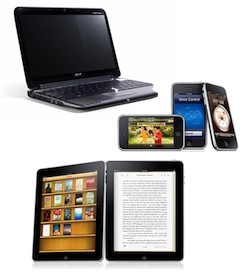
The capabilities of the iPhone, the Droid, the netbook? Absolutely amazing. The first computer I worked on, a 1979 AM-Jacquard minicomputer, cost about $129,000. It occupied a room of its own, took up the space of a walk-in freezer, and had a huge disc drive system involving 10-pound metal platters that each had capacity of 5 megabytes. And that was huge. It was hard to imagine using that much storage space up, ever. My iPhone has 64,000 times more storage space.

I could go on all day with comparisons like that. I love new technology. I love gadgets. I love the Web and social media. And it helps me enjoy it all when I remember how far we’ve come. It’s all amazing.