Category Archives: Business Strategy

New Fremium Formula Pits Revenue Against User Satisfaction

What would you think of a restaurant that offered really good food, but the salad is free and the dressing is extra? The potatoes are free but the sour cream is extra. The soup is free but heating it costs extra. And table service is free if you wait two hours, but table service in 20 minutes costs extra.  

That’s sort of what’s happening with a free mobile app that’s generating a ton of money (It’s been called “a big public test of freemium.”) and a lot of user hostility at the same time. I’m fascinated by the trade-offs here. 

Real Racing 3 complaints

It’s an auto racing game: Real Racing 3, published by Electronic Arts. It’s a free download for both iOS and Android phones and tablets. It shows up very high in multiple mobile app revenue tracking reports, such as the App Annie Index — which means it makes lots of money. 

It’s a great game. It’s won several app awards. You drive fast racing cars over simulated tracks. Tilt your mobile device to steer. Use a finger on the right hand to accelerate, one from the left to brake. I’m not a typical gamer, but I do play this one and I like it. 

Playing it for free takes real patience. It works with inside-game money to buy, fix, and upgrade cars. In practice, you either repeat races a lot, wait a lot, or buy game money with real money. The rewards for winning races don’t cover the game money requirements to keep upgrading to better cars and better races. Fixing cars takes time but you can buy time with game money, and you can buy game money with real money. Buying cars is required to move up the degree of difficulty, but the reward for a win isn’t enough to sustain the normal flow of new cars needed, so you either repeat races of go to the store to get more game money. 

http://www.148apps.com/wp-content/uploads/2013/02/2013-02-23-at-17-14-49-1-600x338.png

In my case, because I’m not patient, I’ve spent more money on it than I care to admit. I’ve bought game money repeatedly to speed things up. And still, after an embarrassing amount already spent, I’d need about five million game dollars to buy and upgrade the cars I need to complete the levels I’m involved with. And while technically I can afford the $99.95 the game wants from me now, I’m starting to question my common sense and I don’t want to be an easy mark or a soft touch. So I’m repeating races and waiting. And cooking up rationalizations for later. 

And I’m absolutely fascinated by the trade-offs here. This is so different from normal price-value tradeoffs. This is not the elasticity we all grew up with. 

The publisher controls  the game-money reward for wins, the waiting times, game-money repair costs, game-money purchase price, and game-money upgrades price. Those factors determine the real-money cost to play the game at various levels of patience and waiting. So it’s very much as if they pit revenue against user satisfaction. It’s more money for more hostility, and less money for less hostility. 

Which do you want: Happy users, or more money? You can’t have both. 

The Growth is Always Greener in Your Neighbor’s Lawn

Have you noticed this? Businesses that sell to small business want to sell to enterprises. Businesses that sell to enterprises want small business. I’ve seen it for 30 years now. 

bigstockphoto.com grass greener

On the one hand, it’s good business. Expand. Go from where you are to where there’s more market waiting. 

On the other hand, damn, I think there’s a DNA problem for most of us. I, for example, have always been comfortable with small business and startups. Companies I’ve started focused on small business and startups. And much as I’ve tried, repeatedly, I never really figured out how to sell to the big business, alias enterprise. 

I think these are different worlds. And they are borders that are hard to cross. I like the way Michael Driscoll puts it in this VentureBeat item: Startups are from Mars, enterprises are from Venus

(Image: bigstockphoto.com)

What Really Happens With Idea Adoption

Seth Godin has a good post today on idea adoption. He calls it you’re not a slot, you choose a slot. It’s an important point: 

wikipedia technology adoption life cycle

Individuals choose a slot based on what sort of leadership or risk or followership behavior makes them happy right now. Early adopters and nerds like to go first. But some people are early when it comes to shoes, or to mystery novels, or records, while others adopt early when it comes to political ideas or restaurants.

Most of the time, most of us choose to be in the slot of mass. The masses wait to see the positive reviews, or they monitor the bestseller lists. The masses know they have plenty of time, that they’ll get around to it when they get a chance, and mostly, they are driven by what their peers (the early adopters, the ones who keep track of this stuff) tell them. “Why waste time and money on the wrong thing,” they argue, with some persuasion. So they wait for proof. Social proof or statistical proof.

I think it’s also a matter of which market, which product. For example, I’m sure I’m very early adopter on high-tech products, even if a bit less so now than I was 20 or 30 years ago; but I’m late on novels, television, and movies. What about you?

More important, Seth’s nice sense of timing. I sense how right he is with this, but I hadn’t seen it as clearly:

The glitch in the system is that many marketers obsess only about the launch. They put their time and money and effort into the first week on sale, and then run to work on the next thing, when in fact, the mass market, those that choose to wait for more than, “it’s new!” haven’t decided to take the leap yet.

That’s so true. And so easy to forget. Great post. 

Classroom Kindle with Big Brother Control One-Ups iPad

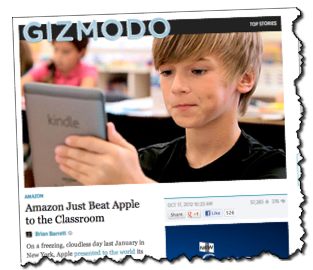
Interesting post: Amazon Just Beat Apple to the Classroom, on Gizmodo. I’ve been following ebooks and textbooks for more than 10 years now, expecting disruption. Textbooks are obsolete. It should have happened years ago. And there’s a lot going on now, but classrooms are still the same. 

In this one, post author Brian Barrett starts by quoting himself from a few months back after Apple presented an iPad solution to classroom learning and textbooks. Brian said then:

Let’s be clear; this is indisputably the future. What we saw today is what our classrooms will look like once iPads are far cheaper, once digital textbooks can be handed down as easily as physical ones, once teachers of every subject have several educational material options to choose among. For now though, it’s important to remember that “new” and “different” always come at a premium. One that the vast majority of us can’t afford.

Brian says that’s as true today as it was then, but …

But look at how Amazon’s offerings have grown since then. A backpack-friendly 7-inch tablet for $160 (and E-ink technology has progressed enough that you could probably make due with a $70 entry-level model). A Kindle eTextbook service that’s ballooned to over 200,000 titles, with generous return policies and cash-saving rental options. And a platform ubiquity that ensures no kid gets left out, regardless of what device he or she owns

And then this, on Whispercast:

But today’s announcement of its Whispercast technology seems to solve problems Apple hadn’t even thought of.

 Whispercast is a free service that serves as an umbrella for many, many Kindle management features, but most of all it provides the kind of centralized control over devices that are a luxury for businesses and a necessity for schools. Content distribution, social media and purchase blockades, password protection, document sharing; there couldn’t be a more teacher-friendly checklist.

Sigh … I guess that’s good news. But it’s sad, at least in some ways, that control, blockades, and protection are barriers to better technology in schools. I can see why — lawsuits, fanatics, porn, bullying, and so forth — but still. Damn. 

(Complete aside: I like the lead from a writing point of view. Here’s Brian’s first sentence from today’s post:

On a freezing, cloudless day last January in New York, Apple presented to the world its vision for the future of education. 

The freezing cloudless day has nothing to do with the rest of the post, but it’s an interesting start.)

The Best Business Success Factor is Value

Keys to entrepreneurial success? We talk about passion, persistence, ideas, funding, planning, sales, product-market fit, and all of that. Do what you love, we say. My opinion changes according to recent events, experience, even mood. Which is fine, because it’s a reaction to events, and we don’t want to get static. But on the long term, most often, what I see making the most difference in business is value. Offer value to customers.

You can do what you love, and if nobody wants to pay you, you don’t have a business. Nobody’s going to pay me to play my guitar, or draw, or ski. I have to think of something I like to do that other people will pay for. So I ended up with business planning. Maybe they’ll pay you to play your guitar. And if you like skiing, maybe you end up as a ski teacher, or you own a resort, or you do ski movies. And maybe they will pay you to draw, if you’re a graphic artist.

And then you give value. It’s not about you and what you want. It’s about them, your customers, and what they want.

I realize it’s a bit out of date, a 1987 book, but Paul Hawken‘s Growing a Business is still my favorite business book.  Growing_a_business It’s the first one I recommend.

Hawken tells real stories of real businesses wrapped around people doing what they like because they like doing it, they think it should be done, and the doing of it flows simply into the logic of filling needs and offering value. Two guys in Vermont get involved with their ice cream. They start selling it. It ends up being Ben and Jerry’s Ice Cream. It’s a great story.

They aren’t all bearded ex hippies. The stories include a bank in Palo Alto, Patagonia (outdoor clothes), Apple computer, etc. What they have in common is a sense of organic, natural growth from the foundations of doing what you want to do, when that’s something that other people want to have done. And they offered value to their customers.

It helped for me that I was a customer of the bank in Palo Alto, and of Ben and Jerry’s, Patagonia, and Apple Computer, and my wife loved buying at Smith and Hawken. I believe in the underlying idea that businesses depend on value — value to the customer — and values — the people in the business have to believe in it.

The business in this book isn’t what you learn in business school. It’s what you want to do. It isn’t about building a business to make money, but rather building a business because it should be built and you want to do it. With that kind of foundation, it seems — and I’ve seen for years now, with hundreds of different business — it grows.

ps: I shared the podium with Paul Hawken in the late 1980s, at Apple, when I was speaking on business planning and he was speaking about the ideas behind this book. He seemed a man whose persona was based on ideas, on the underlying values. I’m not surprised at the way his career has gone since.

Enhanced by Zemanta

The Vital Fresh Look for Business Survival

The artist knows the scene. He lives there. But he closes his eyes, squinting, to get a fresh view of it. Sometimes things get too familiar. 

Back in the 1970s when I was a foreign correspondent living in Mexico City, I dealt frequently with an American diplomat who provided information about Mexico’s increasing oil exports, which were a big story back then. We had lunch about once a month. He became a friend.

Then one day he told me he was being transferred to another post because he had been in Mexico too long. “What? but you’ve only been here for three years,” I said. I was disappointed for two reasons. “You’ve barely learned the good restaurants!” He explained to me that the U.S. foreign service moved people about every three years on purpose. “Otherwise we think we know everything and we stop questioning assumptions,” he said, “that’s dangerous.”

I remember that day still because I’ve seen the same phenomenon so many times in the years since, in business. We — business owners and operators — are so obviously likely to fall into the same trap. Our business landscape is constantly changing, no matter what business we’re in, but we keep forgetting the fresh look. “We tried that and it didn’t work” is a terrible answer to a suggestion when a few years have gone by.  What didn’t work in 2000 might be just what your business needs right now. But you think you don’t have to try again what didn’t work five years ago.

This is why I advocate the “fresh look” at the market at least once a year.  Existing businesses that want to grow too often skip the part of business planning that requires looking well at your market, why people buy, who competes against you, what else you might do, what your customers think about you. Think of the artist squinting to get a better view of the landscape. Step back from the business and take a new look.  Use the standard Know Your Market techniques and content, just applying it to your business, not a new opportunity.

Talking to customers — well, listening to customers, actually — is particularly important. Don’t ever assume you know what your customers think about your company. Things change. If you don’t poll your customers regularly, do it at least once a year as part of the fresh look.  As an owner, you should listen to at least a few of your customers at least once a year. It’s a good exercise.

For creativity’s sake, think about revising your market segmentation, creating a new segmentation. If for example you’ve divided by size of business, divide by region or type of business or type of decision process. If you’ve always used demographics, use psychographics instead.

Remember to stress benefits. Review what benefits your customers receive when they buy with your, and follow those benefits into a new view of your market.

Question all your assumptions. What has always been true may not be true anymore. That’s what I call the fresh look.

(Image: istockphoto.com)

(Note: this was first published here in April of 2006. This version is slightly modified) 

The Thin Line of Fremium Strategies

It’s not like I’m going to say “poor Tripit.” Tripit was purchased last year for $120 Million in cash and stock. So I presume it generated a collection of happy founders. But the pressure on so-called fremium sites, like Tripit, must be tough. I’m getting emails now offering enticements to upgrade. 

I like Tripit. I’m a happy user. I forward those confirmation emails I get from United and Hertz and Hilton to a Tripit email and they keep track of them for me, confirmation numbers, times, the whole collection of trip information. But — and here’s the problem — I don’t like it enough to pay for it. I’d rather keep track of conformation emails than pay for the “Tripit Pro” upgrade. 

And yet I do pay monthly fees for some web apps. I’d give a quick example but the one that comes to mind competes with one I’m involved with, so I’m mentioning neither. But I do, I promise.

And there are also some I’d pay for if I had to. Evernote and Dropbox, for example. Both are free for me but (don’t tell them) if I had to pay they are so useful that I would.  Within reason, that is. 

And there are some I won’t pay for and will stop using before I pay. Like Tripit, which has my sympathy today because of the emails they’re sending me trying to get me to upgrade. 

Specifically, my condolences go out to the people who have to decide how to sort features between free and premium versions. That’s got to be a really tough think line to walk. Tightropes come to mind. I’ve had some brushes with problems like these, which in my case were about light versions and free trials, and I didn’t do well with any of them. Tripit people, good luck with that. 


Should Your Strategy Be Constantly Changing?

I read Holly Green’s Shifting from Strategic Planning to Strategic Agility, on Forbes.com the other day. Ok, agile sounds good for a business. And the world does change rapidly, too. But what about this, from something I wrote about 10 years ago:

Better a mediocre strategy, consistently applied over time, than a series of brilliant strategies, changing rapidly, contradicting each other.

Is that no longer true? Here, in contrast, is Holly’s argument for strategic agility:

At its core, strategic planning involves a process of analysis. You do some research into what is and what is possible. You define a goal, break that goal down into manageable steps, and determine how to implement them while identifying the expected consequences of each step. It’s a logical, straightforward process designed to sequentially move the organization from where you are now to where you want to go.

The huge flaw in this is the assumption that the world is reasonably stable and somewhat predictable. Maybe a few generations ago. But anyone who has been paying attention the last few years knows that today’s world is neither.

That sounds reasonable as I read it, but in fact, I disagree. I don’t think strategic planning assumes that the world is stable and predictable. It does, however, assume that one core foundation of any strategy is your identity. It’s your uniqueness, what sets you apart from the rest of the world. That’s true for companies as much as for individuals. And that doesn’t change easily. You can change strengths and weaknesses only over a long time, and with a great deal of effort. So that part of strategy is relatively stable. And that’s a very important part.

Of course markets change, technologies change, and goals change; which is why the “agility” component is attractive. But strategic agility doesn’t replace strategy. I say good business strategy mixes long-term attributes with changing markets and focus, and of course it’s always a process, never fully stable. One element affects the other elements. It is never sequential. But strategy is also a matter of focus, understanding core identity, building positioning over time, and it takes consistency too.

What do you think?

Those Sad Stories of Elephants and Mice in Startups and High Tech

Big squashes little. The elephant steps on a mouse and kills it, but never even notices. We stop on ants on the sidewalk without realizing.

You can probably think of a lot of these cases.

I had a friend who rode a big wave in the late 1980s with a PC-compatible add-on board that enabled a PC to send a fax as easily as printing a document. It was a huge win. Millions of dollars were made. Then Microsoft added a fax facility into a new version of Windows. Pop, crackle, snap.

At about the same time, there was a company in Canada that had a huge business selling compression software that worked with PCs. Then Microsoft bundled compression into a new version of Windows. Pop, crackle, snap.

I read iCloud Communications sues Apple for obvious reasons the other day on Engadget. Pop, crackle, snap.

It’s part of life in the world of startups and high tech. Big companies kill little companies without even knowing, much less caring. No law against it. No reason not to?

What do you think?

(Illustration: hikingartist.com via Flickr cc)

3 Stories Your Business Strategy Depends On

Stories are not just stories; they’re experience repackaged. They can tell a lot more than just a story. If you own a business, or ever want to, you should be able to tell each of these stories well. If you can, you’ve already nailed the essence of long-term strategy. If you can’t, then here’s a good way to rethink your business.

You want to be able to tell these stories because they’ll help you understand, focus, and manage your business better.

1.  The Story of The Buying Event

Tell the story of an imagined best-possible customer wanting or needing something, finding your business, and buying from you. Try to describe that person (or company) in detail. Be able to describe the process in glorious detail. What did she want? What did he need? What led her to your business? What was he looking for? What problem did she have? How did he find your business, and what made him decide to buy? What were the important decision factors?

2.  The Story of Why We Exist

Be able to tell a simple story about how your business makes some people better off. Guy Kawasaki talks about making meaning, making the world better. And that’s not just the social enterprises or non-profits, that’s the shoe repair business on the corner, the marketing consultant, graphic artist, and the hot dog stand that appears before noon. Every successful business does something for somebody, or it doesn’t last. And that’s a story you should tell yourself. What difference does your business make to the world?

3.  The Story of Our Future

We used to call this the vision statement in the old-fashioned formal business plan. I don’t care whether it’s part of a document or not, but it’s a good concept to keep. Imagine your business three to five years from now. What does it look like then? What is it doing differently, then,  that it doesn’t do now? How has it changed? Is it in a different location? What new things is it selling, and to whom? How has its meaning changed?

If you can tell these three stories, you’ve got a business strategy.

(Image: istockphoto.com)