Category Archives: Business Planning

Don’t Be Fooled By Mismanaged Data

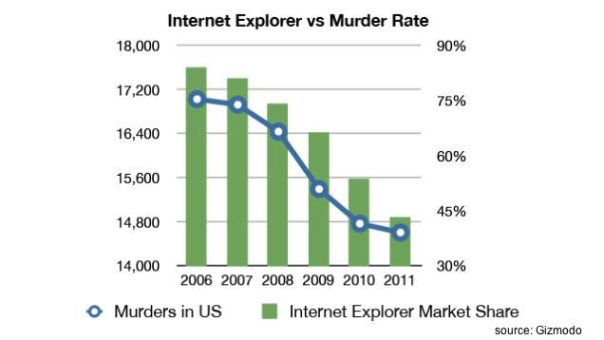
Here’s another great example of why you don’t blindly trust research. This illustration comes from this Gizmodo post. Post author Jesus Diaz is not saying this means what it seems to say (see his conclusion below). But here you are with another example of how easy it is to get the wrong conclusions, especially when the research is summarized to easy conclusions.

Correlation is not causation

Gizmodo author Jesus Diaz doesn’t say where this data comes from, nor does he define the terms, which is fine with me because the data makes the point.

And I like the way he concludes:

p.s. If you take this seriously, you are an idiot and you should go stick your head up some dark hole.

Q&A: What Do I Include in a 1-Page Business Plan

I received this question overnight from my ask-me-a-question page:

I am entering a competition that is asking for a one page business plan and I am having a hard time trying to determine what to put on it and what not to include. What information is absolutely required?

To answer this well I’d need to know the criteria set up for the competition. Some are more concrete than others. Some are more about the idea, but most emphasize investment potential. I think of what I want to see as I review submissions to an angel investment group. These are essential to me:bar-charts-37107002_600W

  1. The problem you solve. This is also called “why-to-buy.” It’s a way to set a target market and potential growth in a single thought. Show the underlying need. And it doesn’t have to be all problems and needs as if your business is going to save the world. Lots of things nobody really needs make good businesses: expensive coffee, gourmet foods, perfume, and so forth.
  2. Your solution. This is your business offering, what you sell. The more new and different, the better – as long as it’s credible. Validation – users, buyers, pre-sales on Kickstarter, for example – is great if you have it
  3. Why you. What’s so special about you that makes your solution interesting. That might be technology, positioning, secret sauce, management experience, traction.
  4. Management team experience. Experience with startups is especially important, but whatever lends credibility to your ability to deliver the solution.
  5. Growth goals. Show projected annual revenue for 3-5 years, if that’s an interesting number; or projected growth in users, downloads, subscribers, unique visits or something like that, if that’s an interesting number. If you can, show it as a small bar chart.

The one page business plan is metaphor for short and simple, a business summary. It’s named incorrectly but it can still be useful. Even a 60-second elevator speech can be useful. Summarizing is a good thing. But I’d rather see a 2-5 page summary than a single page; and I’d rather take it as a summary, not a plan.

I’m biased of course but LivePlan does a great one-page summary that it calls a pitch, which shows problem, solution, market, secret sauce, milestones, revenue, and team leaders.

Q&A: Winning Business Plan for a Competition

How do you do a winning business plan for a business plan competition? I’m glad you asked. I’m a frequent judge of these competitions so it’s in my interest to help you improve your chances by developing a better business plan, pitch presentation, summary, and elevator speech.win the competition

So that you know, I’m answering this question with reference to the mainstream high-profile business plan competitions I’ve judged many times, including the University of Texas’ Global Venture Labs Investment Competition, the Rice Business Plan Competition, and the University of Oregon’s New Venture Competition. I’ve done these three at least 10 times each. I’m assuming they are typical – but I could be wrong.

Here’s how the process works, with regard to what you deliver and how decisions are made:

  1. You submit either a business plan or executive summary to a steering committee that selects a few dozen entrants from hundreds of submissions. These committees vary. Many still use the full plan, but trends favor just the summary. This step takes place behind the scenes, before the visible portion of the competition begins. The entries selected are called semi-finalists. They are invited to go to the competition, at the site, which usually involves a Thursday, Friday, and Saturday, most often in April or May.
  2. Semi-finalists are divided into groups of four to six. Semi-final judges, mostly angel investors, venture capitalists, and executives from sponsor companies, read and evaluate the full business plans before the competition starts.
  3. An elevator speech round happens on the Thursday, in the evening. The teams do a 60-second elevator speech for prizes and awards. Winning that competition doesn’t formally help win the main prize, but informally, it affects the judges who see it. About half the judges will attend that first evening.
  4. The semi-final round takes place on Friday. Teams do pitch presentations and answer questions from the judges assigned to their group, who have read their business plans. Judges choose a finalist based not on the quality of business as a potential investment. The plan matters of course, and the pitch matters as well, but the choice is ultimately about the business. Judges try to make decisions based on investment criteria, including growth potential, defensibility, scalability, and experience of the management team.
  5. Finalists go through the same gauntlet on Saturday. Finals judges read the plans, listen to pitches, and ask questions. They choose the winner based on the same criteria they use to choose investments.

In all of these competitions, the judges are told to choose the best plan for outside investors, not the best-written or most attractively formatted business plan. So, a mediocre business plan for a great business will always beat a great business plan for a mediocre business. What you want from your business plan is to present your business well in a way that makes it easy for judges to see what you have. Your business plan alone isn’t enough to determine your fate in these competitions, but it does provide the first impression and the detailed background. In fact, all three of the competitions I mentioned above have special prizes for the best business plan, but those awards pale in comparison to the main prizes.

Therefore, the best way to help your chances with your business plan is to make sure the judges see the critical elements that make a business attractive to investors: potential growth and scalability, proprietary technology or some other kind of barriers to entry, and an experienced management team.

Here are some related tips that might also help:

  1. Make sure you cover the information investors want. Tell a convincing story about the problem you solve and the solution you offer, in a way that will interest the investors and let them believe your market story. Show whatever traction you have, and as much startup experience in the management team as you can. Show how your business will defend itself (proprietary technology, trade secrets, whatever secret sauce you have) from competitors entering the market. Show how you can scale up for high growth. Show that you understand how exits might work in 3-5 years.
  2. Keep it brief. Be concise. Don’t show off your knowledge, push your main points forward. Bullet points are appreciated.
  3. Show your numbers and your key assumptions. Numbers without assumptions and underlying story are useless. Forget present value and IRR games that depend on future assumptions. Show unit economics and build forecasts bottom up, from assumptions, not ever as some small percentage of a big market.
  4. Use illustrations that simplify and explain. Have the detailed numbers to back them up, of course, but use bar charts and line charts and pie charts to help readers get the idea quickly.
  5. Check your numbers against real world benchmarks. Investors will react negatively, not positively, to unrealistic profitability projections.
  6. Maintain alignment between the key points you emphasize in the business plan, the pitch presentation, and the elevator speech. Ideally your business plan is like the screenplay for the pitch presentation and the elevator speech.
  7. Don’t be afraid to revise numbers constantly, and don’t apologize if the numbers you show today are different from what you showed yesterday. Plans are supposed to evolve constantly.

(Image: shutterstock.com)

What Percent of Small Business Owners Manage Cash Flow?

cash-ball-chain-bigstock-5041553 (1)I’m fascinated by the numbers Denise O’Berry turns up in her post Use Metrics To Manage Cash Flow – Small Business Expert Denise O’Berry. She quotes results of a survey sponsored by the American Institute of CPAs, which surveyed 500 owners of businesses averaging less than 10 employees and less than $2 million in revenues.

According to this, the biggest worry of small business owners, is (drumroll):

The number one issue facing small business is ensuring adequate cash flow from operations, according to 83% of survey respondents.

That’s Denise quoting Bill Reeb, CPA, surprising nobody. It is sort of like saying the number one issue in health is breathing.

(Of course, this is the AICPA asking … do you think (I’m just asking, that’s all) the results might have been different if the survey were taken by, say, the American Marketing Association? That increasing sales might have shown up as the top worry? That idea intrigues me. I’m just not a big fan of facts via surveys.) 

But this gets even more interesting, as Denise adds this:

Driving this issue is the fact that 51% of those surveyed say they don’t use a cash flow budget or forecasts to help manage their business and 32% say they don’t have specific metrics in place to monitor performance on a daily or weekly basis. And only 17% agreed that daily or weekly metrics are as important to them as their financial statements.

I commented on Denise’s post, wondering whether there might be a relationship between the roughly half of business owners who don’t plan and manage their cash flow and businesses whose normal operations don’t involve the cash-flow killers, sales on credit or product inventory. Sales on credit are not credit card sales, but rather business-to-business sales in which product or service is delivered to a business along with an invoice that will be paid later. That relates to collection days and accounts receivable. And product inventory means working capital is tied up in building and holding inventory, which separates the cash flow from the normal sales less cost of sales flow shown in a profit and loss statement.

I’ll tell you what taught me to watch cash flow, always, and very carefully: the lack of it. It wasn’t two years at business school; it was a growth spurt (sales doubled) that sucked up all the cash and left me looking for a second and third mortgage to keep the business going. That’s something you don’t forget.


When So-called Experts Say Don’t Do a Business Plan…

… don’t be confused. What they really mean is … experts speak half truths

  1. Don’t do a long static formal business plan. Do a lean, just-big-enough business plan. Deal with it as a constantly-renewing latest version, with a shelf life of a few weeks at most. Don’t fill it with excess supporting information.
  2. They won’t even look at a business plan until after they’ve understood the main points from a summary memo, and — in most cases — been through the pitch and met the people. The idea that potential investors would read a business plan as a first step, from somebody they’ve never met, without going through preliminary materials … is laughable.

Understand where the business plan fits in the process of securing investment.

  1. It’s not the calling card, not the sales brochure, not something you ever send to somebody who doesn’t already know you, your business, and the basic story.
  2. It’s likely to come up for deals that have gotten through some filters first. Investors will ask for it as part of the due diligence that starts after they understand the deal and are interested in pursuing it further.
  3. It explains a deal: problem, solution, product-market fit, potential market, potential growth, scalability, defensibility, traction, major milestones, management team, and essential projections of financial progress and, in cases where this applies, trackable progress in traffic, visits, downloads, users, and so forth.
  4. It’s the screenplay for the summary memo and the pitch. Even though investors won’t want the plan immediately, you’ll need it, when you pitch, to refer to later to answer questions like “can you grow faster with more money” or “how would it look with double the sales force?”

And you don’t have to call it a business plan. The lean startup advocates, for example, like to call it anything but a business plan, but ask them about it, and they’ll confirm you need to cover the same ground as I have in my point 3 above.

My suggestion: call it a lean business plan.

Truth is a Believable Story

I grew up believing that facts, like research, numbers and percentages, told the truth. I believed in objective, verifiable truth, based on fact. I distinguished that from mystical religious truth, based on faith.

I was a mainstream journalist for almost 10 years in the 1970s. Every professional journalist believed in objective verifiable truth based on fact. That was the goal of reporting. We separated subjective opinion from objective truth. Truth was hard to find, yes. It often had to be dug up and uncovered. But it was there.

Now I know better.

Truth is not research and data. Although my generation grew up believing hard numbers were truth, it just isn’t so.  Nowadays there is data to prove anything, regardless of how absurd. And people routinely hide their opinions as data. Eggs are good? There’s data to prove it. No, eggs are bad? There’s data to prove that too. The same for coffee, sugar, exercise, structure, discipline, whatever.  The truth is not in the data.

Truth is not just a believable lie, either. It’s more like a matter of angles and reflections and angles of light, like a gas, not a solid. It’s something like what William Blake implied about  300 years ago, in Proverbs of Hell:

Every thing possible to be believ’d is an image of truth.

Truth is a believable story. And much of human truth is better told in stories than a facts, and much less numbers.

And in business, Seth Godin says marketing is stories. I say planning is stories. Truth isn’t what the research says, or the focus group, or the latest survey.

Take a step back from it and ask, always: Does this make sense? Is this credible?

Truth as told in stories is still truth. I love how Harvey Cox says truth is in stories. This is from his book When Jesus Came to Harvard:

All human beings have an innate need to hear and tell stories and to have a story to live by…religion, whatever else it has done, has provided one of the main ways of meeting this abiding need.

I don’t mean it as disrespectful to see the “story” in religious doctrine. On the contrary: The right stories, real stories, the best stories communicate truth better than so-called facts. And it’s almost a proof of God how themes and meanings overlaps between the different stories of the different religions. Maybe there is a God gene, in our species DNA. And the stories are an expression of how humans all struggle to understand God, or creation, or whatever that immensity is, in their own way. With their own background and culture.

My summary: truth is a believable story.
Interesting Chart on Age as People Marry

Every so often I stumble on interesting statistics and good simple business graphics that show them. That applies to this line chart of Median age at first marriage by sex: 1890-2010 published by Imgur at imgur.com, and developed by the U.S. Census:

I’m intrigued with the way the marriage age dropped suddenly after the second world war, then increased steadily for several decades. And is still increasing today. I like it when actual data matches what we see in the real world, and we definitely see people waiting to marry at more advanced ages. 

Sometimes this kind of data generates business ideas, business opportunities, or business threats. Does it affect your business? 

Bad Advice on Data Decisions

Oh dear, there it is again: somebody else pushing data over common sense. Paul B. Brown, on Forbes.com, writes: 

data vs. intuition

data from your customers is always better than your best intuition.

Wait, what? Did he really say that? 

 Not that Steve Jobs was right on everything, but I can’t resist my favorite Jobs quote here:

It’s not the customers’ job to know what they want. 

Paul Brown tells a story of a mouse pad combined with paper that he thought was a great idea, he bought, he used, and he didn’t like. He suggests that asking customers would have been better than guessing.

Talking to customers, sure; great. Data from customers? Not so much. 

My problem is that so-called “data from customers” is rarely truth. Data gathering is plagued with problems of research design, random lists, skewed questions, half truth and innuendo disguised as data. If it were really good data, the real result of actually talking to customers, that would be pretty good. But seriously, how often are customer polls and primary research really valid? Seldom. 

And ironically, his story argues for using the darn thing, not polling potential customers. He says he liked the idea until he actually used it. I think that’s a clue. No? 

My career has been software, and I can tell you this: The best software comes from people who use what they create. Not from customer data. 

The problem with thinking like this is that then data ends discussion and trumps common sense. Which would be okay, most of the time, if so-called data were truth. But it rarely is. 

The Power of One Simple Question

I like this. If you want real customer feedback, keep it simple. My friend Stephen Lahey, of Small Business Talent, understand email, and who he’s talking to, when he asks his small business owner clients one simple question:

Stephen Lahey SmallBusinessTalent.com simple survey

“When you think of me and our working relationship, what are the five adjectives that first come to mind?”

The illustration here on this post shows the survey link he offered. There it is, a single question, with the promise of “done” showing right there on the submit button. 

And — no surprise — this keep-it-simple strategy works great for getting responses. The subject line of the email was “Single Question Survey.” The open rate was higher than average, almost all who opened clicked-through to view the survey, and about 60% of this number actually submitted survey feedback. Those are really good results. 

I think that’s a brilliant example of how to use data and surveys, and get people to join in. Even though yesterday I posted Don’t base business decisions on data and statistics on Up and Running, which contradicts this post, I still think this is brilliant. And yes, the one does contradict the other.  That happens all the time. 

Steve said: 

The feedback I received was consistent and encouraging. But it wasn’t exactly what I expected — it challenged my assumptions. Valuable? Yes, indeed.

And he makes this point: 

My point? If you want to understand the reality of your brand, then don’t assume anything. Ask your clients for their feedback. I think that you’ll find it’s an eye opening experience.

Yes. Well said. Great example.