Category Archives: Business Planning

Standard Business Plan Financials: Projected Profit and Loss

Continuing with my series here on standard business plan financials, all taken from my Lean Business Planning site, the Profit and Loss, also called Income Statement, is probably the most standard of all financial statements. And the projected profit and loss, or projected income (or pro-forma profit and loss or pro-forma income) is also the most standard of the financial projections in a business plan.

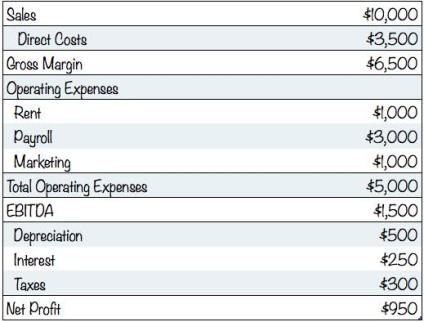
Either way, the format is standard, as shown here on the right.Simple Profit and Loss

  • It starts with Sales, which is why business people who like buzzwords will sometimes refer to sales as “the top line.”
  • It then shows Direct Costs (or COGS, or Unit Costs).
  • Then Gross Margin, Sales less Direct Costs.
  • Then operating expenses.
  • Gross margin less operating expenses is gross profit, also called EBITDA for “earnings before interest, taxes, depreciation and amortization.” I use EBITDA instead of the more traditional EBIT (earnings before interest and taxes). I explained that choice and depreciation and amortization as well in Financial Projection Tips and Traps, in the previous section.
  • Then it shows depreciation, interest expenses, and then taxes…
  • Then, at the very bottom, Net Profit; this is why so many people refer to net profit as “the bottom line,” which has also come to mean the conclusion, or main point, in a discussion.

The following illustration shows a simple Projected Profit and Loss for the bicycle store I’ve been using as an example. This example doesn’t divide operating expenses into categories. The format and math start with sales at the top. You’ll find that same basic layout in everything from small business accounting statements to the financial disclosures of large enterprises whose stock is traded on public markets. Companies vary widely on how much detail they include. And projections are always different from statements, because of Planning not accounting. But still this is standard.

Sample Profit Loss

A lean business plan will normally include sales, costs of sales, and expenses. To take it from there to a more formal projected Profit and Loss is a matter of collecting forecasts from the lean plan. The sales and costs of sales go at the top, then operating expenses. Calculating net profit is simple math.

From Lean to Profit and Loss

Keep your assumptions simple. Remember our principle about planning and accounting. Don’t try to calculate interest based on a complex series of debt instruments; just average your interest over the projected debt. Don’t try to do graduated tax rates; use an average tax percentage for a profitable company.

Notice that the Profit and Loss involves only four of the Six Key Financial Terms. While a Profit and Loss Statement or Projected Profit and Loss affects the Balance Sheet because earnings are part of capital, it includes only sales, costs, expenses, and profit.

Standard Business Plan Financials: 3 Essential Projections

Yesterday I posted here the six key financial terms every business owner or startup leader needs to know. That’s reposted from my site on Lean Business Planning. These six terms work into three essential statements (for past results) or projections (in business plans or anything referring to the future) for standard business plan financials. A pro-forma statement, by the way, is another way to say projection. TheProfit and Loss (also called Income) includes Sales, Costs and Expenses. The Balance includes Assets, Liabilities, and Capital.

Three Essential Statements

And these three are conceptually linked and interconnected. The following illustration shows how they relate to each other:

Linking Financials


The standards of accounting, like double-entry bookkeeping, make a delightfully automatic error check with the three statements. They link up conceptually so that if the balance doesn’t balance, it’s wrong. If assets are not the sum of capital plus liabilities, it’s wrong. If retained earnings don’t add up to profits less distributions to owners (as in dividends, or owners’ draw), it’s wrong. If your spreadsheet, or your software, doesn’t reflect every change in the profits to the cash and balance, and every change in balance to cash, then it’s wrong.

I’ve heard an intelligent successful lawyer claim that double-entry bookkeeping was the most important invention of the western world. I’m not going to go there in this book. I’m not doing debits and credits. But knowing how these statements link up is important. Having standard business plan financials matters if you have a business plan event and have to show your business plan to bankers or investors.

Standard Business Plan Financials: Six Key Terms

A good argument for teams in business is not having to know finance if you love sales, marketing, or product development. But you’re a business owner. You’ll run your business better if you understand the standard business plan financials. These important terms aren’t that hard to learn and understand. You owe it to yourself and your business.

Like it or not, some very common terms including capital, assets, liabilities, costs, and expenses have very exact meanings in accounting and finance; but they are often used in conversation with much more flexible and fuzzy meanings. For example, in a conversation over coffee, a business owner might refer to her website as an asset; but in finance it’s an expense. And an employee whose work is sloppy might be called a liability; but that’s not proper use of the accounting term.

Just Six Terms

Every item in every standard accounting system is one of the following six terms. The first three (assets, liabilities and capital) appear on a standard balance sheet, and the next three (sales, direct costs, and expenses) appear on the standard income statement. Explanations of those, plus the all-important cash flow, are coming. But first, the six terms you need:

Assets

Assets are things of value a company owns. Money is an asset. Money in a bank account, or in securities like stocks and bonds, or liquidity accounts and banking instruments, is an asset. It goes on your books as some amount of dollars or pounds, francs, yen, or whatever currency you use. Land, buildings, production equipment, and furniture are assets. One definition is “anything with monetary value that a business owns.” Inventory is a very common category of assets, meaning the goods a business owns to resell (like the books in a bookstore or the bicycles in our cycle shop example), or, in a manufacturing business, materials to be assembled or processed to become a product.Rule of Accounting

Assets are often divided into current or short-term assets and fixed or long-term assets. The exact distinction between the two usually depends on decisions a company makes and sticks to consistently over time. Land and buildings are durable production equipment are almost always fixed or long-term assets, and furniture and inventory are almost always short-term assets. Some companies consider vehicles long-term assets, and some consider them short-term assets; and some vehicles (dump trucks and cement mixers, for example) are almost always long-term assets. You have flexibility on how you categorize long- and short-term as long as you know it and stick to it.

Assets can be tangible, like money in banks or physical goods, or intangible, like patents and trademarks and money owed to you, called Accounts Receivable.

Tax law and accepted standards dictate the value of the assets listed in your books. This can be annoying when your accounting lists a piece of land at $100,000 because that’s what you paid 10 years ago, even though its market value is $500,000 today. And tax code makes you list your patents and trademarks in your books at the value of the legal expenses you incurred in securing the registration; less “amortization,” a complicated formula that specifies in tax code the decline in value over time. And your plant, equipment, and vehicles have to be listed at what you paid for them less “depreciation,” another complicated formula that tax code specifies for their hypothetical decline in value.

Liabilities

Liabilities are debts: money your business owes and has to pay back. The most common liability is called Accounts Payable, which can be any money you owe to anybody but is usually money owed to vendors for goods and services purchased recently but not yet paid for. And there are notes, loans outstanding, long-term loans, and others.

Like assets, liabilities are often divided into short-term or long-term, and short-term liabilities are often called current liabilities. Accounts Payable are always short-term or current liabilities. Companies can choose how to distinguish between short- and long-term liabilities, as long as they are consistent. So some companies call debts owed within a year short-term debts, and others call them current debts. Some companies break out the next year’s payments of long-term debts as “Current Portion of Long-term Debt.” All of these options are fine as long as you maintain them consistently.

Capital

The quickest way to explain capital is by the magic formula that is always true in finance and accounting:

Capital = Assets less Liabilities

Capital starts formally with money the owners of a business put into its bank account to get it started. When our restaurant example owner Magda writes a check from her own funds to open a bank account for her restaurant, that’s supposed to go into the books as capital. It’s usually called paid-in capital. When an angel investor writes a check to a startup, that money goes into the books as paid-in capital.

You’ll also hear about so-called working capital, which is the money it takes to keep a company afloat, making payroll, buying inventory, and waiting for business customers to pay what they owe. Accountants and financial analysts calculate working capital by subtracting current or short-term liabilities from current or short-term assets.

And retained earnings, which are profits you didn’t distribute to yourself or other owners as dividends, or to yourself or other co-owners as a draw, add to capital in standard accounting. If there are no dividends, then last year’s earnings in the balance sheet are added to previous Retained Earnings to calculate this year’s Retained Earnings. And both Earnings and Retained earnings are part of capital, while dividends and distributions or draws decrease capital.

But none of those common interpretations of capital change the basic rule. The capital in a business is always, exactly, in every case, the number that results from subtracting the liabilities from the assets.

Sales

Most of us understand sales from an early age. Sales is exchanging goods or services for money. Technically, in standard accounting, the sale happens when the goods or services are delivered, whether or not there is immediate payment. Do you know it can be a criminal offense to report financial results including sales that you haven’t actually made, even if you are 99% sure your client intends to buy? Some very big companies have gotten into legal trouble for confusing optimism with actual sales, when for example they book a full year’s service contract into sales in the same month the customer signed the agreement. Technically the sale is for 1/12th of the annual contract value each month.

Direct costs (COGS, unit costs, cost of sales)

Most people learn COGS in Accounting 101. That stands for Cost of Goods Sold, and applies to businesses that sell goods. COGS for a manufacturer include raw materials and labor costs to manufacture or assemble finished goods. COGS for a bookstore include what the storeowner pays to buy books. COGS for Garrett, our bicycle shop owner in Section 3, are what he paid for the bicycles, accessories, and clothing he sold during the month. Direct costs are the same thing for a service business: the direct cost of delivering the service. So for example it’s the gasoline and maintenance costs of a taxi ride.Defining Profits

Direct costs are different down the value chain of a business. The direct costs of a bookstore are its COGS, what it pays to buy books from a distributor. The distributor’s direct costs are COGS, what it paid to get the books from the publishers. The direct costs of the book publisher include the cost of printing, binding, shipping, and author royalties. The direct costs of the author are very small, probably just printer paper and photocopying; unless the author is paying an editor, in which case the editor’s income is part of the author’s direct costs.

The costs of manufacturing and assembly labor are always supposed to be included in COGS. And some professional service businesses will include the salaries of their professionals as direct costs. In that case, the accounting firm, law office, or consulting company records the salaries of some of their associates as direct costs.

Direct costs are important because they determine Gross Margin. Gross Margin, which is part of the Profit and Loss, is an important basis for comparison with other companies.

Expenses

It’s hard to define expenses because we all have a pretty good idea. Expenses include rent, payroll, advertising, promotion, telephones, Internet access, website hosting, and all those things a business pays for but doesn’t resell. They are amounts you spend on business goods and services that aren’t direct costs but reduce your taxable income and profits.

You have to understand what isn’t an expense. Repaying loan principle isn’t an expense. Buying an asset isn’t an expense. Purchasing inventory isn’t an expense; amounts spent on inventory go into direct costs when goods are sold, but they aren’t expenses.

(Ed note: this is reposted here from the original at leanplan.com.)
 

Standard Business Plan Financials

Why You Need to Know

I believe these three things about startup entrepreneurs, business owners and standard business plan financials:

  1. The essential need-to-know facts about financials are very important;Financial Forecasts
  2. They are easy enough to learn; and
  3. Bankers, accountants, investors and their analysts expect you to know them and use them correctly.

And here’s why, quoting from a post I wrote for the Amex OPEN forum:

All financial projections are wrong, by definition. We’re human and we don’t predict the future accurately. So don’t expect accuracy. Go for plausibility, and then follow up with regular plan versus actual analysis, review and revisions. We call that management.

What You Need to Know

It starts with standard financial terms. Please don’t use financial terms incorrectly. Banking, finance, and investment assign exact meanings to several important financial terms. They are easy to learn and really important because using them wrongly in business plan financials is at best going to make a very bad impression, and at the worst could even be fraud.

The guardians of financial correctness live in an unforgiving world. Banking and securities laws make even some innocent financial errors look like fraud. Preserving the details of financial standards is the only way business numbers can stand up to legal scrutiny. Numbers in financial statements have to mean what they are supposed to mean.

And seriously, it doesn’t take an MBA degree or CPA certification to know essential financials required for business planning and, really, running a business. It takes focusing your attention for an initial few minutes and then having the discipline to check back when you need to. Read and understand this section, keep it in mind when you deal with financial projections, and you will be fine.

There are three standard financial projections: the Projected Income (also called Projected Profit and Loss), Projected Balance, and Projected Cash Flow. I’m going to continue in following blog posts with more details, and how-to, with steps and illustrations, for each.

All of this is taken from my Lean Business Planning website, reprinted here with permission. If you’d like to jump ahead into the details, you can find it all starting on this page. Or just check back with this blog tomorrow, and once a day for the next few days.

Business Planning is not Accounting

Stargateverysmall_1 The picture here represents the legendary Stargate, a science fictional gateway between two dimensions. There was a 1994 film starring James Spader and Kurt Russell.

I often use it to illustrate the difference between business planning and accounting. Business planning begins today and goes forward into the future. Accounting ends today and goes backward into the past. Planning is for making decisions, setting priorities, and management. Accounting is also for information and management, of course, but there are legal obligations related to taxes. Accounting must necessarily go very deep into detail. Planning requires a balance between detail and concept, because there are times when too much detail is not productive.

The catch that causes many misunderstandings is that the statements look very similar.  Your accounting system produces an Income statement (alias Profit or Loss), a Balance Sheet, and a Cash Flow statement.  A good business plan has at least the same three statements as “pro-forma” (meaning projected) statements. The form, presentation, and order of appearance of these financial statements are almost identical, but their information content is quite different.

Accounting should zoom into ever-increasing detail.  Business planning should summarize and aggregate.

Accounting can never be wrong.  Business plans are always wrong (not that they aren’t useful — it’s like walking or steering, the value is in the correction and the management of where and why they’re wrong, but that’s a different post.)

A Simple Cash Flow Spreadsheet Anybody Can Use

If there’s just one formal business skill every business owner should have, it’s understanding and forecasting cash flow. It’s not intuitive because it’s not the same as profits; but it’s vital. We spend cash, not profits. It’s one of the most important pieces of every lean business plan.

Here’s my recommendation for a relatively simple way to lay out cash flow in a spreadsheet, so you can see it. It doesn’t take a CPA or an MBA to do it … just knowing your own business. (Note: you can click on the image to see it full size, and you can find more variations with this search on the lean business plan site.)

Simple Cash Flow Spreadsheet

Do Your Numbers

Making Your Estimates

  1. In lines 3 and 4, you forecast the revenue from sales. Yours might be just cash sales, a single line. If you have sales on account, you know it. If you’re not sure (maybe you’re looking at a startup so you don’t have the experience yet), assume you do have sales on account if you sell to other businesses; and probably not if you sell to consumers. Line 4 is your prediction for when the business customers will pay invoices.
  2. The ‘Start’ column reflects the starting balances and starting funding for a startup. With an ongoing business, you might have that balance labeled ‘Dec’ for the ending month of the previous year. In this example, the startup owner borrows $55,000 and gets $25,000 as new investment.
  3. Lines 5 and 6 are important because new money from loans and investments doesn’t show up in your profits, but it’s there.
  4. That whole block of rows 3-6 is a simplification. You know your business. Where else does money come in? Maybe you’re selling assets too? Stay flexible. Take this simple example as just that, an example. Make yours specific to your business.
  5. Rows 9-10 are also simplified. Use as many rows as you want to estimate operating expenses, focusing mainly on fixed costs, rent, utilities, and payroll.
  6. Row 11 is there to make the point that cash flow counts what you spend for inventory and other direct costs of sales, when you spend it – not when it shows up in profit and loss. When a bookstore spends $10,000 in November to buy books to sell, those books might not show up in profits (as cost of goods sold) until December, January, or beyond … but that money leaves your bank in November. So you put it into your cash flow in November. If you don’t sell products, and don’t deal with inventory, then you might have a row for direct costs such as hosting, or customer service.
  7. Row 12 is there because most businesses pay a lot of expenses at the end of the month, or 30-45 days after received. For example, the ad you place might come through as an invoice that you’ll pay later. Row 12 is for all those things you pay later. And, just in case you’re keeping track, these are expenses, including tax and interest. The projected interest on that $55,000 loan is included there.
  8. Rows 13 and 14 show two items that are often forgotten in cash flow planning. Principal payments on debts, and buying new assets, don’t show up in profit and loss. But they cost money that goes out of your bank account.

Simple Calculations

As you can see in the illustration, row 7 sums the money coming in, row 15 sums the money going out, row 16 shows the cash flow for the month, and row 17 shows the projected cash balance. You can see from the illustration how the cash flow is the change in the cash balance, and the cash balance is the equivalent of checking account balance; it’s how much money you have.

They Key is Using it Right

First, tailor your cash plan to match the actual details of your business. This is a very simple example. Be flexible about adjusting it so it matches your business, and your bookkeeping,

Second, using it correctly requires keeping it up to date. Review it every month. Calculate the differences between what you expected and what actually happened, and make adjustments.

You never guess right. And this is all guessing. What matters is watching carefully and updating so you can react to changes in time.

Like all business planning, the value is in the decision. The business value of cash planning is the decisions it causes.

(Ed note: I’m reposting here from my post yesterday on the SBA.gov Industry Word blog: A Simple Cash Flow Spreadsheet Anybody Can Use)

The Value of Business Plan Assumptions

(This post is an excerpt from my latest book, Lean Business Planning, reprinted here with permission.)

Identifying assumptions is extremely important for getting real business benefits from your business planning. Planning is about managing change, and in today’s world, change happens very fast. Assumptions solve the dilemma about managing consistency over time, without banging your head against a brick wall.

Assumptions might be different for each company. There is no set list. What’s best is to think about those assumptions as you build your twin action plans.

If you can, highlight product-related and marketing-related assumptions. Keep them in separate groups or separate lists.

The key here is to be able to identify and distinguish, later (during your regular reviews and revisions, in Section 3), between changed assumptions and the difference between planned and actual performance. You don’t truly build accountability into a planning process until you have a good list of assumptions that might change.

Some of these assumptions go into a table, with numbers, if you want. For example, you might have a table with interest rates if you’re paying off debt, or tax rates, and so on.

Many assumptions deserve special attention. Maybe in bullet points. Maybe in slides. Maybe just a simple list. Keep them on top of your mind, where they’ll come up quickly at review meetings.

Maybe you’re assuming starting dates of one project or another, and these affect other projects. Contingencies pile up. Maybe you’re assuming product release, or seeking a liquor license, or finding a location, or winning the dealership, or choosing a partner, or finding the missing link on the team.

Maybe you’re assuming some technology coming on line at a certain time. You’re probably assuming some factors in your sales forecast, or your expense budget; if they change, note it, and deal with them as changed assumptions. You may be assuming something about competition. How long do you have before the competition does something unexpected? Do you have that on your assumptions list?

The illustration below shows the simple assumptions in a bicycle shop sample business plan.

assumptions
Sample List of Assumptions

How Startups Estimate Market Size

It’s a common question. How do I know market size?

Of course what one does for that depends on the type of business. What works for a web app won’t work for a restaurant. The kinds of information available in one market differs from another. Local demographics might be quite enough for a retail business, but irrelevant for a web business.

Know Your Market or Prove Market Size

What you do, how much research you do, also depends very much on your real business need. Do you want to feel comfortable taking a risk, for yourself; or are you looking to prove a market to the satisfaction of outsiders (such as investors)? Knowing the market is one thing, proving it quite another. Many entrepreneurs will skimp on market research when they are comfortable with their feel for their market. And why not? Business information is worth the decisions it causes, and if you are going to take the risk anyhow, and market research is difficult and expensive, then it’s not good business. But you really do need to know your market. If you don’t know, for sure, find out. Market Segments

Crossword Puzzle

Think of it as like a crossword puzzle. You search for clues. You put clues together to fill gaps. And with that in mind, figure out how many customers are potentially in the market as a whole, and how many of them you can reach. Use available demographics, industry-by-industry data, web searches, financials of existing companies, whatever sources are available.

Here are some additional tips, from Market Information: Needles and Haystacks, part of my book  Lean Business Planning:

Try to divide the market into meaningful groups, called segments. That will help you guess how much potential there is by segment. As an example, a computer manufacturer might segment the market by usage, as in homes, schools, small business, enterprise, and government.

Avoid Tunnel Vision

Don’t get tunnel vision about data and research. Way too often I see people struggling to find information to fit their preconceived notions of what’s needed instead of accommodating what’s available. For example, I dealt with a person who was going crazy trying to divide businesses into categories of annual revenue, which is impossible, instead of just defining categories by numbers of employees, which is easy to find. Take what information is available, if it works and takes you to meaningful business decisions; not what information you thought you wanted.

For example:

  • If you want to divide U.S. businesses into segments according to size, use the numbers of employees data the government offers; don’t insist on some other size factor such as revenues or office space.
  • If you want to divide businesses into size using employee numbers, use the government classifications. The U.S. economic census divides employee numbers into the classifications shown below. It obviously makes no sense to decide to break the sizes into 1-15 and 16-20 when the government already uses a different classification.
  • As you look for market information you’ll often find classifications established by somebody else, before you started looking. Be flexible. Use what’s available.

The point? Do what you have to, to make your business decisions. If you have to prove your market, watch sources and validators.


Coming Crisis of Social Metrics

I think we’ve gone too far on marketing and metrics. We used to do most of our marketing blind, essentially guessing whether or not it worked. Now we have analytics to measure almost everything. Where we’ve gone to far now is we’re tempted to discount, entirely, what we can’t measure. And that’s just wrong. We are headed for a crisis of social metrics.

“Not everything that can be counted counts, and not everything that counts can be counted.”– Albert Einstein

It used to be mostly pay and pray

Crisis in Social MetricsTo those of us old enough to have done marketing in the last century, to know click rates, conversions, email opens, visits, hits, downloads and all of that is heaven. We used to guess at the message, guess at the medium, guess the delivery, then pay and pray.

Don’t think “and where did you hear about us” ever worked well. Most of the time, the phone operator forgot to ask, or chose not to ask to focus on getting the order, not the info. And when they did ask, two thirds of the time the answer was useless. They’d cite some magazine we’d never advertised in.

We lived with it because we had to. Big companies had research, focus groups, surveys, better answer to our collective hunger for knowing. But really, it was all just guessing. I routinely made marketing decisions based on what maybe a fourth of our customers told us about the source of their interest.

Show me the money became show me the analytics.

I’ve read some of the best minds in marketing confuse “measurable” with “valuable.” Now that we have analytics, we want analytics. What can’t be measured isn’t worth doing. What’s the value of a like in Facebook or a follower in Twitter? Where are the metrics?

To some extent this makes perfect sense. Clicks are attention. Clicks become visits, and visits become conversions, and conversions become money. Why guess. You can know. You can get amazing detail on what works and what doesn’t work on a website, a landing page, a checkout page, and emails of course. A/B testing means immediate feedback and fine tuning results. As the Huffington Post rode its meteoric rise to fame, they did real-time testing on headlines and changed them, improved their traffic impact, in minutes.

Compared to what we used to do, this is heaven. Count me in. Except …

But aren’t there values we can’t measure?

Consider this case. Put yourself in this place. So you’re running a business. You get featured, favorably, in a segment in the local television news. Tens of thousands of people see you as a local expert in your field. Is that valuable to you? Will it show up in your website metrics? Of course it probably will, right? You’ll see a bump in traffic.

But think of this problem: Let’s say that win the other night was the result of years of local speaking dates, lunches with journalists, meetings, conferences, and, well, call it just showing up. That ended with the TV reporter calling you. Right? So where were the metrics? You have the bump now, months, years, later. But were you able to track the analytics of every article, blog post, conference presentation? Were there analytics? Did you have metrics? No. But you still did the work. And it was still worth it.

Voila. There is still marketing that isn’t immediately measurable. Not everything is clicks.

Crisis of social metrics

Now we have social media. It’s amplified word of mouth. It’s like a giant conversation. People who focus on analytics – clicks, leads, visits, hits, downloads, conversions – are going to question the return on relationship, the analytics of long-term relationship, offering useful content, contributing, standing up for values, representing something. So they are tempted to focus their social media representation on what is essentially self-centered selling. Offers, promotions, product announcements, and all the equivalents of shouting slogans, don’t generate relationships. They don’t generate empathy, trust, or – the ultimate definition of marketing – getting people to know, like, and trust you and your business.

And a fascinating trade-off. Social media done right generates long-term relationship, know-like-and-trust. I’m convinced it’s critical to business now and is going to be steadily more so in the future. But what works takes time, and doesn’t generate instant analytics. It pays off over the long term. So is that not also valuable?

Business Plan Market Research and the Fresh Look

The Artist
The artist takes a fresh look at the scene every time paints it. How many times as this man seen the banks of the Seine? It doesn’t matter, because he takes the fresh look every time.  The business needs to take a fresh look at its market and its strategic situation at least once a year.

Back in the 1970s when I was a foreign correspondent living in Mexico City, I dealt frequently with an American diplomat who provided information about Mexico’s increasing oil exports, which were a big story back then. We had lunch about once a month. He became a friend.

The Fresh Look

Then one day he told me he was being transferred to another post because he had been in Mexico too long. “What? but you’ve only been here for three years,” I said. I was disappointed for two reasons. “You’ve barely learned the good restaurants!” He explained to me that the U.S. foreign service moved people about every three years on purpose. “Otherwise we think we know everything and we stop questioning assumptions,” he said, “that’s dangerous.”

I remember that day still because I’ve seen the same phenomenon so many times in the years since, in business. We — business owners and operators — are so obviously likely to fall into the same trap. Our business landscape is constantly changing, no matter what business we’re in, but we keep forgetting the fresh look. “We tried that and it didn’t work” is a terrible answer to a suggestion when a few years have gone by.  What didn’t work in 2000 might be just what your business needs right now. But you think you don’t have to try again what didn’t work five years ago.

Not Necessarily Business Plan Market Research

For the record, I disagree with so many experts who insist on detailed and thorough business plan market research for every plan. I vote for a lean business plan that includes only what you are going to use. And a lot of us know the market already, so we don’t have time, resources, or budget to do market research for our normal planning process. I make this point here in my latest book on Lean Business Planning.

However, I do also suggest taking the “fresh look” at the market at least once a year.  Existing businesses that want to grow too often skip the part of business planning that requires looking well at your market, why people buy, who competes against you, what else you might do, what your customers think about you. Think of the artist squinting to get a better view of the landscape. Step back from the business and take a new look.  Use the standard Know Your Market techniques and content, just applying it to your business, not a new opportunity.

It’s about your now and future customers

Talking to customers — well, listening to customers, actually — is particularly important. Don’t ever assume you know what your customers think about your company. Things change. If you don’t poll your customers regularly, do it at least once a year as part of the fresh look.  As an owner, you should listen to at least a few of your customers at least once a year. It’s a good exercise.

For creativity’s sake, think about revising your market segmentation, creating a new segmentation. If for example you’ve divided by size of business, divide by region or type of business or type of decision process. Aim for strategic segmentation.

Remember to stress benefits. Review what benefits your customers receive when they buy with your, and follow those benefits into a new view of your market.

Question all your assumptions. What has always been true may not be true anymore. That’s what I call the fresh look.