Category Archives: Business Research

What I Hate About Market Research…

… is when the research stifles common sense and kills discussion. And I think that happens a lot. For example:analysis

  • Say you did a focus group on packaging colors. The focus group liked the green package, but what you don’t know is that the group was overly influenced by one charismatic person who liked green that day. It didn’t reflect the whole population. But now you’re stuck with green, regardless of what’s really right. And nobody in your group is going to be comfortable suggesting red or blue. After all, the research is done, and the answer is green.
  • You did a customer survey, asking people whether they liked your idea and what they would pay for a subscription. The truth behind the scenes is that the survey went out wrong to a list of people already biased in favor, and since they knew about you and liked you, they overestimated their willingness to pay. So you build the business and launch, and discover, way too late, that people in the real world, spending real money, won’t pay what the people in the survey said they would. And nobody on your team can question the advisability or the pricing “because we did the research.”

So it isn’t that I don’t want information. It’s a matter of information that takes on more certainty than warranted. I like research to be there, used, considered, but taken with healthy skepticism. If it doesn’t seem right, it might not be. Whether you call it research or not.

Does that make sense?

(Image: Adam Radosavljevic/Shutterstock)

Who Knew? Actions Give Better Data Than Words

At first glance, Paying Star Employees Well is a Good Strategy for Innovation in a Stanford business school newsletter seems like one of those "no-doh" discoveries that happen when academics turn their focus on the real world and end up confirming the obvious. But I clicked, and read, and it turns out to be much more interesting than that. They researched what people and companies actually do, not just what they say.

The article admits that the research conclusion is obvious:

Is there a link between the market strategies of software companies and how much they pay their employees, particularly the best and the brightest? There is. Software firms competing in volatile sectors in which the potential payoff for innovative products is the greatest — and the penalty for failure is severe — pay more to star workers than companies in more stable segments of the industry.

And then gets to the much more interesting topic of how they researched it:

The paper is noteworthy for more than its insight into the software industry. It’s an example of how insider econometrics, the careful analysis of rich, new sources of data, combined with interviews of industry insiders, is leading to a much clearer understanding of the efficacy of management strategies in general, and human resources practices in particular.

Now that’s intriguing. I dislike research that asks people questions and codifies their collective answers. Most of the time the people asked are a skewed list. And then there’s a huge gap between what people say and what they think, and another huge gap between what they think and what they actually do.

In this case, though, they studied what companies actually pay, and to whom. None of this is based on polling people and analyzing answers:

Testing that assumption would have been difficult in the past. Detailed data on a broad sampling of employees was simply not available, which is why most compensation studies until recently have focused on CEO pay. Empirical studies, say the researchers, had yet to establish a link between product market strategy and human resource practices using data covering more than a small number of firms or a select group of employees.

Now, however, much broader and deeper data is available through the Longitudinal Employer-Household Dynamics Program of the U.S. Census Bureau. The researchers analyzed salary and revenue data from software firms in 10 states, including exercised stock options and bonuses. Using that data, they were able to calculate the different potential payoffs for various types of software products and how those payoffs related to compensation.

Not only was there more data available for use in this study, it’s of better quality. For example, many studies that use income information derive it from surveys or interviews, while the "Stars" study used unemployment insurance data to find out exactly what people were paid over a period of time, rather than relying on their memories.

The researchers needed to understand the range of payoffs of software projects. To do this, they used firm-specific data for companies in 30 software sectors from the Economic Census. Ultimately, they created a "product payoff dispersion" measure for each company, which in turn created a model of project selection.

The research did eventually get into talking to real people in the field, asking their opinions. But even that phase wasn’t a poll, but rather a series of in-depth interviews, which I think (hope) means that researchers were able to get through the objectivity of simple polling and look into what people really do.

Conclusion: research is good, data is good, but knowing what people actually do is way better than just knowing how a group of people answers a set of questions.

A Short History of Business Plans

Somebody on Quora asked for a history of business plans, and Noah Parsons suggested I answer. I searched for an authoritative source, and didn’t find anything that really goes into history. But the topic is interesting to me, and I’ve been dealing with business plans since 1974, so I thought I might at least add some anecdotal history.

First, an interesting bit of data, a word search on the appearance of the phrase “business plan” in books, compared to “venture capital” and “entrepreneurship,” using Google’s beta ngram search. It shows the relative use in books, from 1900 to 2008, of the terms “entrepreneurship,” “venture capital,” and “business plan.”:

What I think we see there is how the business plan (the blue line) became really prominent in synchronization with venture capital (the red line) and entrepreneurship (the green line). There was some kind of a bump in all three in 1907, then a steady increase in entrepreneurship from the late 1960s. Notice how the blue line for business plan seems to track very closely with the high-tech boom and growth of Silicon Valley, and with Venture capital.

This fits my anecdotal history, my impression of what I’ve seen in the general area of business plans since I first started with business plans in 1974, through to the present. My earliest references to business plans, back in the middle 1970s, were generally corporate. I had friends and business contacts who were managers of large companies, and they dealt with business plans as annual corporate exercises.

My first focused involvement with business plans was in 1979, when I took a course at Stanford called “small business management,” which was in fact a course on developing business plans for seeking venture capital, for high-tech ventures. It was taught by Steve Brandt. As I got out of business school and into consulting with Creative Strategies, and then when I left that company to go out on my own, business plans were a core component in all high-tech startups.

If you look carefully at the high points and drops, remember that this is book usage, so it’s on a longer cycle than say use in newspapers or magazines. It takes a couple of years for a trend to show up in a search of books.

I started on my own in 1983. I was based in Palo Alto, across El Camino from Stanford, in the heart of the Silicon Valley. There was a huge demand for business plans. Venture capital was taking off, Silicon Valley was taking off, the PC boom was in full swing. That drop in the middle 1990s, all three terms, that shows up on the chart? That was the recession of 1992-1993, I think. The PC boom started to settle, but the Internet boom hadn’t started. Then the second big drop in recent times is the aftermath of the dot-com crash beginning in 2000.

My personal opinion, not backed by research, and just a guess, is that the term “business plan” is suffering lately from the misunderstanding of the business plan as if it only exists as a formal document. In my mind, the format is evolving as tools and capabilities evolve, so that the business plan of today is as valuable as ever, but not as a set formal document, but rather as the first step in planning, to be part of a process that includes regular revision and review. If you check the large number of posts here in the business planning category, you’ll see what I mean. (Sorry, there’s 186 posts right now in that category; I write about business planning a lot.)

Why Going Soft Is Good For Business

Dyke Drummond had an interesting quote in a comment to my list of entrepreneurship traits post last week:

And I agree about EMPATHY. I think it is a very underused term because people think it is “Soft” … and it is the core of any successful marketing campaign. You must be able to put yourself into the shoes of your prospect.

Me, I’m soft, and that’s good.

In a world that people like to divide into techie vs. fuzzy, I like fuzzy. You could call that liberal arts vs. science and engineering, if you’d like. I don’t care, because, after all, I’m a fuzzy.

In response to my confusing numbers with truth post last week, Kevin McNulty said:

I disagree: data is by definition a body of facts. Misrepresenting data or drawing poor conclusions is the problem.

And I disagreed back: Data is not necessarily facts. “Misrepresenting data and drawing poor conclusions” is commonplace, more the rule than the exception. It’s built into misunderstanding people, stories, truth, and uncertainty. Truth is in stories, not facts; and much less research.

And empathy leads to success way more often than research, data, or facts. Stay soft. It’s good for business.

Facts, Facts, Everywhere, But Truth is Scarce

I’ve got a new business idea for anyone who wants it: become a paid data liar, by offering to find facts to fit any point of view your clients want to put forth. Call it facts for hire. It would be a bit like the hired gun in the old west, but more suited for today’s times.

For example, your client wants to say that eggs are unhealthy? “Sure,” you say, “I’ll find you facts for that.” You quote a price, clients like it, and off you go. You’ll come back with the story about eggs and cholesterol. And of course you’ll tell just the one side of the story.  Or you can do the same with coffee, milk, most any food or drink.

And don’t think your business would be limited to facts about foods or health. You could easily find facts to justify almost any position about business, the economy, entrepreneurship, and so forth.

I think of the iPhone app ads. State a position, about any issue, and there’s a fact for that.

There was a time when good information was worth money because it was hard to find. Now good information is abundant, so much so that every view that’s possible to be imagined can be supported with charts and graphs. William Blake wrote:

Everything possible to be believed is an image of truth.

Now you can add: and we can find facts to prove it.

If you don’t believe me, consider all those claims in the political ads we heard during the recent election season; or global warming. And in the areas I normally follow, such as entrepreneurship education, or the cost of startups, or the prospects of venture capital, or the rise of angel investment, facts are just as easy to find.

So, if you’re running a business, what do you do with the analytics? How many decisions do you make based on the research? Good luck with that.

Customer Opinion, Maybe, But Do You Bet The Store On It?

Sure and of course we all want to stay close to our customers. No doh. But I’m tired of the overworn customer survey advice that shows up everywhere, as if anybody hadn’t thought of that. And, more important, as if anybody ever tells the truth in surveys.

Opinions are easy, and often off base. Most of this research lives on very thin ice. The customer vote that counts is not their opinion, but what they do with their money.  Sorry, that’s my opinion. Irony intended.

I don’t think I’d ever heard of neuromarketing, but that’s such an intriguing phrase, that when I saw Gini Dietrich’s tweet (shown here in Tweetdeck), I had to click. I ended up with Gini’s post Customer-Centric and Customer-Centered Organizations: Which Do You Prefer? on the Spin Sucks blog. And an explanation:

Neuromarketing is fascinating and I’ve been studying it quite a bit all year (the best book I’ve found on the topic is from Patrick Renvoise called Neuromarketing. It talks about how to understand how your customers make decisions so you can create and market the products and services they will buy. While you take the customer into the creation and marketing process by understanding who they are and how they buy, they don’t actually have a say in what you provide.

That’s interesting. It reminds me of a wave of paranoia about subliminal advertising in the 1960s. Playing with your minds. I looked for the wikipedia definition. Kind of creepy, perhaps, but really interesting too:

Neuromarketing is a new field of marketing that studies consumers’ sensorimotor, cognitive, and affective response to marketing stimuli. Researchers use technologies such as functional magnetic resonance imaging (fMRI) to measure changes in activity in parts of the brain, electroencephalography (EEG) to measure activity in specific regional spectra of the brain response, and/or sensors to measure changes in one’s physiological state (heart rate, respiratory rate, galvanic skin response) to learn why consumers make the decisions they do, and what part of the brain is telling them to do it.

Gini points out in her post that there are some confusing labels around this area. Is it customer focused? Customer centric? One of the more significant questions is whether the customer is the boss, and gets to determine what happens; or does the company build with the customer in mind, but retaining the ultimate control. Apple Computer is a good example. They design for the customer, they build what they think the customer will want; but they don’t let the customer tell them what to build. That’s an interesting distinction.

Wikipedia puts it well. It’s not what the customer says, but what the customer does, that matters:

Marketing analysts will use neuromarketing to better measure a consumer’s preference, as the verbal response given to the question, “Do you like this product?” may not always be the true answer due to cognitive bias. This knowledge will help marketers create products and services designed more effectively and marketing campaigns focused more on the brain’s response. This makes neuromarketing and its applied results potentially subliminal.

What I like best about it, to be honest, is recognizing that what people say is so often different from what they actually do. That’s always a huge problem in primary research like surveys and focus groups. They’re only as good as we believe the customer is telling the truth. And furthermore, how often does anybody really know why they buy? I fool myself about this all the time. I think everybody does.

So this is a fascinating new area. Can we do this stuff in small business? We can try. And, if nothing else, adding cynicism is a good idea.

(Thin ice image: CarbonSilver Photography/Shutterstock)

What To Pay That Business Plan Consultant, Part 1

I was asked this question on Twitter yesterday and I can’t resist answering it here: “What should I pay a consultant to develop a business plan for my company?”

Start, please, by reading about my worst ever consulting engagement. That’s an old story now, about how one startup team misunderstood the place of the plan and the consultant, but it’s as true now as it ever was.

The moral of that story, which I really hope comes out loud and clear, is:

Never think of a business plan as a use-once document. It’s not a hurdle you get over. To make your company work you’ll need planning, not plan, and it’s best used like a steering wheel to manage your business.

That worst-ever engagement was my first in business plan consulting. I made my living as a business plan consultant, mostly (there’s almost always a mix of engagements when you’re on your own as a consultant) from 1983 through 1994. I learned fairly quickly that the best business plan consulting was done looking over the clients’ shoulder, making suggestions, asking good questions, facilitating, contributing to the clients’ planning process. Not writing a plan.

So my first answer to this question is this: don’t pay a consultant to develop a business plan. Do it yourself. And don’t think of it as a fancy polished document printed at Kinko’s and coil bound to be presented to investors once and then forgotten. Make your business plan short and practical and just big enough to cover for yourself your strategy, review schedule, milestones, tasks and responsibilities, and basic numbers including sales, costs, expenses, and cash flow. The plan is what’s going to happen. Do it organically, keep it on a computer, and expect it to change.

Think of that document as output of the real plan. Its just a snapshot of what the plan was on that particular day. You’ll be changing it regularly for as long as your business still exists. And in many cases it’s not even a document, but rather a pitch presentation – which doesn’t mean you don’t plan, but rather, that you customize the output to match the requirements of the moment.

You want a consultant? Do you have the budget? Get somebody who’s been through the startup process, raised money successfully, knows what works and doesn’t, and is willing to work with you providing that kind of expertise. That’s what’s usually missing. Not just writing a plan.

I have more on this for tomorrow.

Scary-but-Simple Formula for Value of Business Information

It was one of those eye-opening moments.

I’d gone to business school after a decade in journalism-laced-with-consulting out of Mexico City. My (meager) income doubled when I jumped from regular journalism to business writing, from United Press International (UPI) to Business International and McGraw-Hill World News. So when David Kreps asked the question “what’s the value of business information,” I raised my hand. I said:

I’m not sure, but it’s a lot. Information is worth a ton of money. Big companies paid my last employer thousands of dollars for economic projections, inflation and currency updates, and so on.

Prof. Kreps said no, that was way off. Here’s the answer: chalkboard

Information in business is worth the difference between the business’ bank account balance. Take the cash in the bank with the information, and subtract from that what it would have been without the information, and that’s the value.

Sure, that’s a bit hypothetical. But it’s also stark reality. It was hard for me to absorb, because I tend to like touchy-feely vague definitions and case-by-case answers; also, this cold hard money definition felt like a reduction. But there it is.

Why scary? Ask yourself: how much time, trouble, and money do I spend on information I don’t use? How much do I research beyond what I need to make a decision?

For Better Market Research Get Real Clicks not Fake Answers

For real information, watching what people do is way better than asking them what they think, what they did, or, the worst case, what they intend to do. That’s why I like this new click-based and search-based research so much.  Don’t go with what people say; go with what they do.

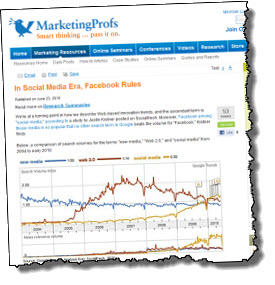
A great recent example is Marketing Profs’ In Social Media Era, Facebook Rules. The data is fascinating; but the methodology, and the tool used, is even more so. Screen Shot

This particular post, for example, uses Google Trends to illustrate the comparative rise and fall of the common phrases. You can see at the bottom of this post how the trends chart shows the rise and fall of the three terms “new media, web 2.0, social media.” You can look at the chart here – taken from that post, which, in turn, highlights research done by Justin Kistner posted on socialfresh. He’s saying that social media is the new third wave of the Web, and he uses the Google trends search and news charts to illustrate. I hope you can see it on the chart below. In Web searches, on the top, “new media” gradually fades from 2004 to now. “Web 2.0” goes up fast in 2005 and 2006, but peaks, and then falls. “Social media” goes up gradually, but seems to be accelerating. In Web news reports, on the bottom, social media is taking over.

Line charts

That’s done with Google Trends. Try it. Go to the Google Trends Web tool and start typing in search terms to see what the whole online world has been looking for, and finding, for the last few years. Try it with the terms “hamburger, sushi” and then with “Twitter, blogs” and you’ll see what I mean. I like what I see for “accountability,” which I think is increasing in importance these days.

This is a great tool for thinking, and planning. Educate those guesses.