Category Archives: Business Financing

Second or third mover advantage

Seth Godin posts "The Netflix of …" today on the value of being an original instead of an imitator. We have the general assumption of first mover advantage and first to market, and nobody wants to be a copy. However, sometimes it’s better to be the second or third to market instead of the first.Quarterdeck

Does that sound crazy? Back in my consulting days I had a client from Quarterdeck Office Systems who was very disappointed the week after VisiCorp had introduced VisiOn at COMDEX. Quarterdeck wanted to be first with a graphical user interface working over the operating systems of the day (remember DOS?) but VisiCorp beat them to it.

VisiCorp died less than two years later. Quarterdeck Office Systems went public nine years later, valued at $182 million (not so much these days, but in 1991 that was a lot of money). And my point, with that entrepreneur back then, is that sometimes second or third is better, because investors understand what you’re talking about.

I followed up afterwards with a Palo Alto venture capitalist David Gold, over lunch. "Often it’s better to follow somebody into the market", he said,  "because it’s so much easier to explain what you’re doing. We’re just like so-and-so except that we do it this way, or that way, obviously some better way." That of course is a much better story than just plain "we’re just like Netflix." Seth makes the point that Netflix’ model tracks back easily to the nature of the DVD business, where being the "Netflix of purses or watches" doesn’t generate immediately obvious images.

However, there is something to coming into the inflection point of the markets, when people understand what it is. Amazon.com was not the first website selling books, Google wasn’t the first searcher (not even Yaho0). Neither Toyota nor Honda had the first hybrid auto. Audi100hybrid_2 You’ve never heard of the first supermarket, but Safeway and  Kroger’s followed along a little later. McDonald’s came along after Automat, White Castle, and many others.

In the world of high tech and venture capital, Microsoft Excel wasn’t the first spreadsheet integrated with graphics, nor was Lotus 1-2-3. Does anybody else remember Context MBA (there’s a blast from the past … do you think the "MBA" in its name hurt it?). The Macintosh wasn’t the first graphical interface operating system either (does anybody remember Xerox Parc and the Xerox Star?). The first personal computers were Altair and MIPS, not Apple, Radio Shack, or Commodore. 

"Just like so-and-so, but better" is a nice pitch. Search Google for "’just  like’, ‘but better’" and you’ll come up with 415,000 pages. 

So yes, being an original is much more satisfying, and if you can seize that advantage and keep it, it’s great business. But being second or third works well too. It’s sometimes easier to explain. 

— Tim

This ‘No Business Plans Post’ is Wrong on So Many Levels

I read Paul Kedrosky regularly and like most of what I read, but this Twitter business plan post is just so wrong, on so many different levels:

"Seeing that Twitter closed
a funding round, and spotting the associated incredulity about Evan’s
company not having a business plan, reminded me of something: Whatever
your feelings about Twitter, business plans are overrated, and profits
perhaps even more so.

"Why? Two reasons. First, because VCs are
professional nit-pickers. Give them something to find fault with, and
they’ll do it with abandon. I generally tell people to come to pitch
meetings with less information rather than more. Sure, you’ll get
pressed for more, but finesse it. Presenting a full and detailed plan
is, nine times out of ten, a path to a "No" — or at least more
time-consuming than having said less.

"Profits are a different
issue. Being profitable too soon gives investors, rightly or wrongly,
an idea of what the margins are on the business, as opposed to what
they could be in some perfect world. As a result, it takes a mighty
force for them to not start wading in with discounted present value
worksheets, and the like, thus hammering your valuation and generally
making funding much more complicated (and equity consuming) than if you
were wildly unprofitable."

  1. The fuzzy thinking about not having a business plan. 


    • Maybe once in a while a venture capitalist will take a deal without having read, maybe without having seen, a business plan; but if so, it involved a star system founder who the VC already knew, a great track record, a business already up and running, and users and traffic or sales to validate the idea.  And even in that case, does not working with a detailed formal thick, coil-bound business plan document mean the funding deals were made without a business plan?  No, not likely.  A plan isn’t a formal document, at least not necessarily; it’s a series of organized thoughts and projections, it’s accountability, and commitment.
    •  

    • Do you really believe Twitter didn’t have a plan? I like Robert Scoble’s post on the subject, he says that is just "bulls**t."  He adds: "…if you REALLY think you can get funded without having a business plan you’re probably smoking something illegal."
    •  

    • And while I’m on the subject (of fuzzy thinking, not of smoking something illegal) the idea that entrepreneurs have just a pitch presentation, instead of a plan, is also wrong. The plan, whether it’s a formal document or not, is built into the presentation. You should never do one without the other.
    •  

    • And — rant continues — it’s wrong for opinion leaders to throw around this loose talk about not planning.  We’re supposed to be giving entrepreneurs good advice, and "don’t plan" is bad advice however you cushion it.  Planning is good.  Set your goals, set the steps to achieve the goals, plan your resources, allocate according to priorities, and track results.  Always.  The fact that somebody somewhere was successful without a plan doesn’t mean "don’t plan" is ever good advice.  Somebody somewhere may have gotten straight A’s in school without working, and somebody somewhere may have won a marathon without training, but does that really make it a good idea?  Come to think of it, the guy who ran the first marathon did it without a plan, and he died.
    •  

    • Disclosure: I’m a business planner, I’ve written books and software for business planning.  No question about bias: I am biased (and proud of it).
    •  

  2. VCs are investors, which makes them partners.  You should choose investors as carefully as you choose a spouse. You’re going to live with them for years, and either win with them or lose with them.  So why should you try to blind them because they’re going to nitpick?  What about accountability, and perhaps even commitment?  I had VC investors in my company for a few years, and they were allies, collaborators, and valuable help.  I was grateful for comments on our plans.  People pay for plan reviews, and these are your partners.  Am I getting too emotional on this point?  How bad an idea is that?
  3.  

  4. "Being profitable too soon gives investors an idea of what the margins are …"  What?!  Read that paragraph again.  He isn’t serious, right?  That’s just a bad joke, isn’t it?  One of the dumbest ideas I’ve ever heard of is seeking dumb investors

— Tim

Start ups As Apples, Oranges, and Whatever

Much as I liked Marc Andreessen’s series of posts on start-ups at his blog at pmarca.com, it’s bothered me that he’s talking about a very select subset of business start-ups, the cream of the start-up crop, and not the mainstream. It brings up a general problem with expert advice on starting a business, which is that start ups include a very wide range of businesses and business plans.

With that in mind, I’d like to suggest three general sizes and shapes of start-up businesses. I don’t mean to suggest some kind of general categories or classification of start-ups with this, but rather, just to point out how the nature of the start-up process is completely different at different levels. At the high end, the process is reserved for a few thousand of the best new ventures, with the best management teams, highest growth possibilities, and the most likely defensibility. At the low end, we have the millions of grass roots entrepreneurs jumping into their own businesses because they can. While all of these businesses have some start-up costs, and some needs for financing, and good reasons to plan, the needs are quite different.

1. The “just get going” start up

This encompasses the majority of real-world start-ups. There ought to be a business plan, but it isn’t about getting financed by investors or lenders, it’s just about getting going. You need customers, not a lot of money. You can bootstrap this business.
Working_at_home_istock_000000635869
There are 20 million no-employee businesses in the U.S. alone. The average cost of a start-up is just $10,000. These are graphic artists, bookkeepers, business plan writers, freelance journalists, landscape architects, Internet search engine experts, massage therapists, fitness trainers, personal shoppers, or bloggers. You don’t need to buy inventory, you don’t need to design and build a product, you’re not worried about product packaging, or high-end website design, or renting and fixing up a location.

Your start-up costs are likely to be your computer, maybe some office equipment, maybe some design for logos and stationery and such, maybe some website design, maybe some legal expenses to get you registered correctly so you can get a business bank account. This is usually a few thousand dollars, enough to finance with credit cards.

What you really need to get going is customers. Planning is good for this start up not because you have to jump some hurdle to get somebody else’s money, but because you want to start right, focused and differentiated, aiming at a definable target market, understanding the benefits you offer your buyers, and getting it right.

Summary: start up costs are low, planning is about doing it well and doing it right, and what drives this start up is customers.

2. The middle ground

These are the start-up businesses that need financing beyond the normal bootstrapping level. These businesses need a plan to determine how much it’s going to cost them to set up the location, equipment, the prototype and early versions, the design, the packaging, the relationships with distribution channels. They can’t really do it right without financing. Think of business loans, friends and family, angel investment, personal funds, and betting the house. Restaurant

One quick example is a restaurant. There are always exceptions, but in general, you can’t get a restaurant up and running without spending six figures for kitchen equipment, furniture, signage, fixing the place up, and market launch expenses. Another example would be the Web 2.0 businesses and software businesses that need a few hundred thousand dollars to get going.

My company, Palo Alto Software, was one of these. At one point we had three mortgages on our Palo Alto house and $65,000 in credit card debt, but we didn’t have outside financing. We grew more slowly than we might have if we’d had venture money, but now, years later, we’re doing fine and it’s all ours.

Summary: these middle-ground start-up companies need financing, they need a business plan to estimate how much financing they need, and to organize their ideas as part of the process of getting that financing. What drives these start ups is a combination of factors involved in the plan, including identity, strategy, sound marketing, execution.

3. The elite

Professional venture capital firms annually invest in a few thousand, maybe 6,000 last year, of these new ventures. They are the cream of the crop. Some VCs look at the management teams first, wanting to invest only in proven people who have already been involved in successful or notable start-up companies. Some look first at the new markets involved, the technology, preferably proprietary technology, the positioning, and other factors to give these ventures a reasonable shot at exits in 3-5 years generating huge returns.Istock_000000355194small

These are hit or miss businesses. VCs look to generate huge returns on each one because they know only a few will hit, and those that do make it big have to generate enough money to pay for the majority that fail.

It’s easy to read about these high-end start ups. Search the blogs for “venture capital investment.” Read Guy Kawasaki’s How to Change the World, David Hornik’s Ventureblog, or Marc Andreessen’s Pmarca blog, and the VC blogs they recommend. It’s also easy to learn about these high-end start ups at business schools.

Summary: excellent management team, excellent prospects, solid planning, and millions in start-up financing, but only for a few thousand companies. And oh-oh, lately some of the best only need a few hundred thousand dollars, which complicates the taxonomy some, but we’ll ignore that for now.

— Tim

Pitch Deck Does Not Stand Alone

Yes, thank you. VC Stu Phillips points out that the so-called "pitch deck" doesn’t stand alone.

"It’s a prop to help YOU tell a COMPELLING story and get the next meeting. You are the star of the show and without your participation the pitch will be flat regardless of the knowledge and experience of the reader."

The uppercase there is his, not mine. I think it helps him make his point.

And his post helps make the important point that a pitch is not a plan. It’s about a plan.

The normal process for seeking venture capital investment includes both a summary memo and a pitch presentation that describe a business plan. Lately the trend is to emphasize the pitch when describing the process, but the point is that the pitch is in person, not a set of slides you can just send; and that the pitch describes the plan.

"This may be a controversial suggestion to my colleagues in the Venture world but resist requests from VCs to "send me the pitch deck" before the meeting.

"Neither the executive summary nor the pitch deck are a standalone business plan."

— Tim

Revisiting the Database of Investors

I had a call to a venture capitalist pending so I just visited TheFunded.com again, and, well, wow! Why didn’t they have things like this when I was immersed in seeking investment, back in the 1980s? Since I was last there just four weeks ago they’ve improved the interface — it wasn’t bad before, but still much better now — and visiting is a reminder of why I recommended it in the first place.

TheFunded.com is a database of comments and reviews on venture capitalists. I used it this morning to check out a New York fund that’s been cold-calling me about my company. I get a lot of calls that seem to be asking to invest, but usually end up being pitches for consulting services. I don’t ask for such calls and since they take time to return, if I didn’t initiate, I usually ignore. Today however I was curious about the call in my voicemail so I checked with TheFunded.com.

Here’s what I found, with the names omitted for obvious reasons. There’s a pretty good visual rating on that company, which also shows me clearly that the rating is based on three reviews. Here’s a screen shot of that:

Thefundedcomoninsight_2

There’s also a series of comments, which are just as useful as the ratings. for example:

thefundedsnippet1

thefundedsnippet2


Why this matters so much — I’m afraid this is my third post that mentions that site in six weeks — is that choosing investors should be like choosing a spouse. I’ve been saying that to entrepreneurs for years, but it usually led to the obvious follow-up questions asking how they can really find out what the investors are like. Which, in the past, wasn’t easy.

Of course a good review system can be manipulated. It’s very anonymous, which is both good and bad, because it promotes honesty with negative reviews but also allows, I assume (although I really don’t know the details), for false positives. Still, it is way better than anything else I’ve seen. I accidentally checked a “disagree” box when I was making the snagit screen shot for this post, and I still haven’t found an email address I could use to send them a quick note to correct it.

There’s also a very engaging letters section, in which entrepreneurs can comment to investors in general. Here’s an example of one of those that I liked:

thefundedsnippet3

To gain access to the details, I had to register, and wait to be approved. That took a day but was no problem, and was well worth the trouble. 

I’ve also discovered a really nice “letters to

In the early years of Business Plan Pro we used to bundle a database of venture capital contacts. Back then, early 1990s, it was useful. These days there is so much information readily available that the old database bundle would be superfluous.  

— Tim

Venture Capital as Start-up Olympics

What would entrepreneurship be without venture capital? Last Thursday Congressman Sandy Levin (D-Michigan) introduced the bill that venture capitalists were dreading: A higher tax on their profits. That, if it actually passes, would hardly kill venture capital, much less entrepreneurship. It might hurt. It would be bad economic policy, or perhaps more accurately, substituting demagoguery for economic policy.

I’ll be following that, but I’m not making predictions, just watching. In the meantime, it’s a reminder of the role venture capital plays. Venture capital is to start-ups what Olympics are to athletics.

In one of the venture contests I judged this Spring, the team said they were going to get $300K in  “venture capital” (VC) on their hypothetical way to business success. This is no big deal but it bothered me nonetheless. MBAs should know the difference. Very few start-ups are financed by venture capital. Most need something else.

Consider the numbers.  The National Venture Capital Association (NVCA) reports that there were only 3,591 VC deals in this country last year. They amounted to a $26 billion investment, an average of  $7.36 million per deal.  Venture capital money is invested for the money’s owners by professional investors in venture capital firms. There are about 850 of those firms in the U.S.

I do write about venture capital in this blog because the VCs are at the top of the pyramid. They point the way. Those 3,591 VC deals are the high-end of start-ups and entrepreneurship in this country. The U.S. VC community is the high-end of world venture investment, too. That’s an interesting trend, because many of the U.S. VCs are already dealing with China, Europe, and Asian opportunities as well.

I also write a lot about the rest of the start-up world, what I might call the real world of getting your business started without venture capital. There are at least 25 Alternatives To Venture Capital listed by businessfund.com last week.  Those include a lot of the more well-known ones that I write about frequently, such as angel investors and friends and family. And bootstrapping, my personal favorite.

So please don’t read this post as about that tax bill and what it means. It just reminded me about the alternatives to venture capital.

Marc Andreessen’s Part 2 on Startups

Marc Andreessen’s second post on startups is as good as the first, a must-read for entrepreneurs, although perhaps too optimistic on the "keep trying" side of things when in many cases maybe means no and get a clue.

Marc goes through how to fix your plan if investors keep declining. He goes point by point through ways to reduce risk, listed by types of risk. This is somebody who has done it several times, who has real credibility. If your plan isn’t working, fix your plan.

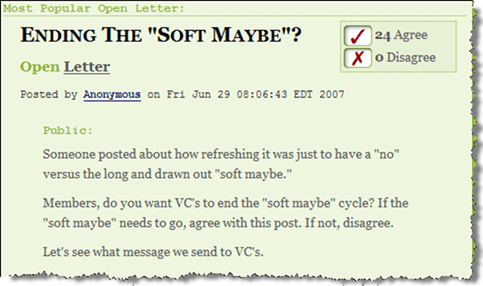
One point I particularly like is how investors don’t say no. They say maybe:

"It’s an old — and true — cliche that VCs rarely actually say ‘no’ — more often they say ‘maybe’, or ‘not right now’, or ‘my partners aren’t sure’, or ‘that’s interesting, let me think about it.’

"They do that because they don’t want to invest in your company given the current facts, but they want to keep the door open in case the facts change."

I’m delighted to see how well he makes two important points about competition:

"Never, ever say that you have no competitors. That signals naivete. Great markets draw competitors, and so if you really have no competition, you must not be in a great market. Even if you really believe you have no competitors, create a competitive landscape slide with adjacent companies in related market segments and be ready to talk crisply about how you are like and unlike those adjacent companies.

"And never, ever say your market projections indicate you’re going to be hugely successful if you get only 2% of your (extremely large) market. That also signals naivete. If you’re going after 2% of a large market, that means the presumably larger companies that are going to take the other 98% are going to kill you. You have to have a theory for how you’re going to get a significantly higher market share than 2%. (I pick 2% because that’s the cliche, but if you’re a VC, you’ve probably heard someone use it.)

The one element I think he’s missing is the investment filter. If investors turn you down, get a clue, maybe they are doing you a favor. He suggests revising the plan, but sometimes the best thing to do is keep your day job. There’s a lot of heartache in relentlessly pursuing something that isn’t going to work even if you never give up.

I’m looking forward to the third part in what he said would be a 3-part series. I suggest, again, that you read part one and then read part two of Marc Andreessen on startups.

Tim

Choose Investors Carefully or Not at All

Choose your investors as carefully as you would choose a spouse. It should be obvious, but we focus on getting financed, as if money were the only object. Investors are partners. As with marriage, in which the wrong partners can ruin your life,  so too with investors. The wrong partner can ruin your business. That can also ruin your life.

It should be obvious but it isn’t. Entrepreneurs long for financing. I had a friend who spent years trying to "get financed" and did nothing but shop his deal in the meantime. That’s deadly. He was like the empty-eyed unshowered two-bit gambler in Las Vegas, living poorly off hope for a big win.  Don’t let the lure of "getting financed" cloud your vision. You’re much better off with no deal than the wrong deal.

I’ve been playing phone tag with Dave Chen of OVP Venture Partners because I want to credit him for the first time I heard somebody suggest entrepreneurs should choose a venture capitalist as carefully as anybody should choose a spouse. I heard him give a talk about that subject at the University of Oregon New Venture Competition.

The wrong partners will push you in the wrong direction, want the wrong thing. Dave pointed out the problem very well. With investors, you don’t just get their money, you get them also in business with you. You’re going to wake up with them every morning, and go to sleep with them every night (metaphorically, but still … ).

The right investors will be good partners. They know your field. They have contacts who can help. They have antennae pointed in the right direction. They have relevant experience.

How can you tell? Keep your eyes, ears, and mind open. You’re not going to get very far down the road without meeting them, spending time with them, talking about issues. Don’t go blindly unconcerned about compatibility. Have the courage to say no to partners who don’t fit. Imagine them as everyday companions. Will they help you? How? Will you want to get them on the phone? Will you look forward to meetings.

Thanks to A VC for pointing me to The Funded, a website collecting reviews and opinions from entrepreneurs about the venture capital firms that funded them.  This is a spectacularly important site to someone looking seriously at taking venture capital money.

–Tim

Hooray! At Least one VC Says Spelling Counts

I’m so glad to see I’m not the only one left. I too, like Stephen Fleming, read a lot of business plans, and damn! Bad spelling and bad grammar throw me off, I can’t help it. It’s distracting, like a bad note played in a concert.

I suppose I should add that Stephen Fleming calls his site "Academic VC" and he teaches entrepreneurship too, so maybe you’re not going to believe him either, if you are one of those who believes spelling and grammar are an obsolete remnant of a dying age. Here’s a quote:

"When I teach my classes on entrepreneurship, I always have at least one student protest my statement that ‘Spelling counts.’ Especially when they’re not native English speakers. ‘It doesn’t affect the meaning! And it certainly doesn’t affect my ability as an entrepreneur!’"

"Sorry, folks, but spelling does count. Not because correct spelling is a virtue in and of itself — William Shakespeare couldn’t spell his own name, when he wasn’t busy taking credit for the Earl of Oxford‘s plays — but because of what it says about the person sending me the document. Usually the CEO."

"If you send me a document that says ‘Our plan estimates there costs to be…’ or ‘the product and it’s derivatives,’ you are telling me that (1) you don’t have good attention to detail, or (2) you’re in a hurry, and (3) you don’t know when to ask for help. None of those make me want to invest in you."

The thing is — and this is me now, not Stephen (although I’m pretty sure he’d agree) — decent simple and correct business writing is not that hard. Nobody says it has to be rhymed or suitable for framing, but at least know the difference between their and there and it’s and its and, my personal favorite, then and than. There’s also this trend to make all plurals possessive, with apostrophes.

We all make mistakes. I’m a good writer and a good speller but I make tons of mistakes from simple typos or writing too fast, and it’s hard to read and catch your own mistakes. In my case my mind moves ahead of my eyes and knows what I intended, sometimes missing glaring errors. But having somebody else look at it is a very good idea. It shows respect for the reader.

In the age of email, and IM, and txt, I suspect the "oh lighten up, you know what I meant" trend will continue. So at least today I’m glad to see Stephen’s post.

Here’s the link to the full post; Academic VC: Spelling Counts

— Tim